ASL meaning depends entirely on where you saw it. In texting and on social media, ASL usually means “age, sex, location,” a question people used to ask strangers in old chat rooms. In any context involving deaf culture, education, or linguistics, ASL means American Sign Language, the visual language used by deaf communities across the US and Canada. Context is everything here.
ASL stands for American Sign Language. It is a complete, natural visual language used by Deaf and hard-of-hearing communities in the United States and English-speaking Canada
Table of Contents
Quick Answer
- ASL (chat slang): Age, Sex, Location, a question asked to learn basic info about a stranger online
- ASL (language): American Sign Language, a full language with its own grammar, used mainly in the United States and English speaking Canada
- Both meanings are common. The one you need depends entirely on where you’re reading it
Read Slang : Let Him Cook Meaning
Why ASL Has Two Completely Different Meanings
Abbreviations collide all the time, and ASL is a good example of it. “Age, sex, location” grew out of early internet chat culture, back when AOL chat rooms and IRC channels were full of strangers trying to figure out who they were actually talking to. Asking “ASL?” was shorthand for skipping the small talk.
American Sign Language, on the other hand, has nothing to do with the internet. It developed over roughly two centuries in the United States, shaped heavily by French Sign Language and the sign systems already used by deaf communities in America before the 1800s. It’s a real, structured language, not a coded version of English.
The overlap in the acronym is coincidental. Neither meaning borrows from the other, they just happen to share three letters.
ASL as Chat and Texting Slang
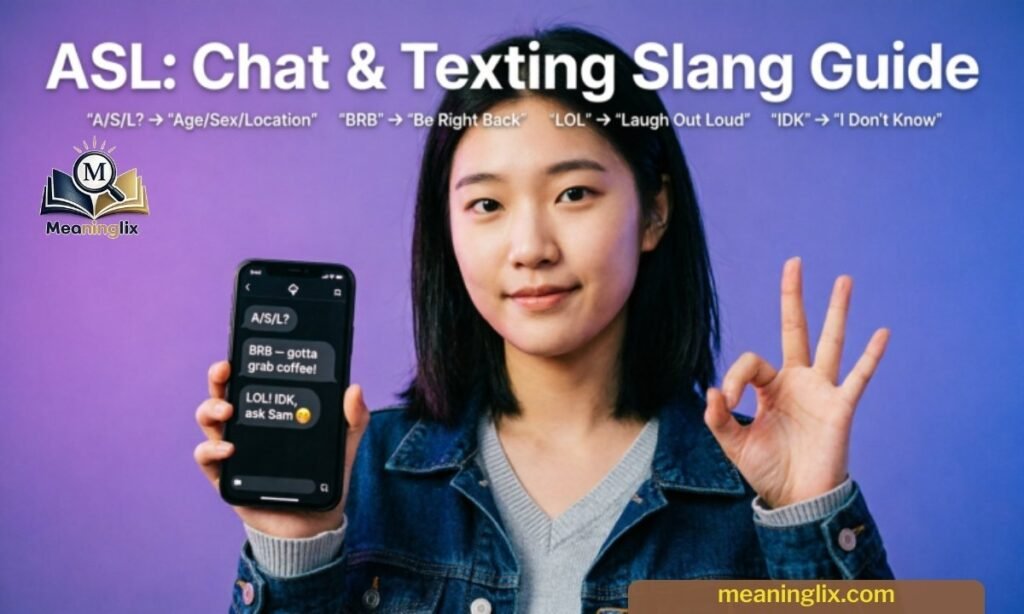
If you’re scrolling through an old forum thread, a gaming chat, or a message from someone using internet slang, ASL almost always means age, sex, location. It was especially common in the late 1990s and early 2000s, when anonymous chatting was the norm and people wanted a fast way to size up who they were talking to.
You’ll still see it occasionally in:
- Older forums and comment sections
- Gaming lobbies, especially in text based or voice chat games
- Nostalgic posts referencing early internet culture
It’s worth noting this usage has faded quite a bit. Most platforms today show profile info automatically, so asking “ASL?” feels dated, almost like a relic of a different internet era. Younger users online sometimes encounter the phrase and have no idea what it means, since they never lived through the chat room years.
Read More : PFP Meaning
ASL as American Sign Language
This is the meaning that matters in almost every other context, especially anything touching accessibility, deaf culture, education, or healthcare. American Sign Language is a complete, natural language. It has its own grammar, its own sentence structure, and it does not map word for word onto English.
That last point trips people up constantly. A common assumption is that ASL is just English spelled out with hand gestures, or that it follows the same word order as spoken English. It doesn’t. ASL uses a topic-comment structure in many sentences, along with facial expressions and body positioning that carry actual grammatical weight, not just emotional tone.
Here’s a nuance most articles skip entirely: ASL is not universal. British Sign Language and American Sign Language are mutually unintelligible, despite English being the spoken language in both countries. Someone fluent in ASL cannot automatically understand a deaf person signing in London. Sign languages develop regionally, similar to spoken languages, and they don’t follow the boundaries of the countries that speak the same verbal language.
How ASL Compares to Other Communication Systems
| Term | What It Is | Grammar Structure |
| American Sign Language (ASL) | A full, natural language | Its own grammar, topic-comment structure |
| Signed Exact English (SEE) | A manual code for English | Follows English word order |
| Pidgin Signed English | A blend of ASL and English patterns | Mixed, varies by user |
| Fingerspelling | A method within ASL for spelling words | Not a language on its own |
People sometimes assume fingerspelling is a separate system. It isn’t, it’s a tool used within ASL for names, brands, or words that don’t have an established sign.
Real-World Examples of Each Meaning
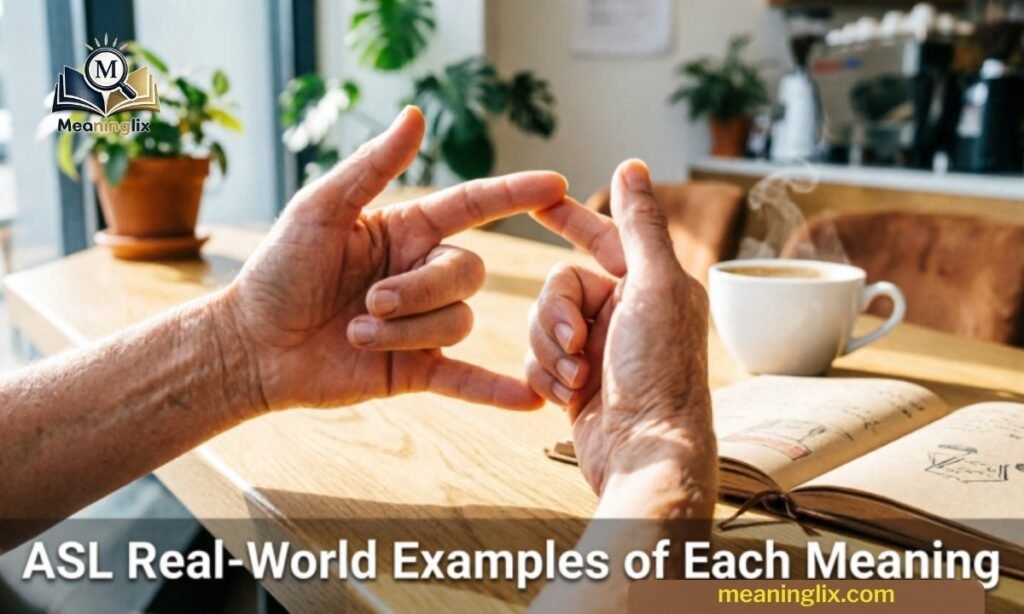
Chat slang example: A stranger messages you in an old-style chat room: “hey, asl?” They’re asking whether you’re a teenager, an adult, male, female, and roughly where you live, all in three letters.
Language example: A teacher tells a parent, “Your daughter is picking up ASL faster than expected, she’s already stringing together three-sign sentences.” Here ASL clearly refers to the language itself, not a question about identity.
Mixed context example: Imagine a job posting that says “ASL proficiency required.” Nobody would read that as an age and location question. The professional context makes the language meaning obvious immediately, even without extra explanation.
When to Use Each Meaning (and When to Avoid It)
Use “ASL” to mean age, sex, location only in casual, informal chat contexts where the audience will recognize the internet slang. Even then, it can come across as intrusive or outdated, so many people avoid asking it outright now.
Use ASL to mean American Sign Language in any professional, educational, medical, or accessibility related writing. This is the default assumption almost everywhere outside of niche internet slang usage.
Avoid using the bare acronym without context in mixed audiences. If you’re writing for a general readership, spell it out on first use, something like “American Sign Language (ASL),” then use the short form afterward.
Common Mistakes People Make
A lot of confusion comes from assuming ASL is interchangeable with “sign language” as a blanket term. It isn’t. Sign language is a broad category that includes British Sign Language, French Sign Language, Auslan in Australia, and dozens of others. ASL is one specific language within that category.
Another mistake, especially among learners, is treating ASL as a visual translation of spoken English. Interpreters actually caution against this constantly, because it leads people to sign in English word order, which reads as unnatural or even confusing to fluent ASL users.
Finally, some writers still default to the “age, sex, location” meaning out of habit, even in formal pieces where the language meaning was clearly intended. Always check context before assuming which one applies.
Related Terms Worth Knowing
- Deaf culture – the shared identity, values, and community norms among deaf ASL users
- Fingerspelling – spelling out words letter by letter using the ASL alphabet
- Interpreter – a professional who translates between ASL and spoken language in real time
- Closed captioning – text based, not the same as ASL interpretation, though often confused with it
- Deaf and hard of hearing (DHH) – a broader term covering varying levels of hearing loss
- Home sign – informal gestural communication developed within families before formal ASL exposure
Frequently Asked Questions
Is ASL the same as English?
No. ASL has its own grammar and sentence structure, separate from English. A fluent ASL sentence often looks nothing like its English translation when written word for word, since word order and emphasis work differently.
Can someone who knows ASL understand British Sign Language?
Generally, no. ASL and British Sign Language developed independently and are not mutually understandable, even though both countries speak English. Sign languages follow their own regional development, unrelated to spoken language borders.
Why did ASL come to mean “age, sex, location” online?
It grew out of early internet chat culture in the 1990s, when strangers used the shorthand to quickly learn basic details about who they were talking to. The phrase stuck around in gaming and forum communities long after chat rooms declined.
Is it rude to ask someone “ASL” online today?
It can come across as outdated or overly forward, since most platforms already display user info. Many people now see the question as a throwback rather than a normal icebreaker, so it’s used far less than it used to be.
How long does it take to learn American Sign Language?
It varies a lot depending on practice frequency and immersion, similar to learning any other language. Conversational comfort can take roughly a year or more of consistent practice, while true fluency typically takes longer.
Does ASL have its own alphabet?
It has a fingerspelling system using distinct handshapes for each English letter, used mainly for names and words without an established sign. It’s not a separate alphabet in the traditional sense, just a hand based way to spell English words within ASL conversation.
Wrapping It Up
The letters ASL carry two unrelated meanings, and figuring out which one applies just comes down to reading the room. In casual chat contexts, it’s an old habit tied to age, sex, location. Almost everywhere else, especially anything touching accessibility or education, it points to American Sign Language, a full and independent language with its own history and grammar.
Once you know both meanings, the context usually makes the right one obvious within a sentence or two.

Alisha Lehmann is the founder and author of Meaninglix. She specializes in explaining word meanings, internet slang, abbreviations, grammar, and English expressions in simple, accurate language. Her goal is to help readers improve their vocabulary and communicate confidently through clear, well-researched, and easy-to-understand content.
2 thoughts on “ASL Meaning: The Powerful Truth Behind This Popular Slang 2k26”