You typed “keeped” into a sentence, paused, and thought something felt off. You are not alone. English loves to break its own rules, and “keep” is one of the worst offenders.
The good news? Once you see the pattern, you will never second guess it again.
Table of Contents
Quick Answer
The past tense of “keep” is kept. Not “keeped,” not “keept,” just kept. It works the same way whether you are talking about yesterday, last year, or a promise you made a decade ago. That one word covers every past tense situation for this verb.
Simple Background
“Keep” belongs to a small but stubborn group of English verbs called irregular verbs. Instead of adding “ed” like normal verbs (walk becomes walked, jump becomes jumped), irregular verbs change their spelling entirely. “Keep” turns into “kept,” and it has stayed that way for centuries, tracing back to Old English roots where similar vowel shifts were common in everyday speech.
Keep Past Tense And Past Participle
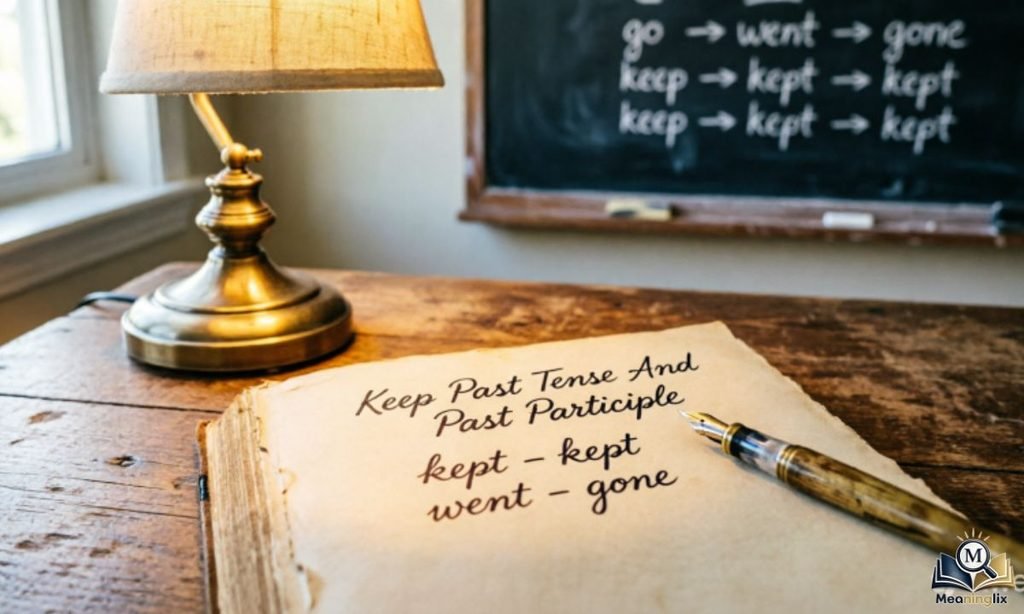
Here is something most articles skip: “kept” is not just the past tense, it is also the past participle. That means you use the exact same word whether you are writing a simple past sentence or a perfect tense sentence.
- Simple past: She kept the letter for years.
- Past participle: She has kept the letter for years.
No extra form to memorize. That is one less thing to worry about.
Read Now : What Does HMJ Mean in Text
Clear Explanation Of The Difference
What Is “Keep”?
“Keep” is the base form, also called the present tense. You use it for actions happening now or habits that repeat.
Example: I keep my keys on the same hook every day.
What Is “Kept”?
“Kept” is what “keep” becomes once the action is finished. It signals that something already happened.
Example: I kept my keys on the same hook all last year.
Notice how the meaning barely shifts. Only the timing changes, and the spelling does the heavy lifting.
Comparison Table
| Tense | Form | Example Sentence |
| Present | Keep | I keep my promises. |
| Past | Kept | I kept my promise last week. |
| Present Perfect | Have/Has kept | She has kept every letter he sent. |
| Past Perfect | Had kept | They had kept the secret before it leaked. |
| Future | Will keep | We will keep in touch. |
Which One To Use And When
Use “keep” when the action is ongoing, habitual, or set in the present or future. Use “kept” when the action already finished, no matter how far back. A quick test: if you can add “yesterday,” “last year,” or “already” to the sentence and it still makes sense, “kept” is your word.
Keep Present Tense
Just to round things out, “keep” in the present tense works for facts, routines, and general truths. “He keeps his word.” “They keep the shop open until nine.” Simple, no twist needed here.
Simple Tip To Remember
Think of “kept” as a locked box. Once something happens, it gets “kept” shut in the past, sealed and done. That small image sticks better than any grammar rule ever could.
Common Mistakes People Make
1. Saying “Keeped”
This is the single most common slip, especially among new English learners and even native speakers typing fast. Your brain wants to follow the regular pattern, but “keep” refuses to cooperate. There is no version of this verb that ends in “ed.”
2. Using Present Tense For Past Actions
“I keep the ticket from that concert” when you mean last year’s concert is a mismatch. If the event is over, switch to “kept.”
3. Forgetting Irregular Verb Forms
Verbs like sleep/slept, feel/felt, and keep/kept follow a similar internal vowel change. Learning them as a small family, rather than isolated words, makes them far easier to recall under pressure.
Everyday Real Life Examples
Seeing the word in real situations locks it into memory faster than any definition can.
Keep Past Tense
In School
The teacher kept the class five minutes after the bell rang.
In Daily Life
My grandmother kept the same recipe card for forty years.
In Messages
“Sorry for the late reply, I kept forgetting to check my phone.”
On Social Media
“Just kept my New Year resolution for a full 30 days, personal record.”
Past Form Of Keep
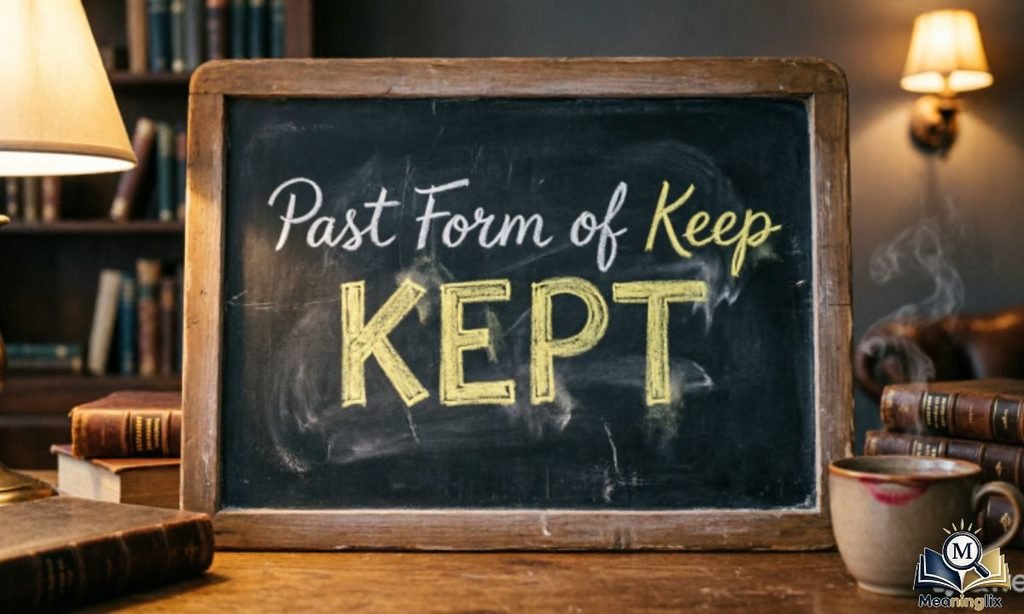
To be direct, “kept” is the only past form you need for both spoken and written English, in formal reports and casual texts alike. No regional variation changes this, and no dialect of standard English uses an alternative.
Short Learning Section For Students
If you are studying English grammar, here is a fast track to locking this verb in.
Step 1: Learn The Forms
Write down all three: keep, kept, kept. Notice the past and past participle match, which cuts your workload in half.
Step 2: Practice
Write five sentences using “kept” about your own week. Real sentences stick better than textbook examples.
Step 3: Use Memory Trick
Picture the locked box idea from earlier. A closed lid, a finished action, kept away in the past.
Step 4: Practice Speaking Aloud
Say your five sentences out loud. Hearing yourself use “kept” correctly trains your ear, and your ear corrects your writing faster than any rule you memorize on paper.
Frequently Asked Questions
Is It Keeped Or Kept?
It is always “kept.” “Keeped” is not a recognized word in standard English, even though it sounds like it should follow the regular pattern.
What Is The 3 Form Of Keep?
The three forms are keep (base), kept (past), and kept (past participle). Unlike many irregular verbs, the last two forms are identical.
What Does “Keep” Mean?
“Keep” means to hold onto something, maintain a state, or continue an action, such as keeping a promise, keeping a secret, or keeping a routine.
What Is The Past Perfect Tense Of “Keep”?
The past perfect uses “had kept,” describing an action completed before another past action. Example: He had kept the ring for years before he finally proposed.
Conclusion
“Keep” might look simple, but its past tense trips up plenty of writers, from students to seasoned professionals typing a quick email.
Remember the one rule that matters most: keep becomes kept, in every past situation, with no exceptions and no alternate spelling. Practice a few sentences today, and this verb will stop feeling tricky for good.

Alisha Lehmann is the founder and author of Meaninglix. She specializes in explaining word meanings, internet slang, abbreviations, grammar, and English expressions in simple, accurate language. Her goal is to help readers improve their vocabulary and communicate confidently through clear, well-researched, and easy-to-understand content.
1 thought on “Keep Past Tense Explained: The Truth Revealed”