A deer that stops and looks straight at you is hard to forget. This is an animal that usually bolts at the first sound, yet here it is, standing still, and the moment can feel oddly personal. Many people go searching for an explanation because it feels like more than chance.
This guide covers the spiritual meanings people attach to the moment, the cultural symbolism behind them, and the plain animal behavior that may explain the same stare. You can hold both views at once.
Table of Contents
Quick Answer: What Does It Mean When a Deer Stares at You?
Spiritually, a deer staring at you is most often read as a nudge to slow down, soften, and trust your intuition. It is linked with gentleness, awareness, and quiet guidance. These are interpretations, not facts, so the meaning that fits best is usually the one that matches what you were feeling when it happened.
What a Deer Staring at You Can Mean Spiritually
Most spiritual readings of deer grow from one idea: the deer is soft and watchful at the same time. It survives by noticing everything without turning hard or aggressive. So when a deer holds your gaze, people tend to hear a message about balance between sensitivity and awareness.
Four meanings come up again and again.
Alertness and Presence
A deer that freezes and looks at you is fully in the moment. Many people read this as a reminder to look up from autopilot and notice what is happening around you and inside you. If you were distracted, rushed, or scrolling when it happened, this reading often lands the hardest.
Gentleness and Self-Compassion
Deer are widely seen as gentle animals, and their symbolism often points inward as well as outward. A calm stare can be taken as an invitation to ease up on yourself, forgive a mistake, or approach a tense situation with less force.
Intuition and Inner Guidance
Because deer react to the smallest shifts in their surroundings, they are often tied to gut feeling. If you were wrestling with a decision or a person you could not quite read, the stare may feel like a prompt to listen to the instinct you keep arguing with.
Comfort and Quiet Reassurance
Some people experience a deer encounter as comforting, especially during a hard season of life. A few traditions and many individuals describe deer as messengers or guides. If the moment felt peaceful, reading it as reassurance is a common and harmless interpretation.
Why the Meaning Changes With the Situation
Two people can see the same stare and take away different things. A few details shape the reading.
- Your state of mind: Stress, grief, curiosity, or calm all color what the moment seems to say.
- The setting: A deer in a quiet forest feels different from one beside a busy road or in your backyard.
- The time of day: Dawn and dusk are when deer are naturally most active, and many people associate those hours with new beginnings and reflection.
Doe, Buck, and White Deer: Do They Mean Different Things?
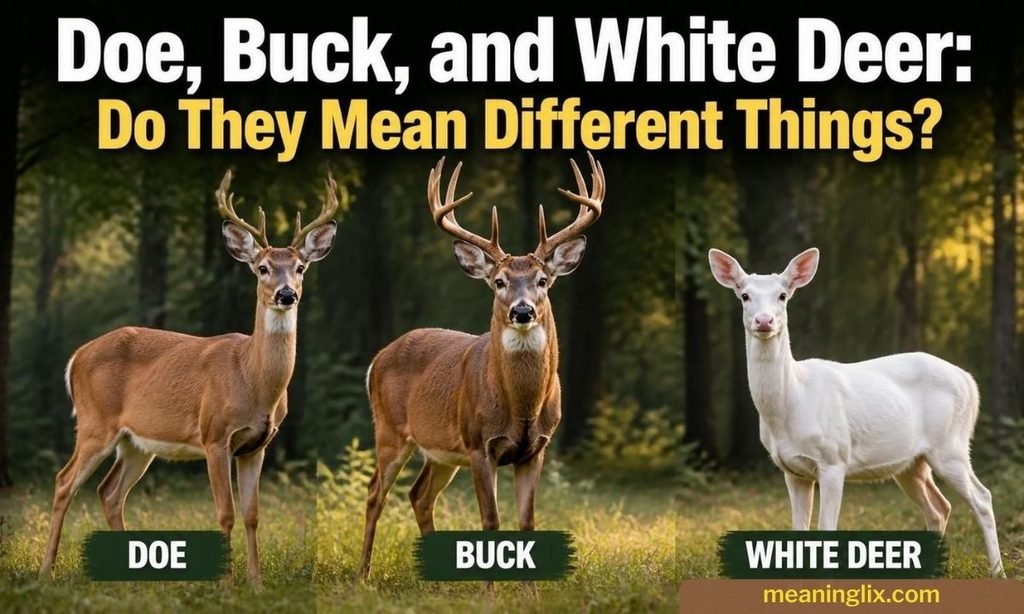
Readers often ask whether the type of deer matters. Interpretations vary, and these are tendencies rather than rules.
A doe is commonly linked with nurturing, intuition, and protection. A buck is more often tied to strength, dignity, and leadership. A white deer is rare, and in European legends it often appears as a sign that something extraordinary or sacred is near. Across all three, the core themes of grace and awareness stay the same.
| Keep Reading These Articles |
| AudioDisplayed Meaning |
| SSA Meaning: What Does SSA Really Mean? Find Out! |
Deer Symbolism Across Cultures
Deer show up in many belief systems, which is part of why the symbolism feels so familiar.
- Celtic traditions: Deer are often connected with the wild landscape and with the otherworld, and an encounter was seen as something special.
- Buddhist imagery: Deer are associated with peace, gentleness, and harmony.
- Christian imagery: Deer appear as a picture of longing for God, as in Psalm 42.
- Native American traditions: Deer are often described as gentle guides who teach compassion and balance. Beliefs differ widely between nations, so treat any single summary as a starting point and look to specific communities for their own teachings.
Spiritual Meaning vs. What the Deer Is Actually Doing
A grounded reading adds to the spiritual one rather than ruining it. Deer depend heavily on sight and smell. A deer that stares has usually noticed movement, a new shape, or an unfamiliar scent and is deciding what to do. Freezing and watching is a normal way to assess whether you are a threat.
Some signs help you read the animal itself:
- A relaxed stance, soft ears, and slow chewing usually mean curiosity or calm.
- Foot stomping or a sharp snort usually means the deer is suspicious and warning others.
- Lowered head, ears pinned back, raised hair, or a stiff body can signal real tension, especially in bucks during mating season.
If a deer stares at you, stay still, avoid stepping closer, and let it decide how the moment ends. Never feed it. Giving the animal space is also the most respectful way to honor any meaning you find in the encounter.
Deer Symbolism Words Compared
These words often appear in deer interpretations, but they are not interchangeable. Each one points to a slightly different message.
| Synonym | Meaning Nuance | Tone | Example Sentence |
| Gentleness | Softness in how you treat yourself and others | Warm, calming | The deer’s calm stare made her think about how harshly she had been speaking to herself. |
| Grace | Moving through hard moments with ease | Elegant, uplifting | He watched the doe step away and felt a quiet reminder to handle stress with more grace. |
| Alertness | Staying awake to what is around you | Practical, focused | The deer’s stillness felt like a lesson in alertness after a week of rushing. |
| Awareness | Noticing your surroundings and your own feelings | Reflective | Meeting the buck’s gaze, she became aware of how tense her shoulders were. |
| Intuition | Trusting gut feeling over overthinking | Personal, insightful | The stare nudged him to trust his intuition about the job offer. |
| Stillness | Pausing long enough to listen | Peaceful | In that minute of stillness, the noise in her head finally settled. |
| Innocence | Openness and a lack of pretense | Tender, nostalgic | The fawn’s wide eyes carried a sense of innocence she had not felt in years. |
| Renewal | Fresh starts and healing after hard times | Hopeful | The deer at sunrise felt like a sign of renewal after a long winter. |
| Guidance | A gentle push toward a direction | Reassuring | Some people describe a deer’s stare as quiet guidance rather than a command. |
| Sensitivity | Feeling deeply without being weak | Compassionate | The encounter reminded him that sensitivity can be a strength. |
Antonyms: What the Deer’s Meaning Stands Against
Looking at opposites clarifies what the deer is said to represent.
- Aggression: Force and hostility, the opposite of the deer’s gentle strength.
- Carelessness: Moving through life without noticing, the opposite of alertness.
- Numbness: Shutting down feeling, the opposite of sensitivity.
- Distraction: Being everywhere except the present moment.
- Harshness: Treating yourself or others without softness.
- Self-doubt: Ignoring your instincts, the opposite of intuition.
Related Words and Phrases
These terms often appear alongside deer symbolism and help you search, write, or journal about the experience.
- Spirit animal
- Animal totem
- Animal messenger
- A sign or an omen
- Synchronicity
- Crossing your path
- Gentle strength
How to Use These Ideas in Different Contexts
Conversation: Keep it light and personal. “A deer stared at me this morning and it felt strangely calming” invites a conversation without claiming a fixed meaning.
Journaling: Write down the time, place, and what you were feeling. Then ask what the deer’s calm attention might be pointing to in your life right now.
Social media: Short, sincere captions work best, such as “A deer held my gaze for a full minute today. I needed that pause.” Skip bold claims about what it must mean for everyone.
Storytelling: A character who meets a deer’s gaze can show a shift in mood without any dialogue.
Essays and articles: Use careful attribution. Phrases like “many people interpret” or “in some traditions” keep the writing honest, because spiritual meaning is belief, not fact.
When Not to Use This Interpretation
A spiritual reading is not always the right lens. Skip it, or at least set it aside, in these cases.
- When the deer looks aggressive. Pinned ears, a lowered head, or a stiff stance are safety signals. Back away slowly and give it room.
- When you are driving. A deer standing near or on a road is a hazard first. Slow down, do not stop to look, and watch for others nearby.
- When the animal seems unwell. A deer that is unusually unafraid, unsteady, or injured may be sick. Keep your distance and contact local wildlife officials.
- When you are making a major decision. An encounter can inspire reflection, but big choices about money, health, or relationships deserve real information and advice.
- When writing for someone else’s grief. Telling a grieving person that a deer was a message from someone they lost can feel presumptuous. Let them decide what it means to them.
- When you need factual accuracy. In news, science, or educational writing, present spiritual meanings as beliefs, not as proven facts.
FAQ
Is a deer staring at me a good sign?
Most spiritual interpretations are positive. People commonly read it as a sign of peace, awareness, or gentle guidance rather than a warning. The meaning still depends on how the moment felt to you.
What does it mean if a deer stares at me and does not run?
Spiritually, it is often read as a moment of recognition and an invitation to pause. Practically, the deer may be unsure whether you are a threat, or it may be used to people. Either way, stay still and give it space.
What does it mean when a deer stares at you at night?
Deer are most active around dawn and dusk and can see well in low light. Spiritually, a night encounter is often read as a call to look inward. Practically, lights or movement near your home may simply have caught its attention.
Does a deer staring mean a loved one is visiting?
Some people find comfort in that idea, and some traditions describe animal visitors this way. There is no way to confirm it, so treat it as a personal belief that you are free to hold or set aside.
What does it mean if a buck stares at me?
A buck is often linked with strength, dignity, and leadership in symbolism. Practically, be cautious, especially in the fall, when bucks can be more tense. Keep your distance and avoid direct approach.
Is a deer my spirit animal if I keep seeing one?
Many people use repeated sightings as a reason to explore deer symbolism. Spirit animal ideas are personal rather than official, so the better test is whether the qualities of gentleness, awareness, and intuition feel true to you.
Conclusion
A deer staring at you is open to many readings, but the most common thread is simple: slow down, stay aware, and be gentle with yourself. Across cultures and personal stories, the deer stands for strength that does not need force. Whether you see the moment as a message or a lovely coincidence, it works as a short pause that is worth noticing.
The most useful meaning is the one that fits your own life. Pay attention to what you felt, write it down, and take one small step that matches it. And always remember that the deer is a wild animal first, so give it room, keep your distance, and let the encounter end on its terms.

Alisha Lehmann is the founder and author of Meaninglix. She specializes in explaining word meanings, internet slang, abbreviations, grammar, and English expressions in simple, accurate language. Her goal is to help readers improve their vocabulary and communicate confidently through clear, well-researched, and easy-to-understand content.