If you’ve ever typed the word “hassle” and then stared at it, wondering whether it should have a “t” in it, you’re in good company. This is one of the most commonly misspelled everyday words in English, and the confusion shows up everywhere in emails, product listings, text messages, and even printed signage. The short answer is simple: hassle is correct, and hastle is not a real word.
But knowing the right spelling is only half the story. In this guide, you’ll learn exactly why this mix-up happens so often, what “hassle” really means as both a noun and a verb, where the word came from, and how to lock the correct spelling into your memory for good. Whether you’re a student polishing an essay, a professional writing client emails, or just someone who wants to stop second-guessing a five-letter word, this article covers everything you need.
Table of Contents
What Is the Correct Spelling: Hassle vs Hastle?
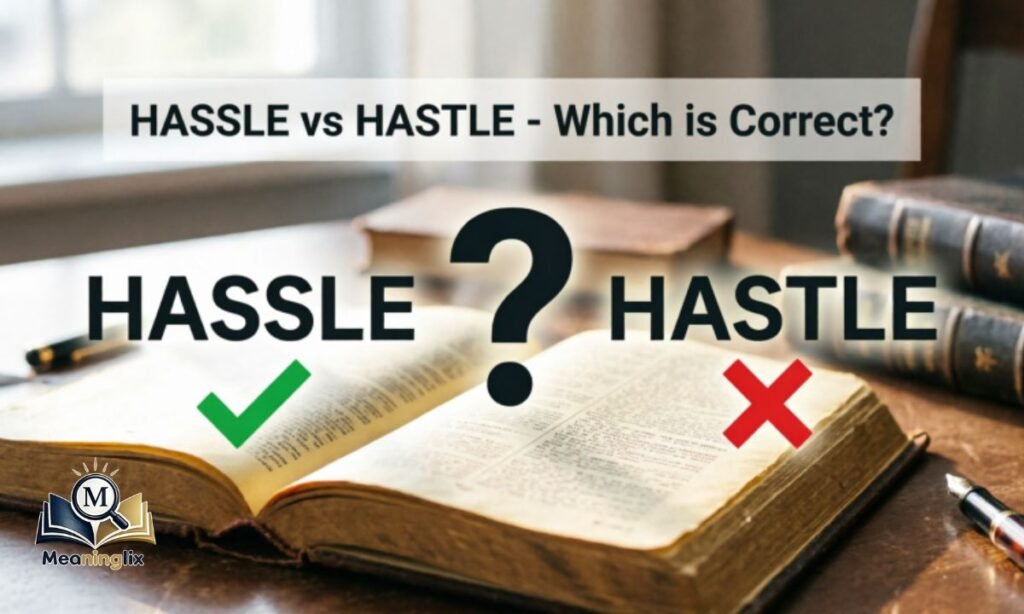
Let’s settle this immediately, because there’s no gray area here.
| Spelling | Status | Notes |
| Hassle | ✅ Correct | Recognized in every major English dictionary |
| Hastle | ❌ Incorrect | A misspelling; not found in any standard dictionary |
“Hassle” is spelled with a double “s” and no “t” H-A-S-S-L-E. There is no version of this word that includes a “t” before the “l.” If you search for “hastle” in Merriam-Webster, Oxford, Cambridge, or Collins, you’ll come up empty. It simply doesn’t exist as a standalone entry, definition, or accepted variant spelling.
The mistake happens because of how the word sounds when spoken casually, plus the influence of other English words that genuinely do end in “-stle.” That combination tricks the brain into inserting a letter that was never there. We’ll dig into the specific reasons shortly, but for now, remember this simple rule:
If you’re describing something annoying, inconvenient, or bothersome, the word you want is hassle always with two S’s, never with a T.
Confused about another word? Explore more spelling and grammar guides at Meaninglix →
HASSLE Vs hustle pronunciation
Another layer of confusion comes from a completely different word: hustle. While “hassle” and “hustle” look similar on paper and share several letters, they are pronounced differently and mean entirely different things.
- Hassle is pronounced /ˈhæ-səl/ sounds like “HASS-uhl,” with a short “a” sound similar to the word “cat.”
- Hustle is pronounced /ˈhʌ-səl/ sounds like “HUSS-uhl,” with a short “u” sound similar to the word “cup.”
The two words rhyme with each other and share the same ending, which is exactly why people blend them together in casual speech. But their meanings don’t overlap:
- Hassle = trouble, inconvenience, or bothering someone
- Hustle = to work energetically, move quickly, or (informally) to hurry someone along
A quick comparison makes the difference clear:
| Word | Pronunciation | Meaning | Example |
| Hassle | HASS-uhl | Trouble, bother, annoyance | “Renewing my ID was a total hassle.” |
| Hustle | HUSS-uhl | Energetic effort or quick movement | “She’s always on the hustle to grow her business.” |
Mixing these two up in speech is common and usually harmless, since context clears things up fast. Mixing them up in writing is a different story, and it’s one more reason “hassle” ends up misspelled some people subconsciously borrow the “u” sound or the general shape of “hustle” and land somewhere in between, occasionally producing “hastle” as an odd hybrid.
Why People Mistype “Hassle” as “Hastle”
There isn’t just one reason people write “hastle” instead of “hassle” it’s usually a mix of habits, sounds, and small slips. Here are the five biggest culprits.
1. Phonetic Confusion
English is not a fully phonetic language, meaning words don’t always look the way they sound. When people say “hassle” quickly in conversation, the soft double-s sound can blur into something that resembles a “t” sound to the ear. If you’re writing from memory of how the word sounds rather than how it looks, it’s easy to accidentally insert a letter that isn’t there.
2. Double-Letter Mistakes
Double letters are one of the most frequently dropped or altered elements in English spelling. Words like “hassle,” “possess,” and “necessary” all trip people up because our brains don’t naturally expect to see the same letter twice in a row. Some writers subconsciously replace the second “s” with a “t,” producing the incorrect “hastle.”
3. Typing Errors
On a standard keyboard, the letters S and T sit right next to each other. Fast typing, small screens, and autocomplete suggestions on mobile devices all increase the odds of a simple slip. A rushed typist aiming for “hassle” can easily brush the “t” key and never notice the error before hitting send.
4. Auto-Correct Interference
Ironically, the tools meant to catch our mistakes sometimes make things worse. Because “hastle” appears so often in casual online writing texts, social posts, forum comments some predictive keyboards and older spell-checkers have learned to treat it as a plausible option instead of flagging it. When software stops correcting an error, users naturally assume it must be fine.
5. Bad Online Examples
The internet is full of unedited, user-generated content. Product descriptions, advertisements, and social media captions frequently go live without proofreading. Every time someone sees “hastle-free returns” on a website or ad, it reinforces the wrong spelling as normal, making the mistake feel more familiar and more “correct” than it actually is.
What the Word “Hassle” Actually Means
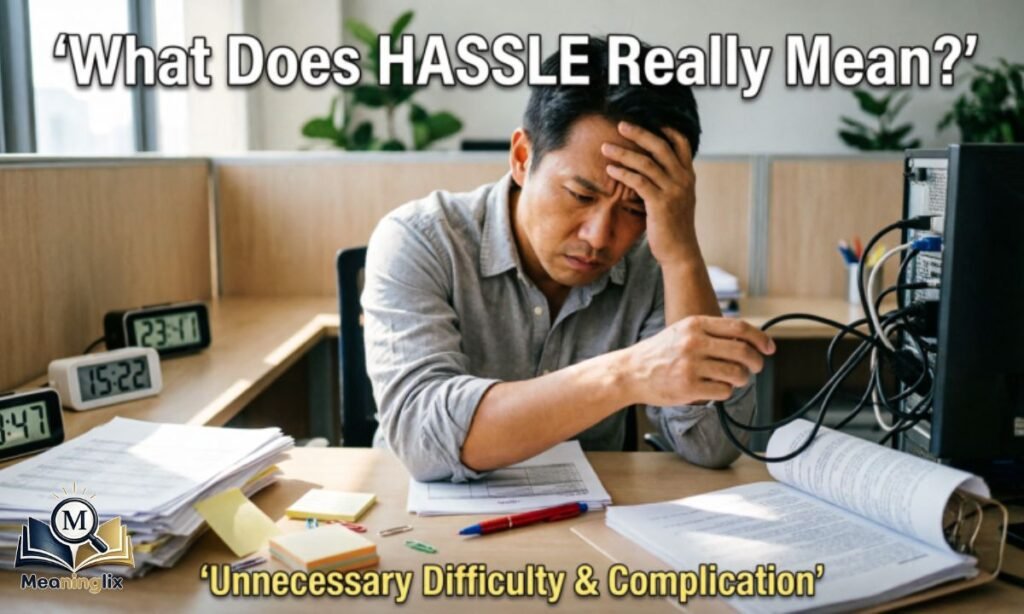
At its core, “hassle” describes something that creates unnecessary friction a task, situation, or interaction that takes more time, effort, or patience than it should. It’s a word people reach for when something isn’t dangerous or catastrophic, just annoying and draining.
The word carries a distinctly informal, conversational tone. You won’t often see it in legal contracts or academic papers, but it shows up constantly in everyday speech, customer service messaging, marketing copy, and casual writing. It works because it captures a very relatable feeling: the low-grade frustration of dealing with something tedious.
“Hassle” can function as either a noun (a thing that bothers you) or a verb (the act of bothering someone). Understanding both roles is key to using the word correctly, so let’s break each one down.
Hassle as a Noun: Meaning + Examples
Definition
As a noun, “hassle” refers to a situation, task, or problem that causes inconvenience, extra effort, or annoyance. It’s typically minor in severity not a crisis, but enough to be irritating.
Examples
- “Finding parking downtown is always a hassle.”
- “Switching internet providers turned into a huge hassle.”
- “I don’t want the hassle of returning this package.”
- “The whole visa application process was one hassle after another.”
- “It’s not worth the hassle of arguing with him.”
Common Situations Where “Hassle” Works Well
- Dealing with paperwork or bureaucracy (renewing licenses, filing taxes)
- Customer service disputes (returns, refunds, billing errors)
- Travel disruptions (delays, cancellations, lost luggage)
- Household chores that drag on longer than expected
- Technical problems (resetting passwords, troubleshooting devices)
Hassle as a Verb: Meaning + Examples
Definition
As a verb, “hassle” means to bother, pressure, nag, or repeatedly pester someone, usually about something relatively small. It implies persistence one request isn’t really “hassling,” but repeated pushing is.
Examples
- “Stop hassling me about the dishes, I’ll do them tonight.”
- “My manager keeps hassling the team about deadlines.”
- “The airline hassled passengers over minor documentation issues.”
- “Don’t hassle your sister while she’s studying.”
- “Telemarketers hassle people at the worst possible times.”
How “Hassle” Is Used in Daily Life
Because “hassle” is such a flexible, low-key word, it naturally weaves into all sorts of everyday contexts. Here’s how it typically shows up.
Common Daily Uses
- Talking about errands: “Grocery shopping on a Friday is such a hassle.”
- Describing minor conflicts: “We had a small hassle over who’d pick up the kids.”
- Venting about technology: “Setting up the new router was a total hassle.”
Business & Professional Uses
- Marketing language: “Enjoy a hassle-free checkout experience.”
- Customer service: “We’re sorry for the hassle this may have caused.”
- Internal communication: “Let’s simplify this process to reduce hassle for the support team.”
Casual Conversational Uses
- Friendly complaints: “Ugh, moving apartments is always such a hassle.”
- Reassurance: “Don’t worry about it, it’s really not a hassle.”
- Light teasing: “Quit hassling me about being late, it was five minutes!”
Etymology: Where the Word “Hassle” Comes From
Possible Origins
“Hassle” is a relatively young word by English standards. Language historians generally place its emergence in American English sometime in the mid-20th century, likely gaining traction through informal spoken slang before making its way into print. Its exact roots aren’t fully settled, but a few theories are commonly discussed:
- It may be a blend influenced by older words like “haggle” (to negotiate persistently) and “hustle” (to push or move energetically).
- Some linguists point to possible ties to older dialect terms associated with shaking, disturbing, or physical scuffling.
- Others suggest it simply developed as informal slang describing minor conflict or argument before broadening in meaning.
Meaning Evolution
Early uses of “hassle” leaned closer to describing an actual argument, scuffle, or dispute between people. Over the following decades, the meaning softened and broadened considerably. Today, it rarely implies real conflict instead, it’s used for everyday inconvenience, from long queues to confusing paperwork.
Interesting Fact
By the 1970s, “hassle” had fully entered mainstream American English and pop culture, appearing regularly in music, television, and advertising. Phrases like “no-hassle returns” and “hassle-free service” became marketing staples precisely because the word so effectively communicates ease and relief from friction something every customer wants.
Why the Confusion? Why People Think It’s Spelled “Hastle”
1. English Word Patterns Are Inconsistent
English spelling doesn’t follow one consistent rulebook. Words that sound alike are often spelled completely differently, and words that end in similar sounds don’t always share the same letters. “Hassle” breaks the pattern that words like “castle” and “whistle” seem to establish, which is exactly why it trips people up.
2. Misheard in Conversation
Because people learn most vocabulary through listening before they ever see it written down, the ear can mislead the hand. If “hassle” sounds slightly like it has a “t” in fast conversation, some writers will spell it that way without ever checking a dictionary.
3. Memory Errors
Once someone writes “hastle” a few times in texts, notes, or quick emails that incorrect version can start to feel familiar. Repetition builds false confidence, and the brain starts treating a mistake as a memorized fact rather than an error worth questioning.
How to Remember the Correct Spelling of “Hassle”
If you’ve mixed this word up before, these tricks can help make the correct spelling stick for good.
1. Think of “Less Hassle = Less Stress”
Both “hassle” and “stress” contain a double “s” and conveniently, they’re often used together in real life. Linking the two words in your mind reinforces the correct double-s pattern.
2. Remember the Pair
“Hassle” rhymes with words like “tassel” and “castle,” which also use “s” sounds without a “t” hiding in the middle of the base word. Picturing this rhyming group can help anchor the spelling.
3. Visual Trick
Picture the double “s” as two parallel lines of tension a small visual cue representing the “friction” the word describes. Seeing “ss” as a visual symbol for stress can make the spelling easier to recall.
4. Use a Quick Mnemonic
Try this: “A hassle has S-S, not S-T.” Repeating a short, rhythmic phrase like this a few times is often enough to override the instinct to add a “t.”
5. Think of Customer Service Phrases
Brands spend a fortune on advertising, and “hassle-free” is one of the most common promises in marketing. Picture a familiar phrase like “hassle-free returns” you’ve likely seen it written correctly dozens of times, and that visual memory can anchor the right spelling.
Hassle in Pop Culture & Media

Common Pop-Culture Uses
“Hassle” has been part of everyday American vocabulary for decades, showing up frequently in:
- Sitcom dialogue, where characters complain about minor daily annoyances
- Advertising slogans promising “hassle-free” service, shopping, or returns
- Song lyrics and titles referencing frustration or life’s small struggles
- News interviews and casual commentary about bureaucratic or logistical friction
Why It’s Popular
The word works so well in media because it’s instantly relatable without sounding dramatic. It captures everyday frustration in a light, conversational way perfect for advertising copy that wants to promise relief, or for scripted dialogue that wants to sound natural and unscripted. Its informal tone makes it feel authentic rather than corporate, which is exactly why brands lean on it so heavily in customer-facing messaging.
Case Studies: Real-Life Examples of When “Hassle” Applies
Case Study 1: Customer Service Hassle
A customer orders a product online, and it arrives damaged. To get a replacement, they have to take photos, contact support, wait on hold, repackage the item, and track a return shipment all before receiving a refund days later. Each individual step is small, but together they add up to a frustrating, time-consuming ordeal. This is a textbook example of “hassle” as a noun: an accumulation of minor inconveniences that drains time and patience.
Case Study 2: Travel Hassle
A traveler arrives at the airport only to discover their flight is delayed, their gate has changed twice, and their checked bag needs extra screening. None of these problems are catastrophic on their own, but stacked together, they create exactly the kind of stressful, inconvenient experience the word “hassle” was made for. Travel is one of the most common real-world contexts where this word gets used naturally and often.
Case Study 3: Workplace Hassle
An employee is asked to redo a report three times because of unclear instructions from a manager, plus repeated follow-up emails asking for status updates before the deadline has even arrived. Here, “hassle” applies as both noun and verb: the repeated rework is the hassle (noun), and the manager’s constant check-ins could be described as hassling (verb) the employee, even if unintentionally.
Sentence Examples Using “Hassle” Correctly
Noun Examples
- “Getting a refund without a receipt turned into a real hassle.”
- “There’s no hassle involved if you book online in advance.”
- “Moving apartments always comes with a few unexpected hassles.”
- “It’s too much of a hassle to fight over something this small.”
Verb Examples
- “Please stop hassling me about the schedule, I already sent it.”
- “The landlord kept hassling tenants over minor lease violations.”
- “Reporters hassled the spokesperson with the same question repeatedly.”
- “Don’t hassle your coworkers right before a deadline.”
Common Mistakes People Make With “Hassle”
Beyond the basic spelling error, a few other mistakes tend to show up around this word:
- Writing “hastle” instead of “hassle” the single most common error, driven by pronunciation and typing speed.
- Confusing “hassle” with “hustle” these are two completely different words with different meanings, despite looking and sounding similar.
- Confusing “hassle” with “haggle” “haggle” specifically means negotiating over price, while “hassle” refers to general bother or annoyance. They aren’t interchangeable.
- Using “hassle” in overly formal writing because the word is inherently casual, it can feel out of place in academic papers, legal documents, or highly formal business writing. Words like “inconvenience,” “difficulty,” or “complication” often fit better in those settings.
- Forgetting the verb needs an object as a verb, “hassle” almost always requires someone being bothered (“hassle him,” “hassle the staff”). Using it without an object can sound awkward.
Hassle: Quick Facts
| Fact | Detail |
| Correct spelling | Hassle |
| Incorrect spelling | Hastle (not a real word) |
| Word type | Noun and verb |
| Pronunciation | /ˈhæ-səl/ (“HASS-uhl”) |
| Tone | Informal, conversational |
| First widespread use | Mid-20th century American English |
| Common phrase | “Hassle-free” |
| Often confused with | Hustle, haggle |
Frequently Asked Questions (FAQs)
What does hustle and hassle mean?
“Hustle” means to work energetically or move quickly, while “hassle” means trouble, bother, or annoyance. They’re different words that happen to rhyme.
What does it mean to be a hassle?
Being “a hassle” means being a source of annoyance, inconvenience, or extra unwanted effort for someone.
Is it hussle or hustle?
It’s “hustle.” “Hussle” is a common misspelling and isn’t recognized in standard English dictionaries.
Is it sorry for the hustle or hassle?
It’s “sorry for the hassle.” This phrase apologizes for inconvenience or trouble, which is exactly what “hassle” means “hustle” doesn’t fit this context.
Conclusion
The debate between “hassle” and “hastle” really isn’t a debate at all “hassle” is correct, and “hastle” is simply a misspelling that spreads through mispronunciation, fast typing, and inconsistent English spelling patterns. Once you understand where the confusion comes from and how the word actually works as both a noun and a verb, it becomes much easier to use it correctly and confidently.
Whether you’re writing a customer service email, a casual text, or a school assignment, remembering the double “s” and skipping the “t” will keep your writing accurate and polished. Use the mnemonics above, pay attention to common phrases like “hassle-free,” and you’ll never second-guess this word again.

Alisha Lehmann is the founder and author of Meaninglix. She specializes in explaining word meanings, internet slang, abbreviations, grammar, and English expressions in simple, accurate language. Her goal is to help readers improve their vocabulary and communicate confidently through clear, well-researched, and easy-to-understand content.
1 thought on “Hassle vs Hastle: Meaning, Spelling, and Common Mistakes 2026”