If you have ever paused mid sentence wondering whether to write “resignate” or “resonate,” you are not alone. This mix-up shows up in emails, social media captions, marketing copy, and everyday conversation. The confusion between resignate or resonate is one of the most common word mix ups in modern English, and it trips up native speakers just as often as new learners.
Resonate is the correct word, and resignate is not a real word in standard English. Resonate means to produce a lasting impression, to evoke a strong emotional response, or to vibrate with sound. Resignate is a common misspelling or mishearing of resonate and has no accepted dictionary definition of its own.
This guide breaks down exactly why the resignate or resonate confusion happens, what resonate really means, how to use it correctly, and how to write messages that genuinely resonate with your audience.
Table of Contents
Resignate or Resonate : Why This Mix-Up Happens Everywhere
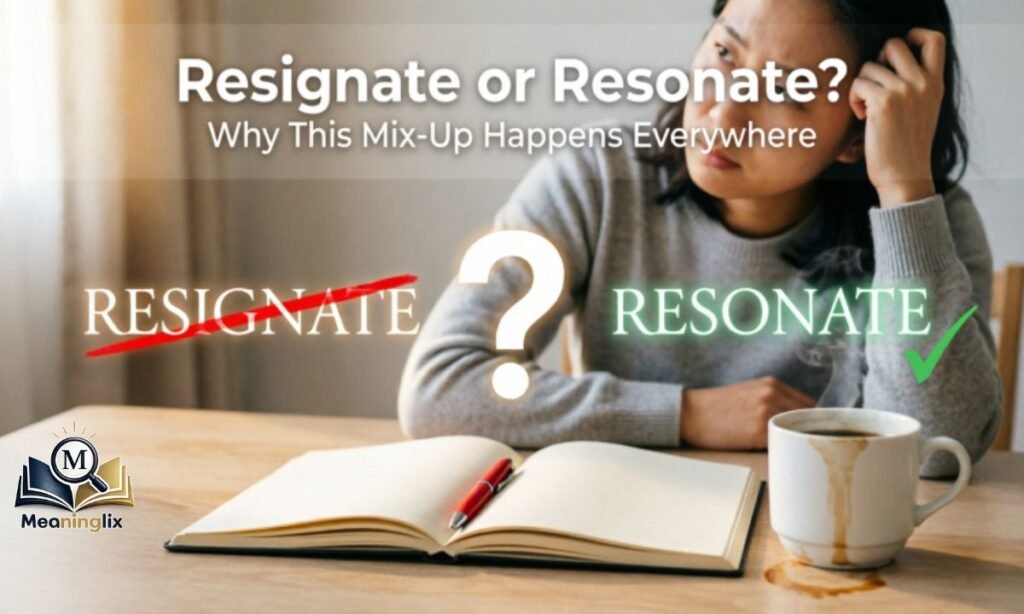
The resignate or resonate debate keeps popping up because the two words sound almost identical when spoken quickly. Add in autocorrect errors, casual texting habits, and the fact that many people learn words by ear rather than by reading them, and you get a perfect storm for confusion.
Search engines see thousands of monthly queries asking whether it is resignate or resonate, which tells you this is not a rare typo. It is a widespread pattern rooted in phonetics, word association, and language drift. Understanding why this happens is the first step to fixing it for good.
Click Here To Read More Grammar
Resignate or Resonate Examples
Seeing the words side by side in real sentences makes the difference click instantly.
| Incorrect (Resignate) | Correct (Resonate) |
| Her speech didn’t resignate with the crowd. | Her speech didn’t resonate with the crowd. |
| This song really resignates with me. | This song really resonates with me. |
| The brand message failed to resignate. | The brand message failed to resonate. |
| His story resignated deeply with readers. | His story resonated deeply with readers. |
| I hope this idea resignates with you. | I hope this idea resonates with you. |
Every single example on the left is grammatically wrong. Resonate is always the correct choice, no matter the tense or context.
The Core Mix-Up: What People Think They’re Saying vs. What They Actually Say
Here is the heart of the resignate or resonate problem. People hear “resonate” spoken aloud, and their brain quietly links it to a more familiar word: resign. Since “resign” already exists and feels like a natural building block, the mind assumes “resignate” must be a logical extension, similar to how “originate” relates to “origin.”
But language does not always follow that pattern. Resonate has nothing to do with resigning. It comes from a completely different root, tied to sound and vibration rather than stepping down or quitting. This mental shortcut is exactly why so many people confidently write resignate without realizing it is incorrect.
Why People Keep Using “Resignate” (Even Though It Isn’t a Real Word)

Phonetic Confusion
Resonate and resignate share a similar rhythm and stress pattern when spoken casually. The middle syllables blur together, especially in fast speech, making the two words sound almost interchangeable to the ear.
Misheard Words
Many people first encounter “resonate” through spoken media like podcasts, interviews, or song lyrics rather than in print. Without seeing the spelling, it is easy to mishear it as “resignate,” especially if the speaker has an accent or speaks quickly.
Assumptions About Word Patterns
English is full of words like “originate,” “designate,” and “resign,” which use similar suffixes and prefixes. People often assume resonate follows the same construction as these familiar terms, leading them to invent “resignate” as a plausible sounding alternative.
Social Spread
Once a few people use “resignate” in comments, captions, or casual writing, others copy the spelling without questioning it. This kind of error spreads quickly online, especially across social media platforms where writing is fast and rarely proofread.
Lack of Exposure to the Correct Term
Some people simply have not encountered “resonate” enough in formal writing to know its correct spelling. Without repeated exposure through reading, the incorrect version can feel just as normal as the correct one.
Is “Resignate” a Real Word? The Unfiltered Answer
No. Resignate does not appear in any major dictionary, including Merriam Webster, Oxford, or Cambridge. It has no recognized definition, no formal etymology, and no accepted grammatical use. It exists only as a common error, not as an alternative spelling or informal variant.
Why It Fails Linguistically
Real English words typically trace back to a documented root or evolve through recognized linguistic patterns. Resignate has neither. It is not a regional dialect term, not an outdated word, and not a legitimate derivative of “resign.” It is simply a blend created by mishearing and mispronouncing resonate, and it has never been formally adopted into the language.
The Correct Word: What “Resonate” Actually Means
Core Definitions
Resonate carries a few related meanings, all connected to vibration, sound, or emotional impact.
- To produce or be filled with a deep, full, reverberating sound.
- To evoke or suggest images, memories, or emotions.
- To have a strong emotional or psychological effect on someone, often creating a sense of connection or agreement.
Real-World Examples of “Resonate”
- The singer’s voice resonated through the concert hall.
- Her message about mental health resonated with thousands of viewers.
- The company’s mission statement resonates with younger consumers who value sustainability.
- His words resonated long after the meeting ended.
What Dictionaries and Style Guides Say About “Resonate”
Major dictionaries consistently define resonate as both a physical and emotional term. Merriam Webster describes it in terms of sound vibration and evoking response, while Oxford emphasizes the emotional and psychological sense, particularly the phrase “resonate with.”
Style guides used in journalism and professional writing treat resonate as standard vocabulary, appropriate for formal, academic, and conversational contexts alike. None of these sources recognize resignate in any capacity, reinforcing that the resignate or resonate debate has only one correct answer.
Etymology: How “Resonate” Evolved from Latin to Today
Latin Origin
Resonate traces back to the Latin word “resonare,” a combination of “re” meaning again and “sonare” meaning to sound. Together, the term originally described something that sounds again or echoes back, capturing the literal idea of vibration and reverberation.
Evolution Over Time
Over centuries, resonate moved from describing physical acoustics, like the echo in a cave or the hum of a musical instrument, to describing emotional and psychological impact. By the modern era, English speakers had extended its meaning to cover ideas, messages, and experiences that create a lasting emotional connection, which is how we primarily use it today.
How to Use “Resonate” Correctly in Everyday Life

In Daily Conversation
Use resonate when describing something that emotionally connects with you or someone else. For example, “That podcast episode really resonated with me” works naturally in casual speech.
In Professional Writing
In business writing, resonate often describes how well a message, brand, or idea connects with an audience. For example, “Our new campaign is designed to resonate with millennial homeowners” is a common and correct professional usage.
In Media & Literature
Writers frequently use resonate to describe emotional depth in storytelling. A well written character’s struggle can resonate with readers long after they finish a book, creating lasting impact through relatable experiences.
Correct vs Incorrect Usage
Always double check your spelling before publishing. If you are debating resignate or resonate in a sentence, resonate is the safe and correct answer every single time, regardless of tense, audience, or formality level.
Writing Messages That Truly Resonate
Know Your Audience
Understanding who you are speaking to shapes every word choice you make. Messages that resonate are built on genuine insight into the reader’s values, struggles, and goals.
Speak to Emotions
Facts inform, but emotions connect. Writing that resonates taps into feelings like hope, relief, curiosity, or nostalgia rather than relying only on logic.
Keep It Clear
Overly complex sentences dilute emotional impact. Clear, direct language allows your core message to resonate without getting lost in unnecessary complexity.
Use a Strong Hook
The first sentence determines whether readers keep going. A strong hook immediately signals that your message is worth their attention and sets the tone for everything that resonates afterward.
Add Sensory Details
Specific, vivid details help readers picture and feel what you are describing, which strengthens emotional resonance far more than vague statements ever could.
Be Authentic
Genuine, honest writing resonates more than polished but hollow language. Readers can sense manufactured sincerity, so authenticity remains one of the strongest tools for connection.
Communication Tips to Make Your Messages Resonate
Use Storytelling
Stories create emotional investment. A short, relevant anecdote often resonates far more powerfully than a list of statistics or abstract claims.
Use Concrete Examples
Specific examples make abstract ideas tangible, helping your message resonate with readers who need something real to hold onto.
Use Rhythm
Varying sentence length creates a natural rhythm that keeps readers engaged, allowing your key points to resonate rather than blur together.
Use Contrast
Highlighting before and after scenarios, or right and wrong choices, sharpens your message and makes it resonate more clearly with your audience.
Avoid Jargon
Technical or industry specific language can alienate readers. Simple, accessible wording resonates with a much wider audience than jargon heavy writing.
Use Active Verbs
Active voice creates energy and directness. Passive constructions weaken impact, while active verbs help your writing resonate with confidence and clarity.
Table: What Creates Resonance vs. What Kills It
| Creates Resonance | Kills Resonance |
| Authentic, honest tone | Overly formal or robotic language |
| Clear, specific examples | Vague generalizations |
| Emotional storytelling | Dry, fact only delivery |
| Active, confident verbs | Passive, hesitant phrasing |
| Understanding audience needs | Ignoring audience context |
Practice: Exercises to Master “Resignate or Resonate”
Fill-in-the-Blank
Complete each sentence with the correct word, Resignate or Resonate.
- Her advice really _____ with the entire team.
- I hope this article _____ with readers searching for answers.
- The melody _____ through the empty hall.
Rewrite the Sentence
Rewrite the following incorrect sentences using resonate instead of resignate.
- “This idea doesn’t resignate with our audience.”
- “Her speech resignated with everyone in the room.”
Mini Writing Prompt
Write a short paragraph, three to five sentences, describing a moment when a song, quote, or story resonated with you personally. Focus on using resonate correctly at least twice.
FAQs (Resignate or Resonate)
Is it resonate or resignate?
It is always resonate. Resignate is not a recognized word in any standard English dictionary and should never be used in writing or speech.
What does it mean to resonate?
To resonate means to produce a deep, reverberating sound, or to evoke a strong emotional or psychological response, often creating a sense of connection or agreement.
What does resonate with you mean?
When something resonates with you, it means it emotionally connects with your personal experiences, beliefs, or feelings, leaving a lasting impression rather than a fleeting reaction.
What does it mean to resignate?
Resignate has no official meaning. It is simply an incorrect variation of resonate, most likely caused by phonetic confusion or mishearing the correct word.
Conclusion (Resignate or Resonate)
The Resignate or Resonate debate has a clear and simple answer: resonate is correct, and resignate is not a real word. The confusion stems from phonetic similarity, mishearing, and assumptions about English word patterns, not from any legitimate alternative spelling.
Resonate carries a rich history rooted in Latin, describing both physical sound and emotional connection, and it remains one of the most useful words for anyone who wants their message, story, or brand to genuinely connect with an audience. Next time you catch yourself typing resignate, pause, correct it to resonate, and focus on the deeper goal, creating writing that truly resonates with the people reading it.

Alisha Lehmann is the founder and author of Meaninglix. She specializes in explaining word meanings, internet slang, abbreviations, grammar, and English expressions in simple, accurate language. Her goal is to help readers improve their vocabulary and communicate confidently through clear, well-researched, and easy-to-understand content.
2 thoughts on “Resignate or Resonate? Powerful Grammar Examples 2026”