
TTM most often stands for Trailing Twelve Months, a financial term used to measure a company’s performance over the past 12 consecutive months rather than a fixed calendar or fiscal year. You’ll see it constantly in investing reports, revenue charts, and stock screeners.
Outside of finance, TTM also pops up in texting and gaming as shorthand for “Talk To Me,” and in business circles as “Time To Market.”
Table of Contents
Quick Answer
| Context | TTM Stands For | Common Usage |
| Finance/Investing | Trailing Twelve Months | Revenue, earnings, growth metrics |
| Texting/Chat | Talk To Me | Casual conversation starter |
| Business Strategy | Time To Market | Product launch planning |
If you landed here from a stock app or a company’s earnings report, you almost certainly want the finance definition. That’s where this guide starts.
TTM Meaning in Finance: Trailing Twelve Months Explained
When a financial analyst or investor mentions TTM, they’re talking about a rolling 12-month window that ends with the most recent completed quarter or month, not the last official fiscal year.
Say a company’s fiscal year ends in December, but it’s currently September. Instead of waiting until year-end reporting, analysts calculate TTM revenue by adding up the last four reported quarters, even if that stretch crosses two different fiscal years.
This matters because annual reports can go stale fast. A company might report strong numbers in its 10-K, but if the last two quarters have slowed down significantly, the trailing twelve months figure will reflect that dip while the annual filing still looks rosy.
Read Also : Ohio Meme Meaning
Why Investors Rely on TTM Meaning Instead of Annual Figures
Annual financials are backward-looking by definition. By the time a 10-K is filed, some of that data is already six to nine months old.
TTM figures update every quarter, giving a more current snapshot of how a business is actually performing right now. This is especially useful for:
- Comparing companies with different fiscal year-end dates
- Spotting momentum shifts before they show up in annual reports
- Valuing a company using metrics like P/E ratio based on the most recent earnings
A P/E ratio calculated with TTM earnings, for instance, reflects the last four quarters of profit rather than an outdated annual number. That’s why most stock screeners and financial data platforms default to TTM instead of the prior fiscal year.
How to Calculate TTM Yourself
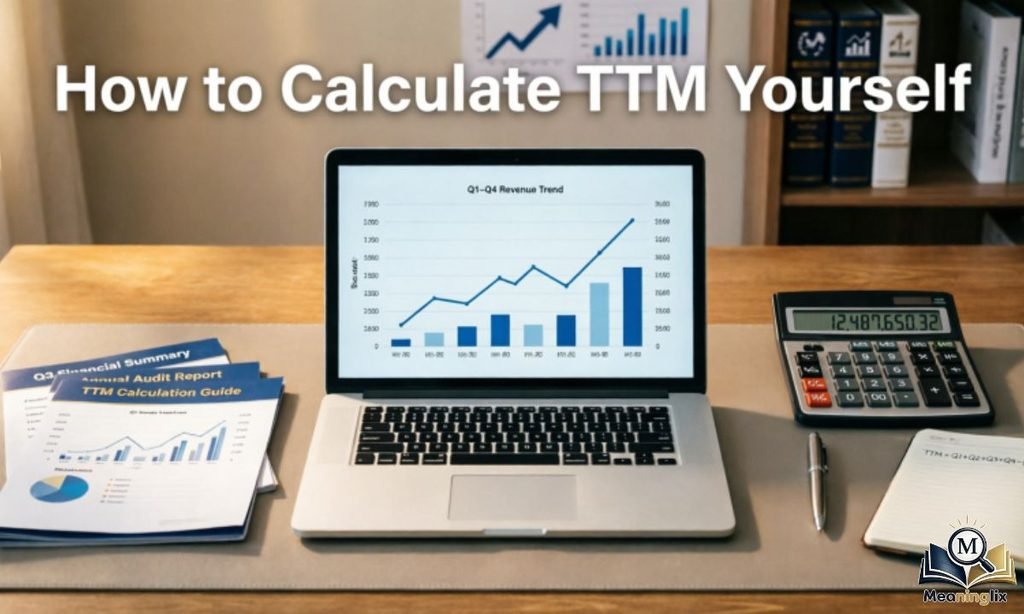
The math is simpler than it sounds. You take the most recent quarter, then add the three quarters before it.
For example, if it’s currently Q3 2026, your TTM figure would combine Q4 2025, Q1 2026, Q2 2026, and Q3 2026. Each new quarter, you drop the oldest one and add the newest, which is why it’s called a “trailing” or “rolling” calculation.
One nuance a lot of beginner investors miss: TTM revenue and TTM net income don’t always move in the same direction. A company can post rising trailing revenue while its trailing profit shrinks because of one-time costs like a lawsuit settlement or a restructuring charge buried in a single quarter. If you only glance at the top-line TTM number, you can miss that the bottom line tells a very different story.
Read Now : WSG Meaning
When TTM Meaning Is Useful (and When It Isn’t)
TTM works well for companies with stable, recurring business models like subscription services, retail chains, or established manufacturers.
It’s less reliable for businesses with heavy seasonality that just went through an unusual event, like a major acquisition, a one-time asset sale, or a natural disaster affecting operations. In those cases, the trailing number can be skewed by something that won’t repeat, so it’s worth pairing TTM with a look at quarter-over-quarter trends before drawing conclusions.
Startups and newly public companies are another exception. If a company only has three quarters of public data, there’s technically no full trailing twelve months yet, and some platforms will either estimate it or simply mark it as not available.
TTM Meaning in Texting and Online Chat

Away from spreadsheets and earnings calls, TTM shows up in a completely different context: casual messaging.
Here, TTM usually means “Talk To Me.” It’s used the same way as “hmu” (hit me up) or “lmk” (let me know), typically when someone wants a friend to reach out or continue a conversation.
Example text exchange:
Person A: “Rough day, don’t really want to talk about it in the group chat” Person B: “TTM whenever you’re ready, I’m around”
Some gaming communities also use TTM as shorthand within Discord servers or comment threads, though the meaning stays essentially the same, an invitation to chat privately or continue talking.
TTM Meaning in Business and Product Development
A third, less common usage is Time To Market, referring to how long it takes a company to go from a product idea to an actual launch.
Businesses in competitive industries like consumer tech or pharmaceuticals track TTM closely because a shorter time to market can mean beating competitors to a release window. This version of the acronym is more niche and usually only comes up in strategy meetings, product management courses, or supply chain discussions, so context almost always makes it clear which TTM someone means.
Common Mistakes People Make With TTM Meaning

A few mix-ups happen often enough that they’re worth flagging directly.
- Confusing TTM with LTM. They’re often treated as interchangeable, and in most everyday use they are, but some analysts use LTM (Last Twelve Months) specifically when referring to private company or M&A valuation contexts, while TTM is more common in public equity research. The distinction isn’t universal, but it’s worth knowing it exists.
- Assuming TTM equals the current fiscal year. It doesn’t. A company’s fiscal year is fixed on the calendar; TTM shifts every quarter regardless of when the fiscal year starts or ends.
- Reading TTM figures without checking for one-time events. A single unusual quarter, good or bad, can distort a trailing twelve month number more than most people expect.
- Using the wrong meaning in casual writing. Typing “TTM” in a business email when you meant “talk to me” can genuinely confuse a coworker who only knows the finance definition, and vice versa in a group chat.
Related and Similar Terms TTM Meaning
A handful of related abbreviations show up alongside TTM often enough that they’re worth knowing:
- LTM (Last Twelve Months) – functionally similar to TTM, more common in valuation and private equity contexts
- YTD (Year To Date) – measures performance from the start of the current calendar or fiscal year to now
- QoQ (Quarter over Quarter) – compares one quarter’s results directly to the prior quarter
- YoY (Year over Year) – compares the same period across two different years
- CAGR (Compound Annual Growth Rate) – measures growth rate over multiple years, smoothed out annually
- P/E Ratio (Price to Earnings) – frequently calculated using TTM earnings rather than annual figures
Frequently Asked Questions ( TTM Meaning )
What does TTM mean in stocks?
In stock analysis, TTM stands for Trailing Twelve Months, referring to a company’s financial performance over the most recent 12-month period rather than its official fiscal year. It’s used to calculate up-to-date metrics like revenue, earnings per share, and P/E ratio.
Is TTM the same as annual revenue?
Not exactly. Annual revenue usually refers to a fixed fiscal year, while TTM revenue rolls forward every quarter. They can match up briefly right after year-end reporting, but they diverge as new quarters get added and old ones drop off.
What does TTM mean in texting?
In texting and casual chat, TTM typically means “Talk To Me.” It’s used to invite someone to reach out or keep a conversation going, similar to phrases like “hmu” or “hit me up.”
How do you calculate TTM revenue?
Add together the revenue from the four most recently completed quarters. Each quarter, you drop the oldest one from the calculation and include the newest, keeping the total rolling and current rather than fixed to a calendar year.
Why do investors prefer TTM over fiscal year data?
Fiscal year data can be several months old by the time it’s published. TTM updates quarterly, giving a more current picture of a company’s performance, which is especially helpful when comparing businesses with different fiscal year-end dates.
Does TTM mean something different in business meetings?
Occasionally. In product development or supply chain discussions, TTM can mean Time To Market, referring to how quickly a company moves from developing a product to launching it. Context usually makes it clear which meaning applies.
Final Thoughts
Most people typing “TTM meaning” into a search bar are looking at a stock chart, an earnings summary, or an investing app and want to know why this abbreviation keeps showing up next to revenue and earnings numbers. In that context, it almost always refers to Trailing Twelve Months, a rolling measure that keeps financial data current between annual reports.
That said, acronyms get reused across different worlds. If you saw TTM in a text message rather than a balance sheet, the meaning shifts entirely toward a casual invitation to talk. Knowing both versions means you’ll never be caught guessing, whether you’re reading a 10-Q or replying to a friend.

Alisha Lehmann is the founder and author of Meaninglix. She specializes in explaining word meanings, internet slang, abbreviations, grammar, and English expressions in simple, accurate language. Her goal is to help readers improve their vocabulary and communicate confidently through clear, well-researched, and easy-to-understand content.
3 thoughts on “TTM Meaning: What It Stands For and Why It Matters”