
You’ve probably typed “cannot,” paused, and wondered if it should be two words instead. This happens because both forms look valid and spell-check rarely flags either one. Here’s the short answer: “cannot” is the standard, correct form in almost every situation.
“Can not” is only correct in a few specific cases, which this guide breaks down clearly.
Table of Contents
Quick Answer: Cannot vs Can Not
Cannot is one word, and it’s the version you should use by default. It’s the standard negative form of “can” in modern American and British English, used in speech, writing, school papers, and professional documents alike.
Can not is two separate words. It’s grammatically valid, but it’s reserved for narrow situations mainly when “not” is paired with another word right after it, like “can not only.” Outside of those cases, “can not” usually just looks like a typo.
What Does “Cannot” Mean?
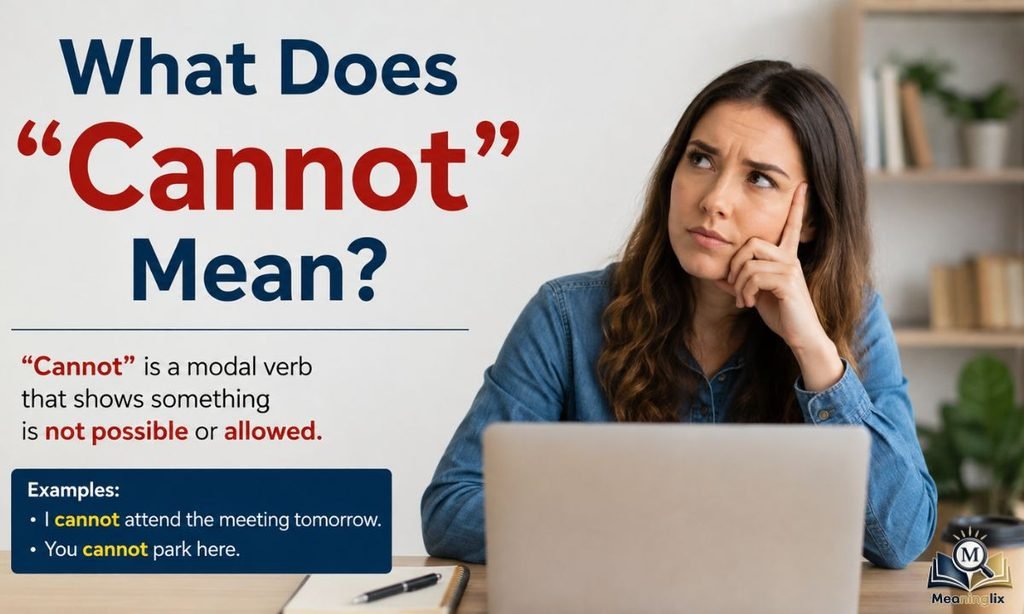
“Cannot” is the negative form of the modal verb “can.” It expresses that something is impossible, not allowed, or not able to happen.
- I cannot attend the meeting on Friday.
- She cannot lift that box by herself.
- This printer cannot connect to Wi-Fi.
Because “cannot” is a single, fused word, it functions the same way “can’t” does in casual speech just in its full, unabbreviated form. It’s the version taught in grammar textbooks and used in nearly all formal and informal writing.
Read Now : Studder or Stutter
What Does “Can Not” Mean?
“Can not” separates “can” and “not” into two distinct words. Grammatically, this is only necessary when “not” belongs to a different phrase than “can,” rather than negating “can” on its own.
The clearest example is the phrase “can not only… but also.”
- You can not only finish the report today but also send it early.
Here, “not” isn’t negating “can” it’s part of the “not only… but also” construction. Written as “cannot only,” the sentence would lose its intended meaning.
Why the Confusion Happens
The confusion exists because English allows compound words to form from two words that started out separate. “Cannot” followed this exact path, and over time it became the accepted standard. Since “can” and “not” are still two recognizable words, many writers assume splitting them is always an option.
Autocorrect tools add to the mix-up. Some browsers and apps won’t flag “can not” as an error, even in contexts where “cannot” is expected, which makes the two forms feel interchangeable when they aren’t.
Cannot vs Can Not: Quick Comparison
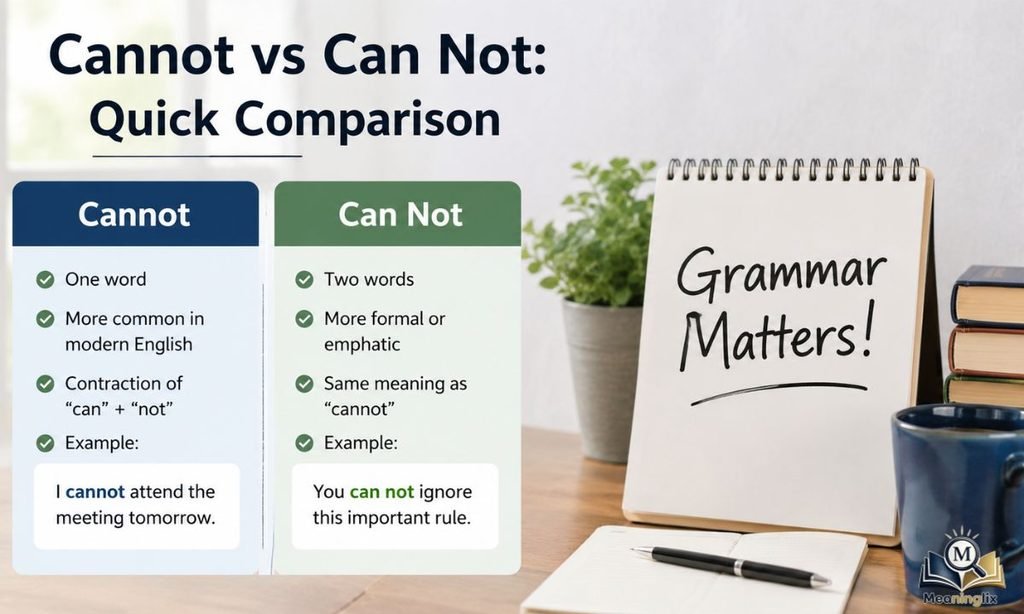
| Term | Correct? | Meaning | Typical Use | Example |
| Cannot | Yes, standard | Negative of “can”; expresses inability or prohibition | Everyday writing, formal documents, academic work | “I cannot finish this by Monday.” |
| Can not | Only in specific cases | “Not” modifies a different word or phrase, not “can” itself | Emphasis, “not only… but also” constructions | “You can not only sing but also dance.” |
Grammar Rules for Using Cannot and Can Not
Follow these rules to choose the correct form without second-guessing yourself:
- Default to “cannot.” If you’re simply saying something is impossible or not allowed, use one word.
- Use “can not” with “not only… but also.” This is the most common legitimate use of the split form.
- Use “can not” for deliberate emphasis. In rare cases, writers separate the words to stress the “not,” as in: “You can not go, if that’s what you decide” meaning going is optional, not forbidden. This use is uncommon and mostly appears in careful, formal writing.
- Never split “cannot” out of habit. If you’re not applying rule 2 or 3, stick with one word.
- In casual writing or speech, “can’t” is usually the better choice. Both “cannot” and “can not” are more formal; “can’t” fits everyday conversation and texting.
Read Confusion : Devide or Divide
Real-Life Examples
Everyday conversation
- Correct: “I cannot believe it’s already August.”
- Incorrect: “I can not believe it’s already August.” (No “not only” or emphasis structure here, so this reads as a mistake.)
School or academic writing
- Correct: “The data cannot support this conclusion without further testing.”
Workplace communication
- Correct: “We cannot approve this request until legal signs off.”
Text messages
- Correct: “Can’t make it tonight, sorry!” (Contraction fits the casual tone better than “cannot.”)
Formal writing with “not only… but also”
- Correct: “The policy can not only reduce costs but also improve response times.”
Common Mistakes to Avoid
The biggest mistake is using “can not” as a casual substitute for “cannot,” without any grammatical reason to split the words. Since both versions are technically real words, this error slips past spell-checkers and readers alike.
- Incorrect: “He can not swim.” (Should be “cannot,” since there’s no “not only” or emphasis structure.)
- Correct: “He cannot swim.”
A simple way to remember the difference: if “not” is paired with “only” right after it, keep the words separate. If it isn’t, join them into “cannot.” When in doubt, one word is almost always the safer, correct choice.
British English vs American English
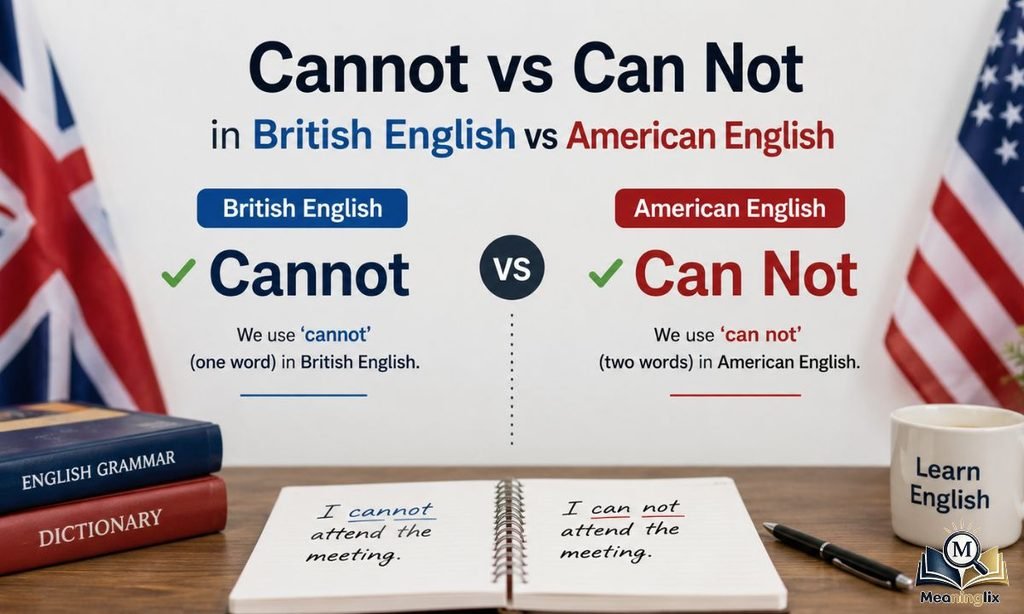
Both American and British English treat “cannot” as the standard form. There’s no regional split here unlike some spelling differences (color vs colour), “cannot” is spelled and used the same way on both sides of the Atlantic. “Can not” follows the same narrow rules in both varieties of English.
Practical Tips to Remember the Difference
- Read the sentence aloud. If you’d naturally say “can’t,” write “cannot” (or “can’t” itself in casual contexts).
- Check for “not only” right after “can.” If it’s there, keep the words apart.
- When editing formal writing, search for “can not” and confirm each instance is intentional most of the time, it should be “cannot” instead.
Frequently Asked Questions
Is “cannot” one word or two?
“Cannot” is one word. It’s the standard, correct spelling for expressing that something is impossible or not permitted, and it’s the form used across formal and informal American English writing.
Is “can not” ever grammatically correct?
Yes, but only in specific situations mainly with “not only… but also” constructions or when a writer wants to place special emphasis on “not.” Outside those cases, “cannot” is the correct choice.
What’s the difference between “cannot” and “can’t”?
They mean the same thing, but “cannot” is more formal, while “can’t” is a contraction suited to casual speech and writing. Both are correct; the choice depends on tone and context.
Should I use “cannot” in professional emails?
Yes. “Cannot” is the appropriate, polished form for professional and academic writing. Save “can’t” for casual messages and everyday conversation.
Final Takeaway
When in doubt, write “cannot.” It’s the correct, standard form for nearly every sentence where you’re expressing inability or refusal.
Reach for “can not” only when “not” belongs to a separate phrase, like “not only… but also,” or when you’re deliberately emphasizing the word “not.” Keep that one distinction in mind, and you’ll never second-guess this pair again.

Alisha Lehmann is the founder and author of Meaninglix. She specializes in explaining word meanings, internet slang, abbreviations, grammar, and English expressions in simple, accurate language. Her goal is to help readers improve their vocabulary and communicate confidently through clear, well-researched, and easy-to-understand content.
1 thought on “Cannot or Can Not: 5 Rules to Get It Right Every Time”