If you’ve ever paused mid-sentence wondering whether you need an “a” or an “e,” you’re not alone. Stationary means staying still or not moving. Stationery means paper, envelopes, and writing supplies.
The confusion happens because the Stationary vs Stationery words sound identical and differ by a single letter, but they describe completely unrelated things: one is about motion, the other is about paper.
Table of Contents
Quick Answer : “Stationary vs Stationery“
Before anything else, here’s the rule in one line:
- Use stationary (with an “a”) when you mean not moving.
- Use stationery (with an “e”) when you mean writing materials or paper goods.
A simple memory trick settles it for good: stationery has an e, just like envelope and letter. If you’re talking about paper, look for the e’s. If you’re talking about something parked, frozen, or fixed in place, it’s stationary.
What Does “Stationary” Mean?
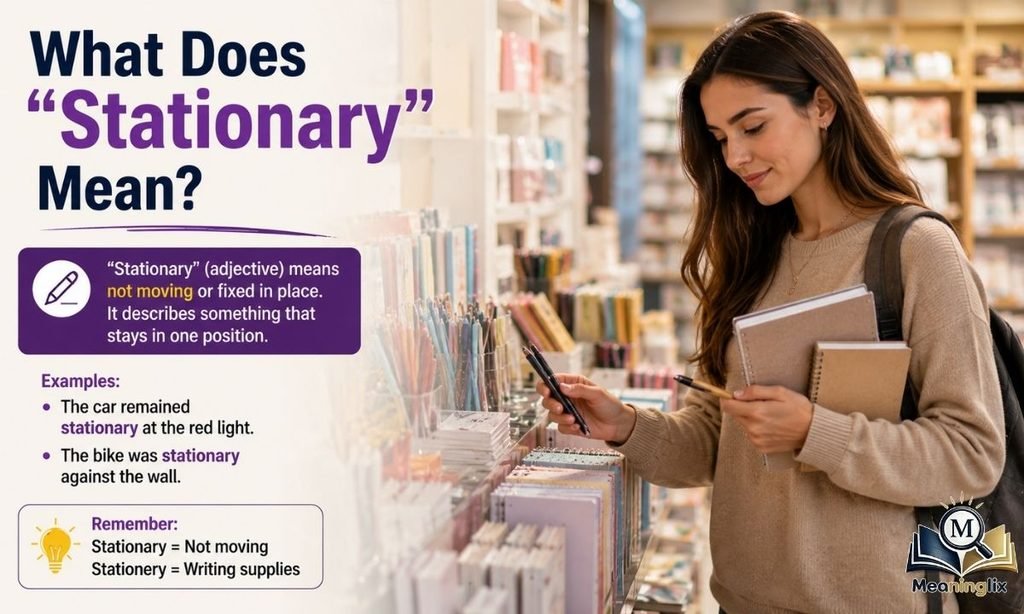
Stationary is an adjective that describes something that is not moving, fixed in one spot, or unchanging in condition. It comes from the Latin word stationarius, related to statio, meaning “a standing place.” Think of it as sharing a root with “station” , a place where things stand still.
You’ll see stationary used in everyday speech, science, and technical writing:
- “The car remained stationary at the red light.”
- “Keep the camera stationary while recording the interview.”
- “A stationary bike is a great option for indoor cardio.”
- “Prices have stayed stationary for the past six months.”
Notice that stationary isn’t limited to physical objects. It can also describe something that stays constant, like a price, a population, or a statistic.
What Does “Stationery” Mean?
Stationery is a noun that refers to paper and writing materials, letterhead, envelopes, notecards, pens, and similar office or personal supplies. The word traces back to “stationer,” a term used in medieval England for merchants who sold books and paper from a fixed shop, rather than traveling peddlers who sold goods from market to market.
Common examples of stationery in a sentence:
- “She ordered custom stationery with her monogram on it.”
- “The office ran out of printer paper and stationery last week.”
- “He wrote a thank-you note on his personal stationery.”
- “Wedding invitations are often printed on premium stationery.”
A useful detail: stationery is treated as an uncountable noun in American English. You don’t say “two stationeries” you say “some stationery,” “a box of stationery,” or “a piece of stationery.”
Why Do People Mix Up Stationary vs Stationery ?
The confusion is almost entirely about pronunciation, not meaning. Stationary and stationery are homophones; they sound the same when spoken aloud, even though they’re spelled differently and mean different things. English has plenty of these tricky pairs (think their/there/they’re or affect/effect), and stationary/stationery is one of the most commonly confused because both words also share the same Latin root.
Autocorrect doesn’t help either. Since both spellings are real words, your phone or word processor won’t flag the wrong one; it will happily let “stationary” slip through even when you meant office supplies.
Stationary vs Stationery: Quick Comparison Table
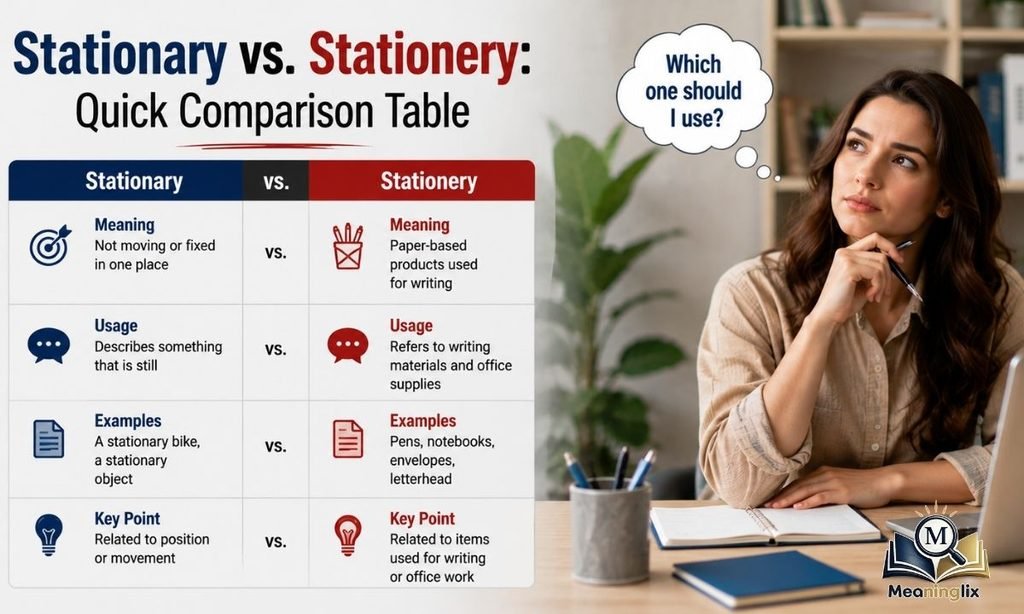
| Term | Part of Speech | Meaning | Typical Use | Example |
| Stationary | Adjective | Not moving; fixed in place | Describing objects, vehicles, or conditions | “The train stood stationary for an hour.” |
| Stationery | Noun | Paper, envelopes, and writing supplies | Describing office or personal writing materials | “She stocked up on stationery for the new office.” |
How to Remember the Difference for Good “Stationary vs Stationery”
If the memory trick above doesn’t stick, try one of these instead:
- Envelope trick: Stationery has an “e,” and so does envelope. Paper goods, envelopes, stationery all “e” words.
- Axle trick: Stationary has an “a,” and so does a car’s axle, which sits still under a parked, stationary vehicle.
- Stationer trick: A stationer sells stationery. Both words share the “er” spelling pattern, which naturally leads into “-ery.”
Pick whichever trick clicks for you, and it will likely stay with you longer than trying to memorize the rule as an abstract fact.
Read Also : Adviser vs. Advisor
Real-Life Examples in Different Contexts “Stationary vs Stationery”
Everyday conversation “Stationary vs Stationery“:
- Correct: “Stay stationary while I take the photo.”
- Incorrect: “Stay stationery while I take the photo.” (This confuses “staying still” with paper products, which makes no sense.)
Workplace communication “Stationary vs Stationery“:
- Correct: “Please order more stationery for the front desk.”
- Incorrect: “Please order more stationary for the front desk.” (This reads as if you want to order something immobile, not paper supplies.)
Academic writing “Stationary vs Stationery“:
- Correct: “The satellite remains stationary relative to the Earth’s surface.”
- Incorrect: “The satellite remains stationery relative to the Earth’s surface.” (A satellite can’t be made of paper, this is a spelling slip.)
Text messages or social media “Stationary vs Stationery“:
- Correct: “Just picked up cute stationery for my planner!”
- Incorrect: “Just picked up cute stationary for my planner!” (This is one of the most common real-world mix-ups, especially in posts about journaling and planners.)
Common Mistakes and How to Avoid Them “Stationary vs Stationery”
The single biggest mistake is using stationary when the writer actually means paper goods. This happens so often that some dictionaries note it as a frequent misspelling. Businesses aren’t immune either; stationery shops have occasionally advertised themselves with signs reading “stationary,” which is a bit ironic for a store built around correct spelling and printed materials.
A smaller but real mistake is treating stationery as a countable noun. Avoid:
- Incorrect: “I bought three stationeries.”
- Correct: “I bought three sets of stationery” or “I bought some stationery.”
To sidestep both errors, pause before you type either word and ask yourself: Am I describing something staying still, or something you’d write a letter on? If it’s the letter, you need the “e.”
Stationary vs Stationery in American vs. British English
Both words are spelled and used the same way in American and British English there’s no regional difference here, unlike words such as “colour/color.” What does vary slightly is usage frequency: “stationery” as a category (pens, paper, cards) is a more common everyday shopping term in British English, since UK high streets have long featured dedicated stationery shops. In American English, you’re more likely to hear “office supplies” as the broader term, with “stationery” reserved for higher-end paper goods like personalized notecards or wedding invitations.
Related Words Worth Knowing “Stationary vs Stationery”
A few connected terms can reinforce the distinction:
- Stationer is a person or business that sells stationery.
- Station shares the same Latin root as both words, referring to a fixed place.
- Letterhead is a specific type of stationery printed with a person’s or company’s name and address.
- Immobile or fixed synonyms for stationary when describing something that doesn’t move.
Seeing how these words connect back to the same Latin root, statio (“a standing place”), can make the spelling feel less random once you notice the pattern.
Frequently Asked Questions
Is “stationary” or “stationery” used for office supplies?
Stationery (with an “e”) is the correct spelling for office supplies, paper, and writing materials. “Stationary” refers to something that isn’t moving and has nothing to do with paper goods.
What is an easy way to remember stationary vs. stationery?
The most popular trick is linking the “e” in stationery to the “e” in envelope, since both relate to paper and writing. If you’re picturing something parked or motionless instead, use the “a” spelling: stationary.
Can “stationary” ever refer to paper products?
No. Using “stationary” to mean paper goods is always a spelling mistake, even though it’s a common one. The correct word for paper and writing supplies is always stationery.
Is stationery a countable or uncountable noun?
Stationery is uncountable in standard American English. Say “some stationery,” “a piece of stationery,” or “a box of stationery” rather than “a stationery” or “two stationeries.”
The Bottom Line “Stationary vs Stationery”
Stationary and stationery sound identical but mean completely different things: one is about staying still, the other is about paper and writing supplies.
The fastest way to keep them straight is the envelope trick: stationery has an “e,” just like an envelope. Once that connection sticks, you’ll never second-guess this spelling again.

Alisha Lehmann is the founder and author of Meaninglix. She specializes in explaining word meanings, internet slang, abbreviations, grammar, and English expressions in simple, accurate language. Her goal is to help readers improve their vocabulary and communicate confidently through clear, well-researched, and easy-to-understand content.
2 thoughts on “Stationary vs Stationery: The 3-Second Trick to Never Mix Them Up Again”