If you’ve ever paused mid-sentence wondering whether to write “principal” or “principle,” you’re not alone. These two words sound identical, share a Latin root, and yet mean completely different things.
Here’s the short answer: principal usually describes a person or thing that is main, primary, or in charge (like a school principal or the principal amount of a loan), while principle is always a rule, belief, or fundamental truth (like a moral principle). Once you separate “person or main thing” from “rule or belief,” the confusion mostly disappears.
Table of Contents
The Quick Answer “Principal vs Principle”
Use principal when you mean:
- The head of a school
- The main or most important thing
- The original sum of money in a loan or investment (before interest)
Use principle when you mean:
- A rule, law, or standard of behavior
- A fundamental truth or doctrine
- A core belief someone lives by
If you can swap in the word “main” and the sentence still makes sense, you want principal. If you can swap in the word “rule” or “belief,” you want principle.
Why Principal vs Principle Get Confused
“Principal” and “principle” are what linguists call homophones they sound exactly the same when spoken aloud but are spelled differently and mean different things. Both words trace back to the Latin princeps, meaning “first” or “chief,” which is part of why their meanings feel like they overlap even though they don’t. Add in the fact that English spelling doesn’t always match pronunciation, and it’s easy to see why even confident writers second-guess themselves.
The good news is that despite the shared history, these words function completely differently in a sentence today, and there’s no real overlap in modern usage.
Principal: Main, Primary, or a Key Person

Principal most often works as an adjective meaning “main” or “most important.” It can also work as a noun referring to a specific person or a sum of money.
As an adjective:
- The principal reason for the delay was bad weather.
- Her principal concern was student safety.
As a noun (a person):
- The principal called an assembly for the whole school.
- Each principal in the business deal signed the contract.
As a noun (money):
- Paying extra toward the principal each month reduces your total interest.
- The loan’s principal was $10,000 before interest was added.
A simple mnemonic many teachers use: the school principal is your pal. Both end in -pal, and both refer to a person.
Read Also : Bet Meaning Slang
Principle: A Rule, Belief, or Truth
Principle is almost always a noun. It refers to an idea, standard, or law that guides behavior or explains how something works.
- She refused to lie, as a matter of principle.
- The court relied on a long-standing legal principle.
- Newton’s third principle of motion explains how forces work in pairs.
A helpful memory trick: principle and rule both end in -le. If the word you’re reaching for is closer in meaning to “rule,” spell it with the -le ending.
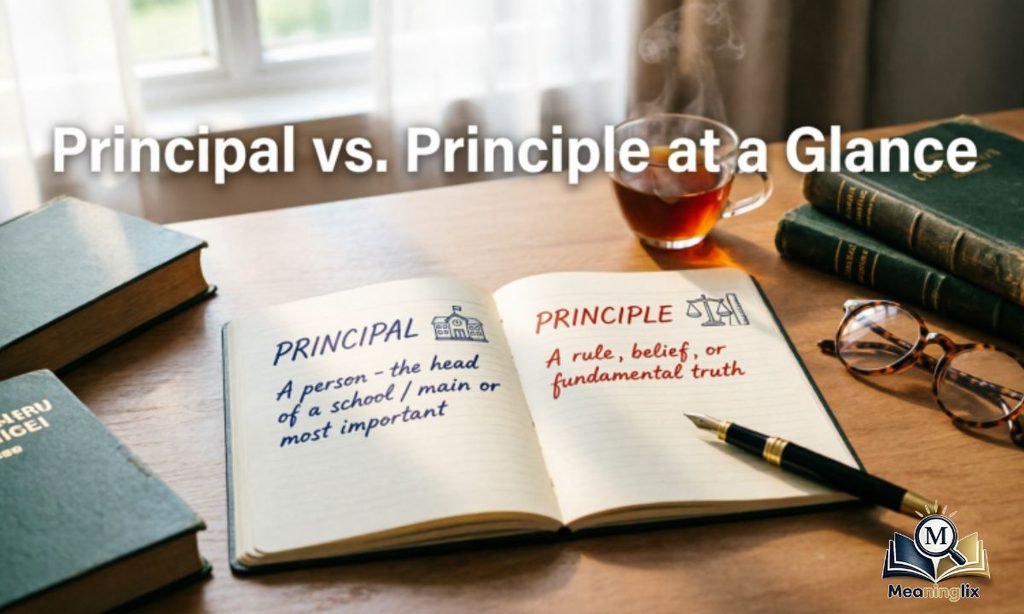
Principal vs Principle at a Glance
| Term | Part of Speech | Meaning | Typical Use | Example |
| Principal | Adjective / Noun | Main, primary, or a key person; also loan capital | Describing importance, a school leader, or loan amounts | “The principal dancer led the performance.” |
| Principle | Noun | A rule, belief, or fundamental truth | Describing ethics, laws, or scientific rules | “Honesty is one of his core principles.” |
Common Mistakes and How to Avoid Them “Principal vs Principle”
The most frequent mix-up happens in professional and academic writing, where people default to “principle” because it feels more formal, even when they mean “main.”
Incorrect: “The principle reason for the merger was cost savings.”
Correct: “The principal reason for the merger was cost savings.”
Here, the writer means “main,” so “principal” is correct. Swapping in “principle” changes the sentence from describing importance to describing a belief, which doesn’t fit.
Incorrect: “She always acts according to her principals.”
Correct: “She always acts according to her principles.”
Beliefs and values are principles, not principals. A “principal” in this sentence would incorrectly suggest she’s following actual people or a sum of money.
Incorrect: “The bank charges interest on the principle.”
Correct: “The bank charges interest on the principal.”
Loan and investment amounts are always spelled principal, never principle, because this meaning relates to money, not rules.
A quick way to remember the difference: ask yourself whether you’re talking about a person, a main thing, or money (principal) or a rule, belief, or law (principle). If you’re still unsure, try substituting “main” or “rule” into the sentence and see which one keeps the meaning intact.
Real-World Examples in Different Contexts “Principal vs Principle”
Everyday conversation Principal vs Principle:
- “I’m not doing that. It’s the principle of the thing.”
- “Who’s the new principal at your kid’s school?”
Workplace communication Principal vs Principle:
- “The principal investors will review the proposal Monday.”
- “Our company operates on the principle of transparency.”
Academic writing Principal vs Principle:
- “The principal finding of the study was a decline in enrollment.”
- “Students learned the basic principles of thermodynamics.”
Text messages or casual notes Principal vs Principle:
- “The meeting moved back to the principal‘s schedule.”
- “Not paying extra, that’s my principle lol.”
Plural Forms and Related Usage “Principal vs Principle”
Both words can be pluralized normally:
- Principals (multiple people or amounts): “The two principals signed separately.”
- Principles (multiple rules or beliefs): “The document outlines five guiding principles.”
There is no grammatical difference in how the plural is formed, just add an “s” so the challenge is purely about choosing the correct base word for the meaning you intend.
A Simple Way to Decide Which Word You Need “Principal vs Principle”
- Ask if you’re describing a person, something most important, or money. If yes, use principal.
- Ask if you’re describing a rule, belief, or law. If yes, use principle.
- When in doubt, try replacing the word with “main” or “rule.” Whichever fits naturally tells you the correct spelling.
This three-step check works for nearly every sentence you’ll encounter, from emails to essays to text messages.
FAQs “Principal vs Principle”
Is “principal” or “principle” used for a school leader?
Principal is correct. The head of a school is always spelled with an “a” , “think “principal” and “pal.”
What is the difference between principal and principle in finance?
In finance, principal refers to the original amount of money borrowed or invested, separate from interest or returns. Principle has no financial meaning at all; it only refers to a rule or belief, such as a principle of ethical investing.
Can “principal” ever mean a rule or belief?
No. Principal never means a rule or belief. If you’re describing a rule, standard, or moral belief, the correct word is always principle.
Why do principal and principle sound the same?
They’re homophones that both come from the Latin word princeps, meaning “first” or “chief.” Over time, English developed two separate spellings and meanings from that shared root, which is why they sound identical but function differently today.
Final Takeaway “Principal vs Principle”
The difference between principal and principle comes down to one clear distinction: principal relates to people, importance, or money, while principle always relates to rules or beliefs.
Keep the “pal” and “rule” mnemonics in mind, and you’ll spell both words correctly every time, whether you’re writing an email, a school report, or a text to a friend.

Alisha Lehmann is the founder and author of Meaninglix. She specializes in explaining word meanings, internet slang, abbreviations, grammar, and English expressions in simple, accurate language. Her goal is to help readers improve their vocabulary and communicate confidently through clear, well-researched, and easy-to-understand content.
1 thought on “Principal vs Principle: The Ultimate Guide to the Difference 2026”