You’re halfway through a sentence, about to add a clause, and you freeze: Which vs That? Both words seem to do the same job, so it’s easy to assume they’re interchangeable. They aren’t.
Use “that” when the clause is essential to the sentence’s meaning, and use “which” when the clause simply adds extra detail. Once you can spot the difference between essential and extra information, the choice becomes automatic.
Table of Contents
The Quick Answer “Which vs That”
Here’s the rule in one line: “that” introduces restrictive clauses (information you can’t remove without changing the meaning), and “which” introduces nonrestrictive clauses (information you could delete and the sentence would still make sense).
- The laptop that has a cracked screen is mine. (Tell you exactly which laptop is essential.)
- The laptop, which has a cracked screen, is mine. (Adds a side detail about the one laptop you own extra.)
Notice the comma. That small punctuation mark does a lot of the work, and it’s the fastest visual clue for telling the two apart.
Why This Mix-Up Happens So Often “Which vs That”
Which and that both introduce clauses that describe a noun, so they feel like synonyms. English also doesn’t mark the difference with separate word forms the way some languages do, so the only signals are word choice, punctuation, and context.
On top of that, British English is more relaxed about the rule many British writers use “which” for both essential and extra information and that flexibility bleeds into American writing through books, shows, and websites. The result is a rule that feels optional even though, in formal American English, it isn’t.
Restrictive vs. Nonrestrictive: The Core Idea
Every clause that follows a noun either narrows down which thing you mean or simply comments on a thing you’ve already identified.
A restrictive clause narrows the noun. It answers the question “which one?” and can’t be cut without losing meaning. The book that Maria recommended changed how I read. (Not just any book the one Maria recommended.)
A nonrestrictive clause comments on a noun that’s already clear. It adds a bonus fact and can be lifted out of the sentence. Maria’s new novel, which took her four years to write, changed how I read. (There’s only one “Maria’s new novel,” so the clause is just extra information.)
A simple test: read the sentence without the clause. If the core meaning survives, you need which (with commas). If the sentence becomes vague or loses its point, you need that (no commas).
Which vs That at a Glance
| Term | Clause Type | Removable? | Commas? | Example |
| That | Restrictive (essential) | No meaning changes | No commas | The chair that wobbles needs fixing. |
| Which | Nonrestrictive (extra) | Yes meaning stays the same | Set off by commas | The chair, which is an antique, needs fixing. |
The Comma Rule, Explained “Which vs That”
Punctuation isn’t decoration here, it changes what the sentence means.
No comma with “that”: That clauses are woven into the sentence, so they never get commas. Correct: “I finally found the keys that I lost last week.”
Commas around “which”: Which clauses are set apart, almost like a whispered aside, so they’re framed by commas (or occasionally dashes or parentheses). Correct: “I finally found my keys, which had been sitting in my coat pocket the whole time.”
If you drop the commas around a “which” clause, you signal that the information is essential which usually calls for “that” instead. Getting this backward is one of the most common punctuation slips in American writing.
Don’t Miss Now : HB Meaning in Text
Real-Life Examples Which vs That
Everyday conversation: Correct: “The restaurant that everyone’s talking about finally opened downtown.” Incorrect: “The restaurant, which everyone’s talking about, finally opened downtown.” (This works only if there’s just one restaurant in context; otherwise it’s vague “which restaurant?”)
Academic writing Which vs That: Correct: “The study that surveyed 500 participants found a strong correlation.” Correct: “The study, which was published last year, found a strong correlation.” (Both are grammatically fine they simply mean slightly different things.)
Workplace email Which vs That: Correct: “Please review the report that Priya sent this morning.” Correct: “The quarterly report, which is attached, covers all three regions.”
Text message Which vs That: Correct: “omg the show that we watched last night was insane”
Formal writing Which vs That: Correct: “The policy that governs remote work will be updated in January.” Correct: “The new policy, which takes effect in January, applies to all departments.”
Common Mistakes and How to Avoid Them
Mistake 1: Using “which” without commas. Incorrect: “The car which is parked outside belongs to my neighbor.” Correct: “The car that is parked outside belongs to my neighbor.” (No commas, so it needs “that.”) This happens because writers reach for “which” out of habit, forgetting that a comma-free clause should almost always start with “that.”
Mistake 2: Using “that” for information that’s clearly extra. Incorrect: “My sister that lives in Denver is visiting this weekend.” (If you only have one sister, this is unnecessary and reads oddly.) Correct: “My sister, who lives in Denver, is visiting this weekend.” Note: when the noun is a person, “who” is generally preferred over “that” in polished writing, even in restrictive clauses.
Mistake 3: Assuming the words are interchangeable. Some writers pick whichever word sounds better out loud. That works occasionally, but it can quietly change your meaning, especially in technical, legal, or academic writing where precision matters.
A simple way to remember it: if you could delete the clause and staple a comma where it used to be, use which. If deleting the clause would leave the reader asking “which one, exactly?” use that.
Formal vs. Informal Usage ( Which vs That )

In careful American English style guides, academic papers, professional reports the that/which distinction is treated as a real rule, and following it makes your writing sharper and easier to parse. In casual speech and everyday conversation, people often use “which” for both restrictive and nonrestrictive clauses without causing confusion, because tone of voice and pauses do the work that commas do on the page.
British English writers also lean on “which” more freely for essential clauses, so you’ll see it in British books and news sites in places American style guides would flag. None of this makes the informal or British usage “wrong” it just means the strict rule is an American formal-writing convention, not a universal law.
Read Also : SYBAU Meaning
Practical Guidance for Everyday Writing “Which vs That”
- Read the clause and ask: does the sentence still make sense without it? If yes, use “which” and add commas. If no, use “that” and skip the commas.
- Check for people. If the noun is a person, reach for “who” or “whom” instead of “that” whenever possible.
- When editing, look for unpunctuated “which” clauses first that’s the single most common error to fix.
- In formal documents, apply the rule consistently. Mixing styles within the same piece makes writing feel inconsistent even when each sentence is technically fine.
- When in doubt, read the sentence aloud. A natural pause before the clause usually signals you need “which” with a comma.
Related Forms Worth Knowing (Which vs That )
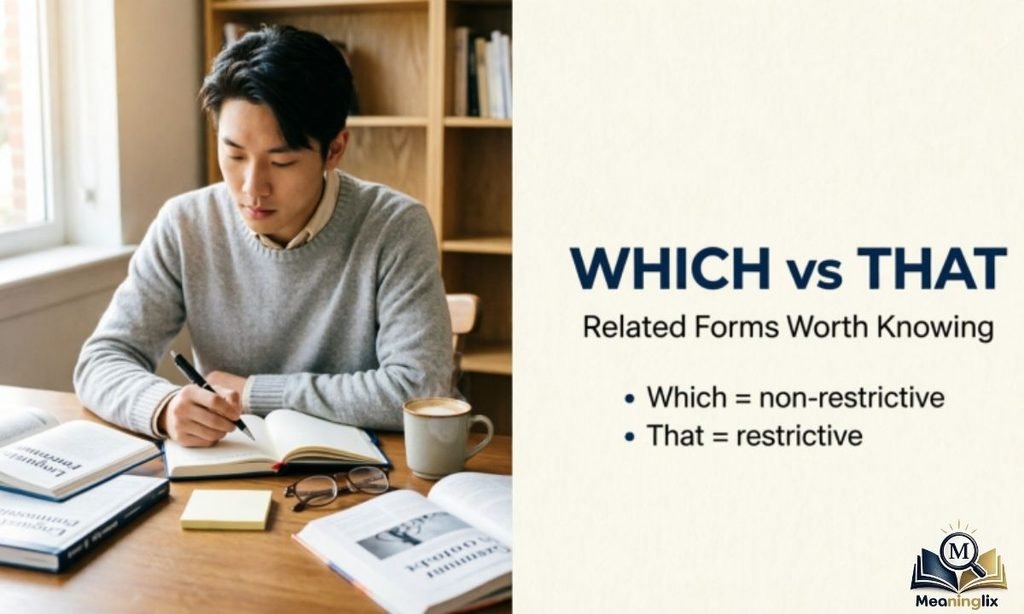
- “Who” and “whom” replace “that” or “which” when referring to people in most style guides.
- “That” as a demonstrative pronoun (“That is my desk”) is a completely different use of the word and isn’t part of this rule.
- “Which” as a question word (“Which one do you want?”) is also unrelated to restrictive and nonrestrictive clauses.
Keeping these separate uses in mind helps you avoid overthinking sentences where “that” or “which” isn’t even functioning as a relative pronoun.
Frequently Asked Questions
Is it grammatically wrong to use “which” instead of “that”?
In formal American English, yes, using “which” for an essential clause without commas is considered incorrect because it blurs necessary information with optional detail. In casual speech and in British English, this distinction is far less strict, so it’s not treated as an error in every context.
What is the difference between “which” and “that” in one sentence?
“That” introduces information the sentence needs to make sense, while “which” introduces information the sentence could live without. For example, “The email that had the attachment” identifies one specific email, while “The email, which had the attachment,” simply adds a detail about an email you’ve already identified.
Do you always need a comma before “which”?
Almost always, when “which” introduces a nonrestrictive clause. The exception is when “which” follows a preposition inside a restrictive clause, such as “the method by which it was made,” which doesn’t take a comma.
Can “that” ever refer to a person?
Yes, informally “the woman that called” is common in speech but most style guides recommend “who” for people in polished or formal writing.
The Takeaway “Which vs That”
The choice between “which” and “that” comes down to one question: is this information essential, or is it extra? Essential clauses that narrow down the noun call for that, with no commas.
Extra clauses that simply add color call for which, framed by commas. Once you start testing each clause with that question, the right word stops being a guess and becomes second nature.

Alisha Lehmann is the founder and author of Meaninglix. She specializes in explaining word meanings, internet slang, abbreviations, grammar, and English expressions in simple, accurate language. Her goal is to help readers improve their vocabulary and communicate confidently through clear, well-researched, and easy-to-understand content.
3 thoughts on “Which vs That: The Simple Rule Native Speakers Use”