
You open your inbox, read a message from a client, and type a quick reply: “Well received with thanks.” It feels polite, short, and professional. But to many native English readers, that sentence says something different from what you intended.
The phrase well received with thanks is widely used in offices across Asia, Africa, and the Middle East as a way to say “I got your message.” In everyday US and UK English, though, “well received” usually describes how an audience reacted to a speech, a film, or an idea. This guide explains the real meaning, shows when the phrase works, and gives you 15 clearer replies you can copy today.
Table of Contents
Quick Answer
Well received with thanks is understandable, but it is not the best way to confirm an email in standard English. The word “well received” normally means “met with approval.” If you only want to confirm that a message arrived, “Received with thanks,” “Noted with thanks,” or “Thank you for your email” is clearer and safer.
Here is the short version:
- Meaning of “well received”: Greeted with approval or praise.
- Is it grammatically wrong? No, but it sounds unnatural as an email acknowledgment.
- Best simple replacement: “Received with thanks.”
- Best formal replacement: “I confirm receipt of your email, and I appreciate it.”
- Best casual replacement: “Got it, thanks!”
Well Received Meaning: Praise vs Email Confirmation
“Well received” is a phrase that describes approval, not delivery. Dictionaries such as Collins define it as something that has been greeted or reviewed favorably. That is why you will see it in sentences like these:

- The new policy was well received by employees.
- Her first novel was well received by critics.
- The product launch was well received in the US market.
In each example, a group of people reacted positively. Nobody is confirming that a file arrived.
Why people use it for email anyway
Many professionals read “well” as a polite booster for “received.” They think: “I received it, and I am being extra courteous.” That logic is understandable. The phrase well received with thanks has also spread through business English courses, templates, and office habits, so it feels normal to the people who use it daily.
The problem is the second reading. A native reader may interpret “well received” as “I liked it” or “I agree with it.” If you reply to a bad news email with well received with thanks, the reader may wonder whether you are happy about the news.
Two meanings side by side
| Context | What “well received” means | Example |
| Praise or approval | The audience reacted positively | The speech was well received. |
| Email confirmation (non standard) | I got your message | Well received with thanks. |
| Possible confusion | I approve of your content | Your proposal was well received. |
A single sentence summary: In standard English, “well received” means approved, while “received” alone means delivered.
The hyphen rule
You will also see “well-received” with a hyphen. The hyphenated form usually sits before a noun, as in “a well-received film.” Without the hyphen, it usually follows the noun or a verb, as in “The film was well received.” Neither form fixes the email problem, because the meaning stays on the praise side.
Is “Well Received with Thanks” Correct in Email?
The phrase is grammatically acceptable, but it is stylistically weak and can be misread. Language forums and grammar sites generally agree on this point. They describe well received with thanks as understandable and common in some regions, yet not the recommended choice for a routine acknowledgment.
When the phrase can work
There are a few cases where well received with thanks sounds natural, because the sender really did hope for a positive reaction:
- You sent a gift, a suggestion, or feedback, and the reader is telling you it landed well.
- A manager tells a team, “Your suggestions were well received with thanks,” meaning leadership liked them.
- A donation, a note, or kind words were accepted gratefully.
In those cases, the “praise” meaning is the correct one, so nobody is confused.
When the phrase causes trouble
The phrase becomes risky in these situations:
- Replying to bad news. A layoff notice, a rejection, or a complaint should not get a reply that sounds like approval.
- Writing to native English speakers in the US, UK, Canada, or Australia. They may find it odd or overly stiff.
- Confirming a legal or financial document. Clarity matters more than courtesy here.
- Job applications and client proposals. A small phrase mistake can weaken a professional impression.
What readers actually think
Most readers will understand your intent, because context is clear. Still, using well received with thanks in a cross-cultural team can leave a faint impression of “learned English” rather than natural English. That impression is small, but it is easy to avoid.
Definition for quick reference: Well received with thanks is a nonstandard email acknowledgment that blends “received” with the praise meaning of “well received.”
Received With Thanks vs Well Received With Thanks
“Received with thanks” confirms delivery and expresses gratitude, while “well received with thanks” adds an approval signal that may not be intended. The difference is one word, but it changes the message.
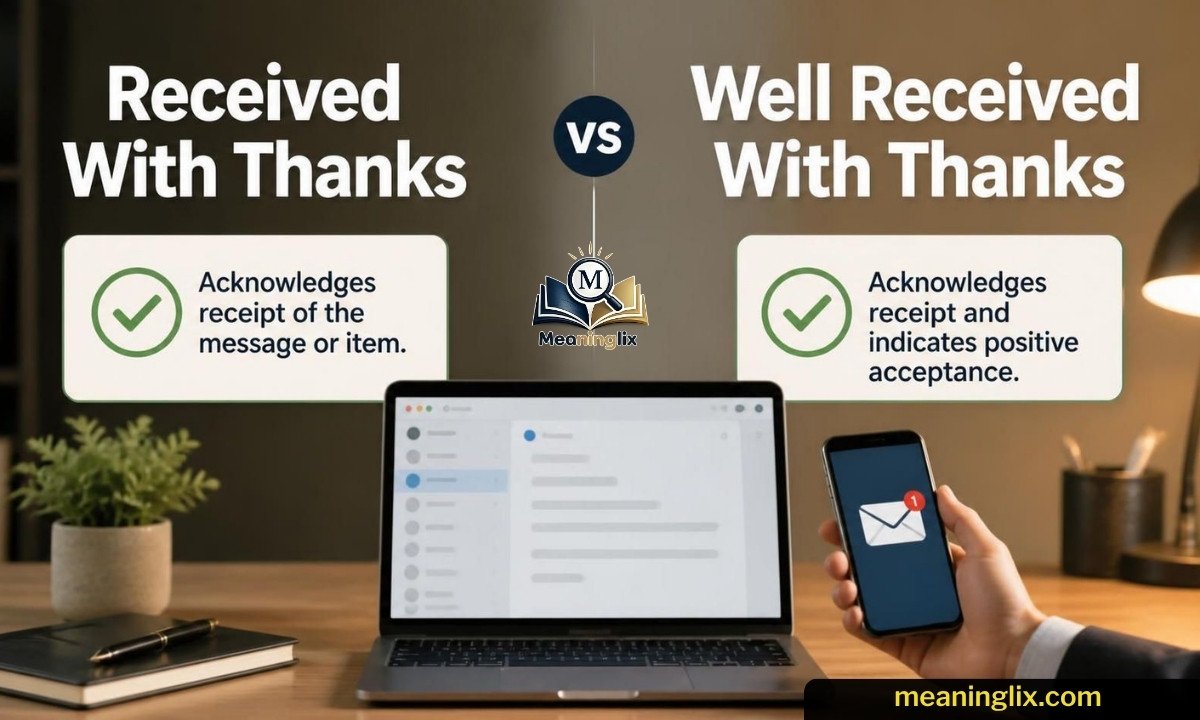
Side by side comparison
| Feature | Received with thanks | Well received with thanks |
| Core meaning | I got it and I am grateful | I got it and it was liked or approved |
| Best use | Emails, payments, documents, gifts | Feedback, ideas, gifts that earned praise |
| Risk of confusion | Low | Medium to high |
| Tone | Neutral and polite | Warm but ambiguous |
| Native speaker comfort | High | Moderate |
Why “received with thanks” works better
The expression “received with thanks” has a long history on receipts and payment slips, where it simply means the item or money arrived and the receiver is grateful. Because that use is old and stable, readers understand it quickly.
A sentence like “Your proposal is received with thanks” tells the sender two things: the proposal arrived, and you appreciate it. It does not claim you approve of the content. That is exactly what most office replies need.
A simple rule to remember
- If you want to say “it arrived,” use received or noted.
- If you want to say “it was liked,” use well received or a plain sentence like “We liked it.”
Using well received with thanks mixes both ideas, which is why it feels blurry.
What about “noted with thanks” and “well noted”?
“Noted with thanks” is a close cousin. It tells the sender that you have read the point and recorded it. Many grammar resources treat “noted with thanks” as a safer formal option than well received with thanks. “Well noted” is also common in business English, although some readers find it slightly stiff. When in doubt, choose “Noted with thanks” or the plain “Thank you for your email.”
Examples
Good email replies are short, specific, and match the situation. Below are 15 better replies to use instead of well received with thanks, grouped by tone.
Everyday professional replies
- Received with thanks. Simple, polite, and correct for most emails. Example: “Received with thanks. I will review the report this afternoon.”
- Noted with thanks. Confirms you have read and recorded the information. Example: “Noted with thanks. I have updated the schedule.”
- Thank you for your email. The safest all purpose reply. Example: “Thank you for your email. I will respond by Friday.”
- Thanks for sending this over. Friendly and natural. Example: “Thanks for sending this over. It helps a lot.”
- I have received your message. Clear and direct. Example: “I have received your message and will follow up shortly.”
Formal replies
- I confirm receipt of your email. Good for contracts and official records. Example: “I confirm receipt of your email dated October 28.”
- This is to acknowledge receipt of your document. Common in legal and administrative writing. Example: “This is to acknowledge receipt of your application.”
- Acknowledged with thanks. Polite and brief for managers and clients. Example: “Acknowledged with thanks. We will proceed as agreed.”
- Your email has been duly noted. Formal, suitable for complaints or policy matters. Example: “Your concern has been duly noted and shared with the team.”
- I sincerely appreciate you sending this. Warm and professional. Example: “I sincerely appreciate you sending the updated figures.”
Casual or friendly replies
- Got it, thanks! Best for coworkers you know well.
- Message received. Quick and clear, often used in team chats.
- Thanks, I have it. Natural for short follow ups.
- All good, thank you. Relaxed and friendly.
- Perfect, thanks for the update. Positive when you do approve of the news.
Quotable tip: Match the reply to the relationship, because a formal phrase to a close teammate can sound cold, and a casual phrase to a client can sound careless.
Choosing by situation
| Situation | Best reply |
| Invoice or payment | Received with thanks |
| Meeting notes | Noted with thanks |
| Contract or legal file | I confirm receipt of your email |
| Complaint | Your email has been duly noted |
| Quick team update | Got it, thanks! |
| Praise or feedback you liked | Thank you, this is helpful |
Sample emails
Example 1: Client sends project files
Hi Maria, Received with thanks. I will review the files and send my comments by Wednesday. Best regards, Ali
Example 2: Manager shares a policy change
Hello Mr. Khan, Noted with thanks. I will share the update with my team today. Kind regards, Sara
Example 3: Feedback you actually liked
Hi Tom, Thank you for the feedback. Your suggestions were well received by the team, and we will use them in the next draft. Best, Dana
Notice that the third example uses “well received” in its true meaning, which is approval by a group.
Common Mistakes
Most mistakes with this phrase come from mixing up delivery and approval. Here are the errors that appear most often in business email.
Mistake 1: Using it as a plain “I got it”
Writing well received with thanks as a stand alone reply can sound like you liked the content. Replace it with “Received with thanks.”
Mistake 2: Replying to bad news with praise language
If someone shares a delay, a rejection, or a complaint, avoid any phrase that signals approval. Use “Noted with thanks” or “Thank you for letting me know.”
Mistake 3: Adding too many extras
Phrases like “well received with many thanks and highest regards” feel heavy. Short replies read better and look more confident.
Mistake 4: Forgetting the hyphen rule
- Correct: “The film was well received.”
- Correct: “It was a well-received film.”
- Awkward: “A well received film.”
Mistake 5: Overusing the same phrase
Sending well received with thanks to every message makes your writing repetitive. Mix in two or three alternatives so your tone stays natural.
Mistake 6: Ignoring the reader’s culture
Teams in different countries read English differently. If your readers are mostly in the US or UK, choose the plain forms. If your readers are in a region where well received with thanks is common, the phrase may still work, but a clearer option helps everyone.
Mistake 7: Skipping the actual answer
A confirmation is not always enough. If the sender asked a question or requested action, add one line about your next step.
- Weak: “Well received with thanks.”
- Better: “Received with thanks. I will send the approval by noon tomorrow.”
How AI Grammar Buddy Can Help
A grammar checker can catch unnatural phrasing before you press send. A tool like AI Grammar Buddy can review a short reply, flag expressions that sound unusual in standard English, and suggest cleaner versions. That is useful when you are unsure whether well received with thanks fits your message.
Here are practical ways to use a tool like this:
- Phrase checks: Paste your draft and ask whether the wording sounds natural for a US audience.
- Tone adjustment: Switch a reply between formal, neutral, and friendly.
- Alternative suggestions: Get several ways to say “I received your email” without repeating yourself.
- Learning support: See short explanations of why a phrase is awkward, so you improve over time.
A tool is a helper, not a replacement for judgment. Always read the final sentence and ask yourself one question: “Does this say what I mean?” If the answer is yes, send it.
FAQ
These quick answers cover the most common doubts about the phrase.
- Is the phrase rude? No. It is polite, but it can sound unusual.
- Will people understand it? Usually yes, especially in international workplaces.
- Is it safe for job applications? A clearer option is safer.
- What is the cleanest swap? “Received with thanks.”
- Can it ever be right? Yes, when you truly mean that something was liked or accepted gratefully.
Think of well received with thanks as a phrase with a narrow sweet spot. It fits praise and gratitude together, but it does not fit simple email confirmation as well as people assume. In short, well received with thanks works best when real approval is part of the message.
Final Takeaway
The phrase well received with thanks is common, friendly, and understandable, but it is not the best tool for confirming an email. In standard English, “well received” points to approval, so the sentence can accidentally suggest that you liked the message. Choosing “Received with thanks,” “Noted with thanks,” or “Thank you for your email” removes that doubt in a single step.
Good business writing is about clarity first and style second. Keep a short list of go to replies, match each one to the situation, and add one line about your next step when action is needed. If you use well received with thanks, use it where praise is truly meant, and your messages will sound natural to every reader.
Frequently Asked Questions
Can I say well received with thanks?
Yes, you can say well received with thanks, and most readers will understand it. However, it is more natural to say “received with thanks” when you only want to confirm that something arrived.
What can I say instead of well received?
You can say “received with thanks,” “noted with thanks,” “thank you for your email,” or “I confirm receipt.” Each option confirms delivery without implying approval.
Is it grammatically correct to say “received with thanks”?
Yes, “received with thanks” is grammatically correct and commonly used in emails, receipts, and formal notes. It means the item or message arrived and the receiver is grateful.
Which is correct: “received” or “well received”?
“Received” is correct for confirming delivery, while “well received” is correct for describing approval or a positive reaction. Use “received” for emails and “well received” for speeches, products, and ideas.

Alisha Lehmann is the founder and author of Meaninglix. She specializes in explaining word meanings, internet slang, abbreviations, grammar, and English expressions in simple, accurate language. Her goal is to help readers improve their vocabulary and communicate confidently through clear, well-researched, and easy-to-understand content.
1 thought on ““Well Received With Thanks”: Meaning + 15 Better Replies”