You see “SMS” on your phone almost every day. It appears in the compose box, in bank alerts, in settings menus, and in the small label under a message that says “Sent as SMS.” Most people know it has something to do with texting, but the exact meaning stays fuzzy. Is it the same as a text message? How is it different from MMS? And why does your phone suddenly say it sent your message this way?
This guide answers all of that in plain English. You will learn what SMS means, how it shows up on Android, Samsung, iPhone, Instagram and Snapchat, where it came from, and when it is the right choice. We also cover what changed in 2026, because RCS has changed what a green bubble really means.
Table of Contents
Quick Answer:
SMS stands for Short Message Service. It is the standard text message sent over your mobile carrier’s network using a phone number, not an app or the internet. One SMS carries plain text only, up to 160 characters. In daily use, “SMS,” “text,” and “text message” mean the same thing.
What Does SMS Mean in Text?
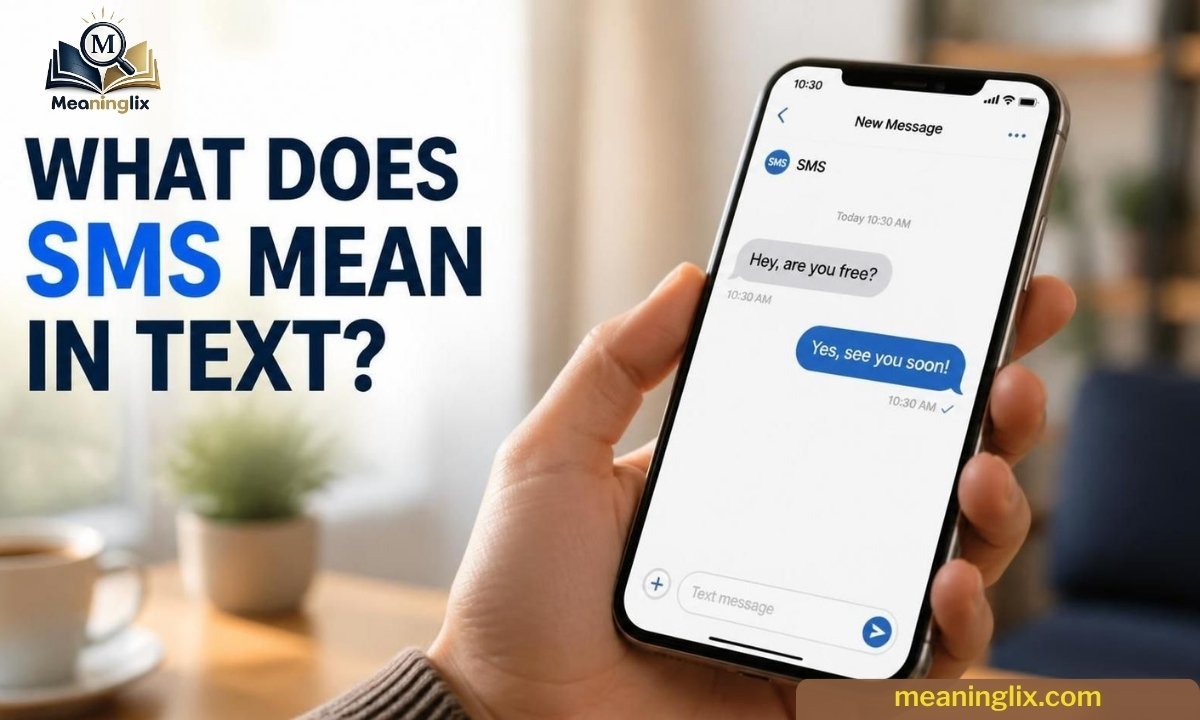
In text, SMS simply means a regular text message. When a friend says “send me an SMS,” they want a normal text to their phone number. When your phone says “SMS,” it is telling you the message travels through the cellular network instead of through an app like WhatsApp or Instagram.
It is a technical label, not slang. That is why you see it in settings, bank alerts and phone screens more than in casual chats.
SMS meaning MMS
MMS stands for Multimedia Messaging Service. SMS handles plain text. MMS handles pictures, videos, audio clips and group messages. If you add a photo to a text, your phone quietly switches from SMS to MMS. MMS needs a data connection, while plain SMS works with just a basic mobile signal.
What is SMS on Android
On Android, SMS is the default texting method used by your messaging app, usually Google Messages. The send button or the compose field often shows whether the message will go as SMS, MMS or RCS. If you see “SMS,” your text is going out as a classic carrier message.
Sent as SMS meaning
“Sent as SMS” means your message was delivered through the carrier network instead of through data. It usually appears when the other person does not have RCS or iMessage, when your internet is weak, or when chat features are switched off. It does not mean something is wrong. It only describes the route the message took.
SMS meaning Samsung
On Samsung Galaxy phones, SMS means the same thing: a standard text message. Newer Galaxy phones use Google Messages as the default app, so the labels match other Android phones. Samsung settings also let you control MMS size limits and whether long texts split into several SMS messages or send as one MMS.
SMS meaning Instagram
Instagram direct messages are not SMS. They travel over the internet inside the app. On Instagram, SMS mostly appears when the app texts you a login code, a phone confirmation or a two factor security code. If you see “SMS” there, it means the code arrives as a normal text message.
| Also Read These Meaning Slang |
| FWU Meaning in Text: Discover What This Slang Means! |
| YNS Meaning in Text: Discover What This Slang Means! |
What Is the SMS Full Form?
The full form of SMS is Short Message Service. It belongs to a small family of messaging terms that are easy to mix up.
| Term | Full Form | What It Carries |
| SMS | Short Message Service | Plain text |
| MMS | Multimedia Messaging Service | Photos, video, audio, group texts |
| RCS | Rich Communication Services | Rich chat features inside the default app |
| GSM | Global System for Mobile Communications | The network standard SMS grew from |
What Does SMS Stand For?
Each word in the name explains the idea:
- Short: messages were built to be brief, around 160 characters.
- Message: a written note sent from one phone number to another.
- Service: a feature your mobile carrier provides, not an app you install.
That last point matters. SMS does not depend on the other person having a specific app. If they have a phone number and a signal, they can receive it.
Is SMS Rude, Offensive, or Neutral?
SMS is completely neutral. It is a technology label, not a slang word, so it carries no tone of its own. Nobody will read “I’ll send you an SMS” as rude.
There is one small exception. In some casual online circles, “SMS” is used as a joke acronym for “Send Me Something,” usually about snacks or small gifts. It is rare, and context makes it obvious. In normal texting, SMS means Short Message Service.
Where Is SMS Commonly Used?
SMS is still one of the most widely used messaging channels because it reaches nearly every phone. Here are the main places you will see it.
Personal Communication
Friends and family still use SMS when they do not share a chat app. It works across iPhone, Android and basic phones without any setup.
Verification Codes
Apps and websites send one time passcodes by SMS to confirm it is really you. These codes usually expire within minutes.
Banking Alerts
Banks send balance notices, card purchase alerts and fraud warnings by SMS. It works even without an internet connection.
Appointment Reminders
Clinics, salons and service providers send short reminders. People open text messages quickly, so reminders cut down on missed visits.
Delivery Notifications
Couriers and stores text you when your order ships, when it is out for delivery and when it arrives.
Marketing Messages
Brands send offers and promo codes by SMS. Businesses in the USA need your permission first, and you can usually reply STOP to opt out.
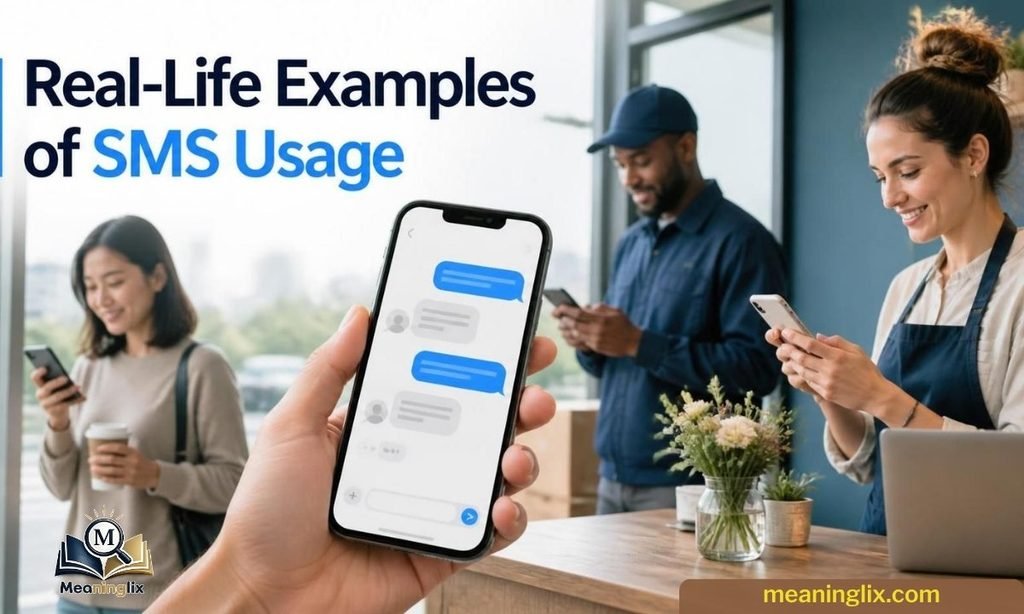
Real-Life Examples of SMS Usage
Friendly Example
“Running ten minutes late, save me a seat!” This is a plain text sent from one phone number to another.
Casual Example
“Did you get my SMS about dinner?” Here the person just means a text message.
Business Example
“Your appointment is confirmed for Thursday at 3 PM. Reply C to confirm or R to reschedule.”
Security Example
“Your verification code is 482915. Do not share this code with anyone.” Never share a code like this, even if the sender claims to be from support.
Social Media Example
“We sent a login code by SMS to the number ending in 42.” This is how platforms confirm your identity before letting you in.
What does SMS mean Snapchat
Snapchat chats and Snaps do not use SMS. They move over data inside the app. SMS shows up when Snapchat texts you a verification code, a login confirmation or a password reset code. If you see “SMS” in Snapchat settings, it refers to receiving that code as a regular text.
Origin and Background of SMS
SMS grew out of the GSM mobile network standard in the 1980s. Engineers found that the network had spare signaling capacity, and they used it to carry short written notes. The 160 character limit came from research suggesting that most short messages, like postcards or telex notes, fit within that length.
The first SMS was sent on December 3, 1992, when engineer Neil Papworth sent “Merry Christmas” to a colleague at Vodafone. Early phones could not even send texts at first, only receive them. By the late 1990s, texting had exploded, and it shaped slang, abbreviations and the way people write short messages.
SMS vs Text Message
In everyday speech, there is no difference. SMS is the technical name, and “text message” is the friendly name. Apple’s own Messages app simply calls it a text message.
The difference appears on smartphones. A “text message” on your screen might travel as SMS, MMS, RCS or iMessage, depending on the app and the person you are texting. SMS is only one of those routes.
SMS vs MMS
| Feature | SMS | MMS |
| Content | Plain text | Photos, video, audio, group chats |
| Network | Carrier cellular network | Carrier network plus data connection |
| Length | 160 characters per message | Much longer, varies by carrier |
| Cost on many plans | Usually cheaper | Can cost more |
| Media quality | Not applicable | Often compressed and blurry |
Photos sent by MMS often look blurry because carriers compress them to keep file sizes small. If quality matters, use a chat app or RCS between supported phones.
SMS vs iMessage and Other Chat Services
iMessage is Apple’s own service. It runs over Wi-Fi or cellular data and only works between Apple devices. Messages appear in blue bubbles. WhatsApp, Telegram and Signal also run over the internet and need the app on both ends.
| Service | How It Travels | Needs Same App | Typical Bubble or Label |
| SMS | Carrier network | No | Green on iPhone |
| MMS | Carrier network and data | No | Green on iPhone |
| RCS | Data, inside default app | No, but needs support | Green on iPhone |
| iMessage | Internet | Yes, Apple devices | Blue |
| Internet | Yes | App specific |
What changed in 2026
This is where many older guides are out of date. RCS now works between iPhone and Android in many places, so a green bubble no longer always means plain SMS. Your phone shows richer features like typing indicators, read receipts and better photo quality when both sides and the carrier support RCS. If something is missing, the chat falls back to SMS or MMS.
Carriers are also moving toward RCS for business messages, with verified brand names, logos and tap buttons. Reports say some European networks, including in Germany, are phasing out MMS in 2026. SMS stays as the universal backup because it reaches almost every phone.
To check your setting on iPhone, open Settings, tap Apps, tap Messages, then look for RCS Messaging. On Android, open Google Messages, then Settings, then RCS chats.
When Should You Use SMS?
Use SMS when reliability matters more than features:
- The other person does not use your chat app.
- You have weak internet or a low data plan.
- You are roaming or traveling.
- You need a message to reach an older or basic phone.
- You are receiving verification codes or alerts.
When Should You Avoid SMS?
Avoid SMS when privacy or quality matters:
- You are sharing sensitive documents, passwords or ID details.
- You want high quality photos or videos.
- You need end to end encryption.
- You are in a large mixed group chat with iPhone and Android users, since it can fall back to MMS and act up.
- You are sending long messages that may split into several parts.
Why Do People Use the Term SMS?
People use SMS because it is short, widely understood and slightly more precise than “text.” Phones, carriers and businesses use the label to separate carrier texts from app chats. In many countries outside the USA, “SMS” is the everyday word for a text, so you will hear it from international friends and colleagues.
Businesses also use it because it sounds official. “SMS alerts” feels more formal than “texts,” which is why banks and service providers prefer it.
Impact of SMS on Communication
SMS changed how the world talks. It made short, fast, written communication normal. It created shorthand like “LOL,” “BRB” and “TTYL,” and it pushed people to say more with fewer words.
For business, SMS became a direct line to customers. Messages get opened quickly, which is why reminders, alerts and delivery updates rely on it. Even with chat apps everywhere, SMS remains the common thread because it needs nothing but a phone number.
Is SMS Safe for Social Media?
SMS is convenient for logging in to social media, but it is not the safest option. Standard SMS is not end to end encrypted, which means it is not protected from third parties while it travels between devices. Scammers also use fake texts, called smishing, to steal login codes.
Here are practical ways to stay safe:
- Never share a verification code with anyone.
- Do not tap links in unexpected texts.
- Use an authenticator app for two factor security when the platform offers it.
- Add a carrier account PIN to reduce the risk of SIM swap fraud.
- Block and report suspicious numbers.
SMS codes are still better than no second step at all. They are just not the strongest choice.
SMS Meaning in Different Contexts
| Context | What SMS Means |
| Texting | A standard text message |
| Android | Carrier based text, shown as SMS in Google Messages |
| iPhone | Green bubble text, unless RCS is active |
| Banking | An alert or code sent to your phone number |
| Social media | A login or verification code by text |
| Business | A marketing or service message to a phone number |
| Slang | Rarely, “Send Me Something” |
Common Mistakes About SMS
- Thinking SMS is an app. It is a carrier service built into your phone.
- Assuming green always means SMS. In 2026, green can also mean RCS.
- Believing SMS needs internet. Plain SMS does not, though MMS does.
- Thinking Instagram or Snapchat chats are SMS. They use data inside the app.
- Trusting every code request. Real companies never ask you to read a code back to them.
- Assuming SMS is private. It is not end to end encrypted.
FAQs:
What is the difference between a text message and an SMS?
In daily use, nothing. A text message is an SMS. The only difference is that “text message” is the casual phrase and “SMS” is the technical one. On smartphones, a text might also travel as MMS, RCS or iMessage.
Why are my texts being sent as SMS?
Your message likely fell back to SMS because the other person does not use iMessage or RCS, your data connection is weak, or those features are turned off. Group chats with mixed devices also fall back often. Check your messaging settings and make sure RCS is on if both phones support it.
Does SMS mean you’re blocked?
No. “Sent as SMS” or “Sent as Text Message” only describes how the message traveled. It is not proof of blocking. It usually means the other person cannot receive an app based message at that moment.
Should I use SMS or MMS?
Use SMS for plain text, since it is simple, reliable and often cheaper. Use MMS when you need to send photos, videos or group messages and the other phone does not support better options. For high quality media, use RCS or a chat app.
Conclusion
SMS means Short Message Service. It is the basic text message that travels over your carrier’s network from one phone number to another. It is not rude, not slang and not tied to any app. You will see it in texting, banking, shopping, Android and Samsung settings, and in login steps for apps like Instagram and Snapchat.
In 2026, SMS still matters because it reaches almost everyone, even as RCS adds richer features. Use SMS when you need reliable delivery, use chat apps or RCS when you need quality and privacy, and always keep verification codes to yourself.

Alisha Lehmann is the founder and author of Meaninglix. She specializes in explaining word meanings, internet slang, abbreviations, grammar, and English expressions in simple, accurate language. Her goal is to help readers improve their vocabulary and communicate confidently through clear, well-researched, and easy-to-understand content.