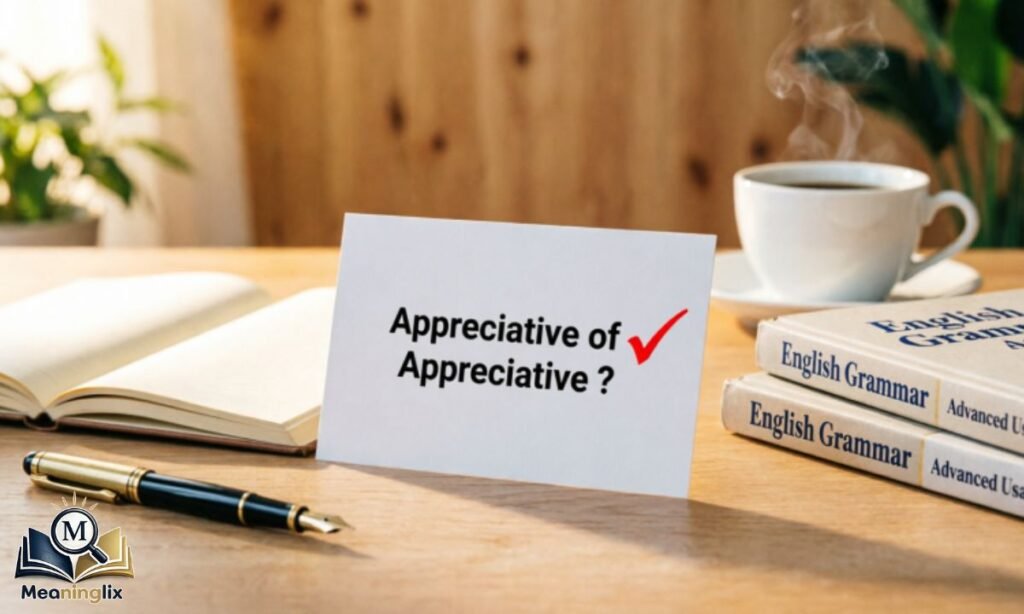
Have you ever typed “I am appreciative for your help” and then paused, unsure if it actually sounds right? You’re not alone. This is one of the most common preposition mix-ups in English, and it trips up native speakers just as often as learners.
The short answer: “appreciative of” is the standard, grammatically correct form, while “appreciative for” is a common but non-standard variation that occasionally shows up in casual speech.
But there’s more nuance here than a simple right-or-wrong rule. In this guide, you’ll learn exactly what “appreciative” means, when each preposition works, why the confusion exists in the first place, and how to use both phrases with total confidence in emails, conversations, and formal writing alike.
Table of Contents
Appreciative of or Appreciative Meaning
Before comparing the two phrases, it helps to pin down what “appreciative” actually means on its own.
“Appreciative” is an adjective that describes a state of recognizing, valuing, or being grateful for something. It comes from the verb “appreciate,” which carries two related meanings:
- To recognize the value, quality, or significance of something
- To be thankful for something someone did or gave
When you say “I am appreciative,” you’re describing an internal feeling a mix of recognition and gratitude. But adjectives like this rarely stand alone; they need a preposition to connect them to the thing being appreciated. That’s where “of” and “for” enter the picture, and where most of the confusion begins.
Click Here To Read another Topic
Appreciative of or Appreciative for: Why So Much Confusion?
If both phrases are trying to say roughly the same thing, why does one sound “off” to careful writers?
There are a few real reasons this mix-up is so widespread:
- Overlap with similar words. “Appreciative” lives in the same emotional territory as “grateful” and “thankful,” and both of those words naturally pair with “for” (“grateful for,” “thankful for”). Your brain borrows the pattern before your grammar instinct can object.
- Spoken English is forgiving. In casual conversation, “appreciative for” often slips by unnoticed because tone and context fill in the gaps.
- Regional and generational habits. Some speakers grew up hearing “appreciative for” used loosely and simply repeat the pattern without questioning it.
- Preposition rules aren’t intuitive. English prepositions rarely follow a single logical rule; they’re often a matter of convention rather than logic, which makes them one of the hardest parts of the language to master.
Understanding why the mix-up happens is the first step toward never making it yourself.
What “Appreciative” Really Means

At its core, “appreciative” signals awareness and recognition, not just emotional thanks. Gratitude may follow, but recognition comes first.
Here’s the distinction in plain terms:
| Word | Core Meaning | Typical Preposition |
| Appreciative | Recognizing value, effort, or quality | of |
| Grateful | Feeling thankful, often emotionally | for |
| Thankful | Expressing thanks, often informally | for |
Notice that “grateful” and “thankful” are built to pair with “for,” while “appreciative” is built to pair with “of.” That single difference explains almost the entire debate.
Think of “appreciative” as a spotlight: it shines attention on a specific person, action, quality, or thing. That’s exactly the kind of relationship the preposition “of” is designed to express.
Appreciative of: The Most Natural and Standard Form
What “Appreciative of” Means
“Appreciative of” means recognizing, valuing, or being thankful for a specific person, action, quality, or situation. The word “of” links the feeling directly to its object, creating a clean, complete sentence.
Example: “I am appreciative of your patience.” Here, “of” ties your appreciation directly to “your patience” , the exact thing being recognized.
When You Should Use “Appreciative of”
Use “appreciative of” whenever you want to:
- Acknowledge someone’s effort, skill, or contribution
- Express recognition in professional or formal writing
- Describe gratitude toward a specific quality, action, or opportunity
- Write with grammatical precision that will hold up under editing
This is the version recommended by dictionaries, grammar guides, and style editors, so it’s the safest default in almost every situation.
Concrete Use Cases
“Appreciative of” fits naturally in:
- Professional emails and workplace communication
- Academic writing and formal essays
- Thank-you notes and letters of recognition
- Performance reviews and recommendation letters
- Public speeches and formal acknowledgments
Sentence Examples Using “Appreciative of”
- We are appreciative of your continued partnership.
- She felt appreciative of the quiet morning silence.
- I’m truly appreciative of the effort you put into this project.
- They were appreciative of the team’s flexibility during the deadline crunch.
- He remained appreciative of the second chance he was given.
- Students were appreciative of the extra time on the exam.
Why “of” Works Here
Grammatically, “of” expresses a relationship of belonging, origin, or connection. When you’re appreciative, your feeling is connected to something specific: a person, a quality, an action. “Of” is the preposition English uses to express exactly that kind of link, which is why it pairs so naturally with recognition-based adjectives like “appreciative,” “aware,” “conscious,” and “proud.”
Appreciative for: Less Common but Not Always Wrong

What “Appreciative for” Means
“Appreciative for” attempts to express general thankfulness for something, similar to how “grateful for” or “thankful for” work. It’s not considered standard English, but it does appear in casual speech and informal writing.
When “Appreciative for” Is Acceptable
There are a few situations where “appreciative for” slides by without much objection:
- In casual conversation or texting, where strict grammar rules relax
- When a speaker is clearly borrowing the rhythm of “thankful for” or “grateful for”
- In quick, informal notes where tone matters more than precision
Even then, it’s better described as “tolerated” rather than “correct.”
When It Sounds Wrong or Awkward
“Appreciative for” starts to sound noticeably off in:
- Formal emails and business correspondence
- Academic papers, reports, or essays
- Published content, articles, and books
- Any writing that will be reviewed or edited
In these contexts, “appreciative for” is likely to be flagged and corrected.
Correct and Incorrect Examples
| Incorrect / Awkward | Correct / Standard |
| I am appreciative for your support. | I am appreciative of your support. |
| She is appreciative for the feedback. | She is appreciative of the feedback. |
| We are appreciative for your patience. | We are appreciative of your patience. |
| He was appreciative for the second chance. | He was appreciative of the second chance. |
Sentence Examples Using “Appreciative for”
These sentences show how “appreciative for” is actually used in casual speech, even though “of” remains the recommended choice:
- “I’m really appreciative for everything you’ve done.” (informal speech)
- “She said she was appreciative for the surprise gift.” (casual retelling)
- “We’re appreciative for the community’s support.” (informal social post)
Notice that each of these could be smoothly swapped to “appreciative of” without losing any meaning which is exactly why editors recommend making that swap.
How Meaning Changes: Appreciative of vs Appreciative for
Meaning Shift in Simple Words
The meaning difference is subtle but real:
- Appreciative of highlights recognition of a specific quality, action, or contribution.
- Appreciative for leans toward general thankfulness, closer to how “grateful for” functions, but without the grammatical backing to support it.
In other words, “of” points at something precise; “for” gestures at something more general and diffuse.
Side-by-Side Comparison
| Aspect | Appreciative of | Appreciative for |
| Grammatical status | Standard, widely accepted | Non-standard, informal |
| Best used in | Formal and professional writing | Casual speech only |
| Meaning focus | Specific quality, action, or object | General thankfulness |
| Editor/style guide support | Strong | Minimal to none |
| Risk in formal writing | Low | High |
How Prepositions Build Meaning
Prepositions aren’t just filler words, they carry real grammatical weight. “Of” expresses connection, origin, or belonging, which is why it attaches naturally to recognition-based feelings. “For” expresses purpose, benefit, or reason, which is why it attaches naturally to emotional-thanks words like “grateful” and “thankful.”
Because “appreciative” sits closer to the recognition category than the pure-emotion category, “of” is the grammatically logical partner.
Historical and Modern Usage Trends
Key Historical Trends
Dictionaries, literature, and formal writing have used “appreciative of” consistently for generations. It’s the version you’ll find in:
- Merriam-Webster and other major dictionaries
- Classic and contemporary literature
- Academic style guides
- Professional writing manuals
Usage data collected from language corpora and tools tracking word frequency over time consistently shows “appreciative of” appearing far more often than “appreciative for” across decades of published English.
Modern Spoken English
In everyday conversation, the line has blurred somewhat. Because “grateful for” and “thankful for” are so common, some speakers unconsciously apply that same “for” pattern to “appreciative.” This is especially common in:
- Quick verbal exchanges
- Social media captions
- Text messages and informal chats
Even so, when people slow down and write formally, most naturally correct themselves back to “appreciative of” a sign that the standard form still feels right, even to speakers who slip up in casual talk.
Common Mistakes Learners Make
Mistake 1: Treating “Appreciative” Like “Grateful”
Because “grateful” and “appreciative” express similar emotions, learners often assume they follow the same grammar rules. They don’t. “Grateful” pairs with “for”; “appreciative” pairs with “of.” Memorizing them as a matched pair, rather than interchangeable synonyms, avoids this trap.
Mistake 2: Overcorrecting in Formal Writing
Some learners, once they realize “appreciative for” is wrong, swing too far the other way and force “of” into sentences where a full rewrite would sound more natural for example, restructuring a sentence entirely rather than simply swapping the preposition. The fix is usually simpler than it seems: just replace “for” with “of” and check that the rest of the sentence still flows.
Mistake 3: Mixing Contexts
Writers sometimes blend “appreciative of” with structures meant for “grateful for,” creating awkward hybrid sentences like “I am appreciative for of your help.” Keep the two expressions structurally separate:
- Appreciative of + noun/gerund
- Grateful for + noun/gerund
Mistake 4: Hearing It in Speech and Copying It Into Writing
Because “appreciative for” is common in spoken English, many writers copy that pattern directly into emails, essays, or reports without realizing spoken habits don’t always transfer cleanly to formal writing. Reading your sentence aloud in a “formal voice” often reveals the mismatch.
Easy Rules to Remember
Rule #1:
Default to “appreciative of” in every formal or professional context. It’s the safe, standard choice almost 100% of the time.
Rule #2:
If you can swap in “grateful for” or “thankful for” without changing the meaning, you’re describing pure gratitude and consider whether “grateful” might actually be the better word choice.
Rule #3:
Use “of” whenever you’re pointing at a specific person, action, quality, or opportunity. “Of” connects your feeling directly to its object.
Rule #4:
In casual speech, “appreciative for” may slip by, but avoid it in anything you plan to publish, submit, or send professionally.
Rule #5:
When editing your own writing, search for “appreciative for” and replace it with “appreciative of” as a quick, reliable proofreading habit.
Case Studies: Real-World Examples
Case Study 1: Corporate Email
A project manager drafted this line in a client email: “We are appreciative for your continued business.” During proofreading, the line was corrected to: “We are appreciative of your continued business.” The revision made the sentence read as more polished and professional, matching the tone expected in client-facing communication.
Case Study 2: Personal Message
A friend texted: “I’m so appreciative for you being there for me.” In casual texting, this passed without any pushback as a good example of how “appreciative for” survives comfortably in informal, personal contexts where tone matters more than strict grammar.
Case Study 3: Teacher Feedback
A student wrote in an essay: “I am appreciative for the opportunity to learn.” The teacher marked it and suggested: “I am appreciative of the opportunity to learn.” This is a common correction in academic settings, where precise grammar directly affects grading.
Case Study 4: Social Media Post
A small business posted: “We’re appreciative for all our loyal customers this year!” While the post performed well and no one seemed to notice the grammar, a brand-conscious editor later revised it to “We’re appreciative of all our loyal customers this year!” for the company’s official blog, since published brand content calls for stricter grammatical accuracy than a quick social caption.
Expert Quote
As one grammar educator puts it, “Appreciative signals recognition first and gratitude second. Once you internalize that ‘of’ connects your recognition to its object, the choice between ‘of’ and ‘for’ stops being a guessing game and becomes automatic.”
Frequently Asked Questions
Is it appreciative for or appreciative of?
“Appreciative of” is the correct, standard form. “Appreciative for” is common in casual speech but is not considered grammatically standard.
What does I am appreciative of mean?
It means you recognize and value something specific a person’s effort, a quality, an opportunity, or an action combined with a sense of gratitude toward it.
How do you use appreciative in a sentence?
Pair it with “of” followed by a noun or gerund, such as “I am appreciative of your help” or “She was appreciative of receiving the award.”
How to be appreciative of someone?
Recognize their specific effort or quality, acknowledge it directly, and express thanks using phrases like “I’m appreciative of your support” or “I’m appreciative of everything you did.”
Conclusion
The debate between “appreciative of” and “appreciative for” comes down to one simple takeaway: “appreciative of” is the grammatically correct, dictionary-supported standard, while “appreciative for” is a casual slip that borrows its pattern from words like “grateful” and “thankful.”
In formal writing, professional emails, academic work, and anything you plan to publish, stick with “appreciative of.” In relaxed conversation or texting, “appreciative for” may pass unnoticed, but building the habit of using “of” will make your English sound sharper, more precise, and more polished no matter the setting.
Once you internalize that “appreciative” is about recognition, and that “of” is the preposition built to express that connection, you’ll never have to second-guess this phrase again.

Alisha Lehmann is the founder and author of Meaninglix. She specializes in explaining word meanings, internet slang, abbreviations, grammar, and English expressions in simple, accurate language. Her goal is to help readers improve their vocabulary and communicate confidently through clear, well-researched, and easy-to-understand content.
1 thought on “Appreciative of vs. Appreciative for: Which Is Correct? (With Perfect Examples) 2026”