
If you’ve ever paused mid-sentence wondering whether to say “what kind of book” or “what kinds of books,” you’re not alone. This tiny grammar puzzle trips up native speakers and English learners alike. The good news? Once you understand the logic behind it, you’ll never second-guess yourself again.
In this guide, you’ll learn exactly when to use “what kind of” versus “what kinds of,” why the rule exists, and how to apply it naturally in everyday conversation, emails, and academic writing. We’ll walk through real examples, a comparison table, common mistakes, and quick tips so you can master this distinction for good.
Table of Contents
What kind of vs what kinds of examples
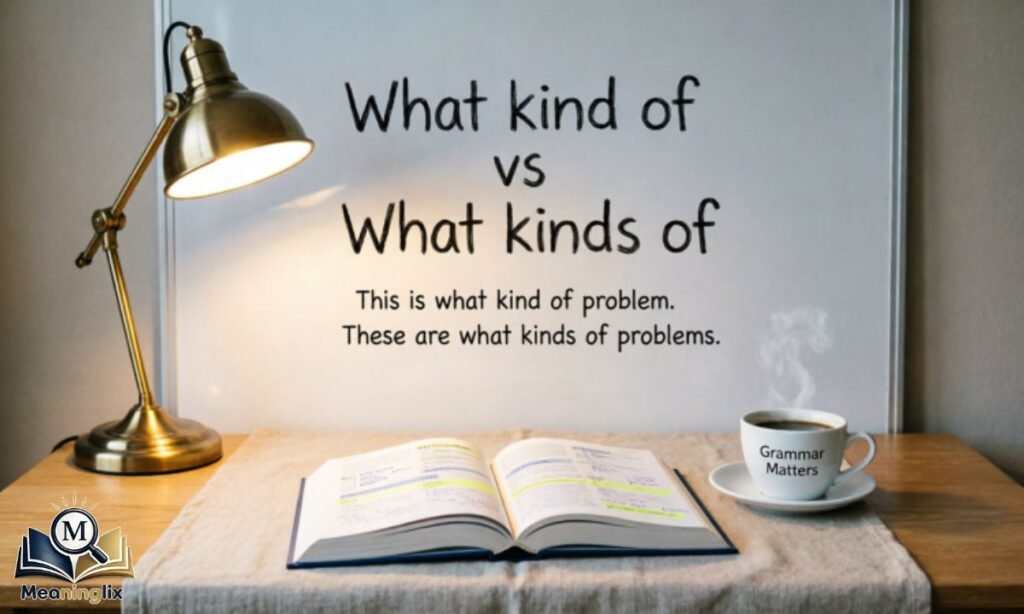
Before diving into the rules, let’s look at a few side-by-side examples so you can see the difference in action:
- What kind of music do you enjoy? → Rock, I guess.
- What kinds of music do you enjoy? → Rock, jazz, and a bit of classical.
- What kind of car does she drive? → A hybrid.
- What kinds of cars does the dealership sell? → Sedans, SUVs, and trucks.
- What kind of person are you? → Honest and easygoing.
- What kinds of people attended the event? → Students, teachers, and parents.
Notice the pattern? When one answer is expected, the noun stays singular. When multiple categories or types are expected, the noun becomes plural. That’s the entire distinction in a nutshell but let’s unpack it further.
Click Here To Read another Topics
Quick answer
Here’s the short version if you’re in a hurry:
- Use “what kind of” with a singular noun when you’re asking about one type or category.
- Use “what kinds of” with a plural noun when you’re asking about multiple types or categories.
Example: What kind of shoe is that? vs. What kinds of shoes do you own?
That’s it. The rest of this article expands on this rule with examples, context, and practical tips.
Quick Difference Between What Kind of and What Kinds of
The core difference comes down to the number singular versus plural. “Kind” is singular, so it pairs with a singular noun and generally expects one answer. “Kinds” is plural, so it pairs with a plural noun and invites a broader, multi-part response.
Here’s a simple way to remember it:
- If you could rephrase your question using “which type”, use “what kind of.”
- If you could rephrase your question using “which types”, use “what kinds of.”
This mental shortcut works in almost every situation, from casual chats to formal writing.
Comparison Table: What Kind of vs What Kinds of
| Feature | What Kind of | What Kinds of |
| Grammar number | Singular | Plural |
| Noun that follows | Singular noun | Plural noun |
| Expected answer | One category or type | Multiple categories or types |
| Common use case | Specific, focused questions | Open-ended, broader questions |
| Example | What kind of phone do you use? | What kinds of phones does the store sell? |
| Formality | Works in both casual and formal English | Works in both casual and formal English |
| Frequency in speech | Very common | Slightly less common, but still frequent |
This table gives you a quick visual reference whenever you’re unsure which phrase fits your sentence.
What Does “What Kind of” Mean?
“What kind of” is a question phrase used to ask about a single category, type, or classification of something. It’s followed by a singular noun, even if that noun is uncountable or abstract.
Think of “kind” as a synonym for “type” or “variety” but in the singular sense. When you ask “what kind of,” you’re narrowing your question down to one specific answer, even though the topic itself might have many possible categories.
For example:
- What kind of weather do you prefer? expecting one general answer like “sunny.”
- What kind of job are you looking for? expecting a focused answer like “remote marketing role.”
It’s also commonly used with collective nouns like “team,” “family,” or “group,” which are grammatically singular even though they refer to multiple people.
What Does “What Kinds of” Mean?

“What kinds of” is the plural version of the same question structure. It’s used when you expect the answer to include more than one type, category, or example.
This phrase signals that you’re open to or specifically asking for a list or range of possibilities rather than a single response.
For example:
- What kinds of books do you read? inviting a list like “mystery, biography, and sci-fi.”
- What kinds of exercises help with back pain? expecting several different exercise types.
Whenever your question naturally leads to a list, “what kinds of” is almost always the better choice.
Singular vs Plural Grammar Rule Explained Simply
At its core, this whole topic is about subject-noun agreement. English requires that “kind” (singular) match with a singular noun, and “kinds” (plural) match with a plural noun.
Here’s the rule broken down:
- Kind + singular noun → one category expected
- Kinds + plural noun → multiple categories expected
A simple test: ask yourself, “Am I expecting one answer or several?” If it’s one, go singular. If it’s several, go plural.
There’s one nuance worth mentioning: even when “what kind of” is used, the answer can technically include multiple items (e.g., “What kind of snacks do you like?” answered with “chips and pretzels”). But grammatically, “kind” still pairs with the singular noun in the question itself the plurality shows up only in the response, not the phrasing.
Sentence Structure Patterns
Understanding the sentence pattern behind each phrase makes it much easier to use them correctly without overthinking.
Structure for “What Kind of”
The typical structure looks like this:
What kind of + singular noun + (verb) + subject?
Examples of the pattern:
- What kind of movie do you like?
- What kind of person would do that?
- What kind of cake is this?
The noun immediately following “kind of” stays in its singular form, regardless of tense or subject.
Structure for “What Kinds of”
The pattern shifts slightly:
What kinds of + plural noun + (verb) + subject?
Examples of the pattern:
- What kinds of movies do you like?
- What kinds of people work here?
- What kinds of cakes does the bakery sell?
Here, the noun takes its plural form to match the plural “kinds.”
Examples of “What Kind of” in Sentences
To help you internalize the rule, here are more natural, everyday examples using “what kind of”:
- What kind of phone do you have?
- What kind of dog is that?
- What kind of music makes you relax?
- What kind of support do you need right now?
- What kind of teacher were you in school?
- What kind of coffee do you usually order?
- What kind of car should I buy for a family of four?
- What kind of question is that supposed to be?
Notice that each of these expects a single, specific answer not a list.
Examples of “What Kinds of” in Sentences
Now here are examples using “what kinds of,” where a broader or multiple-item answer is expected:
- What kinds of movies do you enjoy watching?
- What kinds of foods should I avoid before a workout?
- What kinds of skills does this job require?
- What kinds of animals live in a rainforest?
- What kinds of questions will be on the test?
- What kinds of activities do you do on weekends?
- What kinds of products does your company sell?
- What kinds of people thrive in remote jobs?
Each of these questions naturally invites a list-style response.
Common Mistakes to Avoid
Even confident English speakers slip up here from time to time. Here are the most frequent mistakes people make:
- Mismatching noun number: Saying “What kind of books” instead of “What kind of book” or “What kinds of books.”
- Using “kind of” with plural intent: Asking “What kind of hobbies do you have?” when multiple hobbies are expected “What kinds of hobbies” is more accurate here.
- Overusing “kinds” in casual speech: Some speakers default to “kinds” even for single-answer questions, which can sound slightly off in formal writing.
- Confusing “kind of” as a filler word with the grammatical phrase (e.g., “I’m kind of tired” vs. “What kind of tired are you?”). Context makes the difference clear.
- Forgetting collective nouns are singular: Words like “team,” “class,” or “family” take “what kind of,” not “what kinds of,” even though they represent multiple people.
Being aware of these patterns will help you catch errors before they slip into your writing.
Can “What Kind of” and “What Kinds of” Ever Both Be Correct?
Yes in certain situations, both phrases can technically work, depending on what the speaker intends to ask.
For example:
- What kind of restaurant should we go to? (expecting one type, like “Italian”)
- What kinds of restaurants are in this neighborhood? (expecting a list, like “Italian, Thai, and Mexican”)
The sentence topic is the same restaurants but the intended scope of the answer determines which phrase fits better. In casual conversation, native speakers sometimes blur this line without causing confusion, but in formal or academic writing, it’s best to stick to the rule based on your intended meaning.
What Kind of vs What Type of
“What kind of” and “what type of” are functionally interchangeable in almost every context. Both ask about a category or classification, and both follow the same singular/plural agreement rules.
| Phrase | Formality | Common Usage |
| What kind of | Neutral, everyday | Casual conversation, writing |
| What type of | Slightly more formal | Academic, professional, technical writing |
For example, “What type of software do you use?” sounds just as natural as “What kind of software do you use?” The choice often comes down to personal style or tone rather than strict grammar rules. “Type” tends to appear slightly more often in formal or technical contexts, such as scientific writing or business reports, while “kind” feels more conversational.
Which Phrase Sounds More Natural in Everyday English?
In spoken English, “what kind of” is used far more frequently than “what kinds of,” simply because most everyday questions expect a single, general answer. Think about how often you ask things like “What kind of day did you have?” or “What kind of food do you want?” these are common, casual questions with one expected response.
“What kinds of” tends to show up more in exploratory or analytical conversations like interviews, research discussions, or when comparing multiple options. For instance, a job interviewer might ask, “What kinds of challenges have you faced in your career?” because they expect a detailed, multi-part answer.
Both phrases sound completely natural; the key is matching the phrase to your intended meaning, not forcing one over the other.
Quick Grammar Tips for English Learners
Here are some simple, practical tips to help you master this grammar point once and for all.
Tip 1: Focus on the Noun
Before choosing “kind” or “kinds,” look at the noun that follows. If it’s singular, use “kind of.” If it’s plural, use “kinds of.” The noun is your biggest clue.
Tip 2: Remember the Simple Rule
Kind = one. Kinds = many. Whenever you’re unsure, ask yourself whether you expect one answer or several, and let that guide your choice.
Tip 3: Practice with Daily Examples
Try rewriting five everyday questions using both “kind of” and “kinds of.” For example: “What kind of shoes do you wear?” and “What kinds of shoes do you own?” Practicing with real-life topics such as food, hobbies, movies makes the rule stick faster.
Tip 4: Read English Regularly
Reading books, articles, or even social media posts in English exposes you to how native speakers naturally use these phrases. Over time, your brain starts recognizing the correct pattern without needing to consciously think about the rule.
Frequently Asked Questions
What is the difference between kind of and kinds of?
“Kind of” is singular and pairs with a singular noun, while “kinds of” is plural and pairs with a plural noun.
Do we say kind or kinds?
It depends on whether you mean one category (“kind”) or multiple categories (“kinds”).
Is it these kind of people or this kind of people?
The grammatically correct form is “this kind of people,” since “kind” is singular. “These kinds of people” is also correct when referring to multiple categories.
Is it which or what kind?
Both are grammatically correct; “which kind” implies choosing from known options, while “what kind” asks more openly without implying a specific set of choices.
Conclusion
The difference between “what kind of” and “what kinds of” really comes down to one simple idea: singular versus plural. Use “what kind of” when you’re asking about one category or type, and switch to “what kinds of” when you expect multiple categories or varieties in the answer.
Once you start paying attention to the noun that follows and whether you’re expecting one answer or several this grammar rule becomes second nature. Keep practicing with real, everyday sentences, and soon you’ll choose the right phrase without even thinking about it.

Alisha Lehmann is the founder and author of Meaninglix. She specializes in explaining word meanings, internet slang, abbreviations, grammar, and English expressions in simple, accurate language. Her goal is to help readers improve their vocabulary and communicate confidently through clear, well-researched, and easy-to-understand content.
1 thought on “What Kind of vs What Kinds of: What’s the Difference? (With Perfect Examples) 2026”