If you have ever paused mid sentence wondering whether to write “targetted” or “targeted,” you are not alone. This is one of the most common spelling mix ups in English, especially for marketers, writers, and students who use the word constantly. The debate over Targetted vs. Targeted comes up so often because the word looks like it should double its consonant, similar to words like “committed” or “regretted.” But English spelling rules do not always follow the pattern we expect.
In this guide, we will settle the Targetted vs. Targeted debate once and for all, explain the grammar rule behind it, and show you real world examples so you never second guess your spelling again.
Table of Contents
Quick Answer
Targeted is the correct spelling in both American and British English. Targetted, with two T’s, is a common misspelling and is not recognized as correct in any standard dictionary. Whether you are writing for business, academic, or casual purposes, “targeted” is always the safe and accurate choice.
Targetted vs Targeted at a Glance
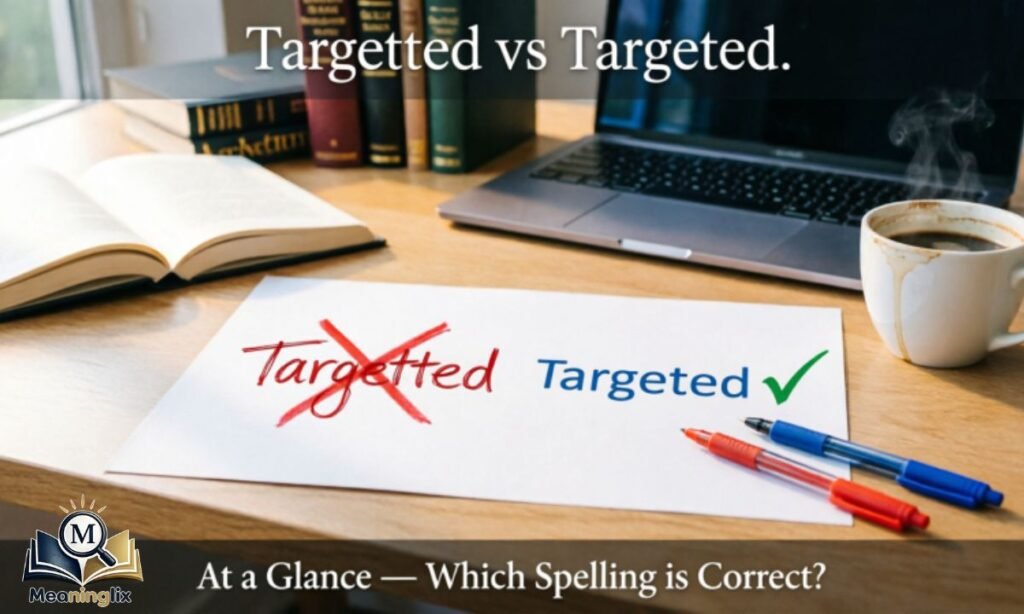
Before diving deeper into the Targetted vs. Targeted comparison, here is a quick summary table to help you understand the difference at a glance.
| Feature | Targeted | Targetted |
| Correct spelling | Yes | No |
| Recognized by dictionaries | Yes | No |
| Used in American English | Yes | No |
| Used in British English | Yes | No |
| Common in casual writing | Occasionally misused | Frequently misspelled |
| Grammar rule followed | Standard past tense rule | Incorrect doubling rule |
As the table shows, when comparing Targetted vs Targeted, only one version holds up under actual English spelling conventions.
Click Here To Read Another Grammar Topic
Which Spelling Is Correct: Targetted or Targeted?
The correct spelling is targeted, spelled with a single T before the “ed” ending. “Targetted” is a spelling error that likely comes from confusion with other verbs that do double their final consonant when adding a suffix.
This is the core of the entire Targetted vs. Targeted question. English has a rule that determines when a final consonant gets doubled before adding “ed” or “ing.” Understanding that rule makes the answer clear, and it also explains why so many people get it wrong in the first place.
What Does “Targeted” Mean?
“Targeted” is the past tense and past participle form of the verb “target.” It means to aim at, focus on, or select something specific as an object of action, attention, or strategy.
For example:
- A company may have targeted a new demographic for its latest product launch.
- An advertisement can be targeted toward a specific age group.
- A medical treatment might be targeted at a particular type of cancer cell.
The word is widely used across marketing, business strategy, healthcare, military contexts, and everyday conversation. Understanding this meaning is essential before exploring the spelling mechanics behind Targeted vs Targetted.
Why Is “Targeted” Spelled with One T?
This is where English spelling rules come into play, and it is the real answer behind the Targetted vs. Targeted confusion.
The rule for doubling a final consonant before adding “ed” or “ing” depends on where the stress falls in the word:
- If the stress falls on the last syllable of the base word, the final consonant is usually doubled. Example: “occur” becomes “occurred” because the stress is on “cur.”
- If the stress falls on an earlier syllable, the final consonant is not doubled. Example: “target” is stressed on the first syllable, TAR get, so it becomes “targeted” with just one T.
Since “target” places stress on the first syllable rather than the last, English grammar rules say the final consonant should not double. This single rule explains the entire Targetted vs Targeted debate.
Other words that follow this same non doubling pattern include:
- Visit becomes visited
- Benefit becomes benefited
- Market becomes marketed
- Limit becomes limited
Notice the pattern. All of these words are stressed on the first syllable, and none of them double their final consonant.
Why Do People Write “Targetted”?
If the rule is so clear, why does the Targetted vs. Targeted mistake happen so often? There are a few practical reasons.
- Pattern confusion: Words like “committed,” “regretted,” and “permitted” do double their consonant, so people assume “target” follows the same pattern.
- Visual habit: Doubling consonants feels like a safe default for many English learners, since it appears in so many common verbs.
- Autocorrect and typing speed: Fast typing sometimes leads to accidental double letters that go unnoticed.
- Regional assumptions: Some writers assume British English always doubles consonants, which is not accurate for every word.
Recognizing why the mistake happens makes it easier to avoid repeating it, especially in professional writing where accuracy affects credibility.
Targeting vs Targetting: Which Is Correct?
The same rule applies when adding “ing” instead of “ed.” The correct form is targeting, with a single T, not “targetting.”
Since “target” is stressed on the first syllable, the consonant does not double for any suffix, whether it is “ed,” “ing,” or even “er,” as in “targeter.” This consistency is one of the more overlooked details in the Targetted vs Targeted conversation, since most people only think about the past tense form and forget the present participle follows the identical rule.
Is “Targetted” Ever Correct in British English?
No. Many people assume British English is more likely to double consonants, since words like “travelled” and “cancelled” use two L’s in British spelling while American English uses one. However, this assumption does not apply to “target.”
Both British and American English follow the same stress based rule for this particular word. That means targeted and targeting are correct across every major English speaking region, including the UK, US, Canada, and Australia. There is no accepted regional variation that makes “targetted” correct anywhere. This is an important clarification, since the Targetted vs. Targeted question sometimes gets mistakenly framed as a regional spelling difference like “color” versus “colour.”
Examples of “Targeted” in Sentences
Seeing the word used correctly across different contexts helps reinforce the right spelling. Below are examples grouped by category.
Business Examples
- The marketing team targeted millennials in its latest social media campaign.
- Our sales strategy is targeted toward small business owners in urban areas.
- The company targeted a 15 percent increase in quarterly revenue.
Academic Examples
- The research study targeted a specific age group to measure learning outcomes.
- Researchers targeted genetic markers linked to the disease.
- The professor targeted common grammar mistakes in student essays.
Everyday Examples
- She felt targeted by the criticism during the meeting.
- The new app is targeted at busy parents who need quick meal ideas.
- He targeted his workout routine to build upper body strength.
Across every category, the spelling remains consistent. There is no context in which “targetted” becomes acceptable, which reinforces the practical takeaway of the entire Targetted vs Targeted discussion.
Common Words Similar to Targeted
Understanding related words can help you avoid similar spelling mistakes in the future. Some semantic keyword relatives and commonly confused terms include:
- Focused
- Aimed
- Directed
- Selected
- Marketed
- Aimed at
- Segmented
- Personalized
These words often appear alongside “targeted” in marketing and business writing, especially in discussions about audience segmentation, customer targeting strategies, and precision marketing. Knowing these related terms also helps writers diversify their vocabulary while keeping their content grammatically accurate.
Frequently Asked Questions
How do you spell targetted in the UK?
There is no correct way to spell “targetted” in UK English. The only accepted spelling in British English is targeted, with a single T, matching American English usage.
Is target or is targeted?
“Target” is the base verb or noun, while “targeted” is its past tense and past participle form. You use “target” when referring to the present action or the noun itself, and “targeted” when referring to a completed action or a descriptive adjective.
Is it targeting or targetting?
The correct spelling is targeting, with one T. “Targetting” is incorrect and does not appear in any standard dictionary.
What does it mean to be targeted?
Being “targeted” means being specifically selected, aimed at, or focused on for a particular purpose, whether that purpose is marketing, criticism, research, or strategic action.
What is the meaning of targeted?
“Targeted” means something has been specifically aimed at, selected, or focused on, often as part of a deliberate strategy or plan. It can apply to advertising, treatment plans, criticism, or any scenario involving intentional focus.
Conclusion
The Targetted vs. Targeted debate ultimately comes down to a simple English spelling rule. Because “target” is stressed on its first syllable, the correct spelling never doubles the final T, whether you are writing “targeted,” “targeting,” or any other variation. “Targetted” is a common but incorrect spelling that does not appear in any recognized dictionary, in either American or British English.
The next time you find yourself typing this word, remember the rule behind stress and syllables, and you will never confuse Targetted vs Targeted again. Correct spelling may seem like a small detail, but in business writing, academic work, and professional communication, it makes a meaningful difference in how credible and polished your content appears.

Alisha Lehmann is the founder and author of Meaninglix. She specializes in explaining word meanings, internet slang, abbreviations, grammar, and English expressions in simple, accurate language. Her goal is to help readers improve their vocabulary and communicate confidently through clear, well-researched, and easy-to-understand content.
1 thought on “Targetted vs. Targeted: Which Spelling Is Correct? Perfect Examples 2026”