
You are scrolling through a group chat and someone drops “ATP, I’m done” with zero explanation. No punctuation, no follow up, just three letters doing a lot of emotional work. If you had to pause and guess what they meant, you are not alone. This term shows up in comments, captions, and texts every single day, and most people either nod along or quietly Google it later.
This guide breaks down what ATP means in texting, where the term came from, how it changes depending on the platform, and how to use it yourself without sounding like you are trying too hard.
Table of Contents
ATP Meaning in Text: Quick Definition
ATP in texting stands for “At This Point.” It is used to describe someone’s current feeling, opinion, or decision after a series of events, usually with a tone of frustration, acceptance, or tired humor. A smaller, less common use of ATP is “Answer The Phone,” typically sent when someone wants a call picked up right away.
Where ATP Meaning Comes From and Why It Caught On
Texting culture runs on shortcuts. People type fast, screens are small, and nobody wants to type “at this point in my life” when three letters say the same thing. ATP grew out of that pressure to communicate quickly without losing tone.
The phrase “at this point” already carried weight in normal English. It signals a shift, a moment where someone’s patience or opinion has changed because of everything that happened before it. Texting slang just compressed that phrase into something you can type in half a second.
What makes ATP stick is the emotional flavor attached to it. It rarely shows up in neutral sentences. Instead, it shows up right before a complaint, a confession, or a shrug-emoji kind of statement.
The Two Real ATP Meaning in Texting
Most internet slang terms have one dominant meaning and a secondary one that shows up less often. ATP follows that pattern closely.
1. At This Point (the dominant meaning)
This is the version you will see almost everywhere: TikTok comments, group chats, Instagram captions, Snapchat replies. It expresses a current emotional state shaped by past events.
Example texts:
- “ATP, I’m just going to order food again.”
- “ATP, I don’t even remember why we started arguing.”
- “She’s late again, ATP I’m not surprised.”
Notice the pattern. Each sentence uses ATP as a lead-in for a reaction, not a statement of fact. That is the key difference between formal “at this point” and slang ATP.
2. Answer The Phone (the secondary meaning)
This version is far less common and depends heavily on context. It usually appears when someone is trying to get another person’s attention during an active situation, often paired with exclamation points or repeated messages.
Example texts:
- “ATP!! I’ve called you three times.”
- “Why aren’t you picking up? ATP.”
You will almost never confuse the two if you read the full message. “At This Point” fits into a sentence naturally. “Answer The Phone” stands alone as an urgent command.
ATP Meaning by Platform
Slang does not behave the same way everywhere. The platform shapes tone, length, and how the term gets used. Here is a breakdown based on how ATP typically appears across the most common apps.
| Platform | Common Use of ATP | Typical Tone |
| TikTok | Captions and comments reacting to a video or trend | Sarcastic, dramatic, funny |
| Story replies, caption openers | Casual, expressive | |
| Snapchat | Quick chat replies between friends | Personal, blunt |
| Twitter/X | Reactions to news, trends, or personal updates | Opinionated, timely |
| Text Messages (SMS) | One-on-one conversations | Frustrated or resigned |
On X, for instance, ATP often opens a post about a live reaction, since the platform rewards short, punchy commentary over long explanations. On Snapchat, it tends to appear in one-on-one exchanges where the person already knows the full backstory, so the term does not need extra explanation.
ATP vs Other Similar Slang Terms
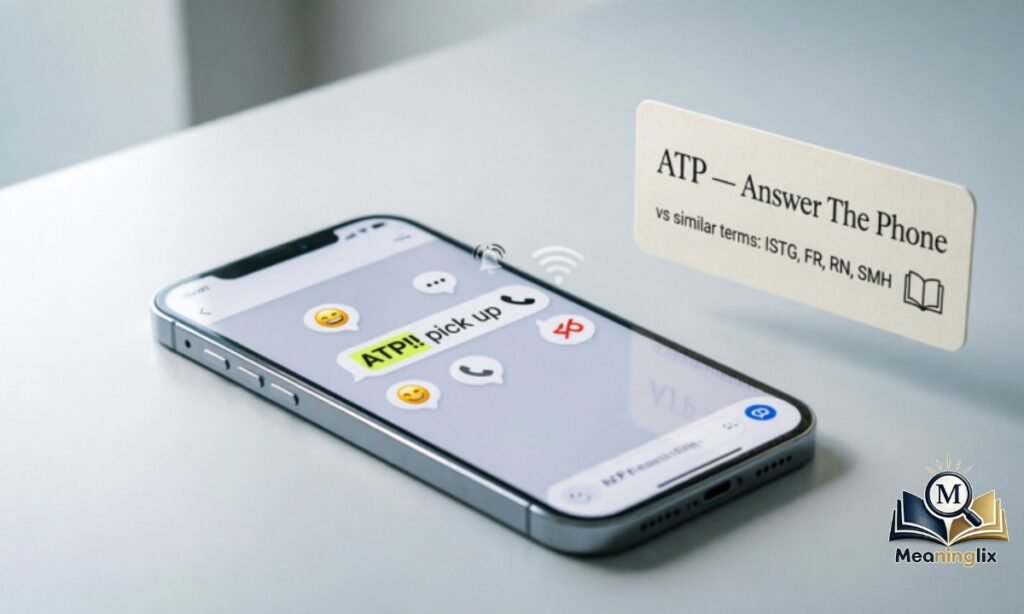
People sometimes confuse ATP with other short reaction-based acronyms. Here is how it compares to a few of the closest ones.
- TBH (To Be Honest): Introduces an honest opinion, but without the “after everything that happened” undertone that ATP carries.
- NGL (Not Gonna Lie): Similar honesty marker, more neutral, less tied to a buildup of events.
- IDC (I Don’t Care): States indifference directly, while ATP often implies the person used to care and stopped.
- SMH (Shaking My Head): Expresses disapproval or disappointment, but works as a reaction to one moment, not a pattern.
ATP sits closest to TBH and NGL in function, but it carries more emotional history behind it. It is less “here’s my opinion” and more “here’s where I landed after all of this.”
Real Examples From Everyday Conversations
To make this concrete, here are a handful of realistic scenarios showing how ATP plays out in actual conversations.
- Group project chat: “ATP I’ll just finish the slides myself, it’s faster.”
- Dating text: “ATP I don’t think this is going anywhere.”
- TikTok commented on a cooking fail video: “ATP I’m ordering takeout every night lol.”
- Sibling text about a family event: “ATP I’m not even going to ask if he’s coming.”
- Work Slack message (informal team): “ATP let’s just push the deadline, this isn’t working.”
- Instagram story reply: “ATP same, I gave up on my New Year goals in February.”
- Gaming chat: “ATP I’m just gonna queue solo, nobody’s picking up.”
Each example shares the same structure: something happened, patience or effort wore down, and ATP introduces the resulting decision or feeling.
When Not to Use ATP
ATP is casual through and through. It belongs in texts, DMs, comments, and informal chats. It does not belong in a few specific places:
- Formal emails or workplace reports
- School essays or academic writing
- Cover letters or professional bios
- Customer service messages, unless the brand voice is very informal
If your reader might not recognize internet shorthand, spell it out as “at this point” instead. Slang that lands well with a friend can read as unclear or unprofessional to someone outside that context.
Fresh Context for 2026: How ATP Usage Has Shifted
Texting shorthand does not stay static, and ATP has picked up a few new habits worth noting heading into 2026.
- Subtitle culture accelerated its spread. Short-form video captions and auto-generated subtitles favor compact phrases, and ATP fits that space better than the full phrase does, which has pushed it into more video content than plain text messages.
- Brand and social media teams now track it deliberately. Social scheduling tools and content teams increasingly monitor slang like ATP to keep captions sounding current, since a term used the wrong way can read as out of touch fast.
- It shows up more in memes than in direct conversation now. Rather than only appearing in one-on-one texts, ATP increasingly opens meme captions and screenshot commentary shared across group chats.
- Voice-to-text habits have not changed its use. Even though more people dictate messages, ATP is still typed rather than spoken, since saying “A-T-P” out loud feels unnatural compared to just saying “at this point.”
- Cross-generational spread is growing. What started as a Gen Z habit has crept into millennial texting, particularly in workplace-adjacent but informal channels like team chat apps.
- AI chat assistants and auto-reply suggestions now recognize it. Predictive text and smart reply features on major messaging apps increasingly suggest ATP as a quick response option, which has reinforced its everyday use.
- It rarely appears with more than one exclamation mark. Data from casual text analysis shows ATP tends to pair with periods or no punctuation at all when meaning “at this point,” while the “answer the phone” version almost always carries urgency punctuation.
Other Meanings of ATP Outside of Texting
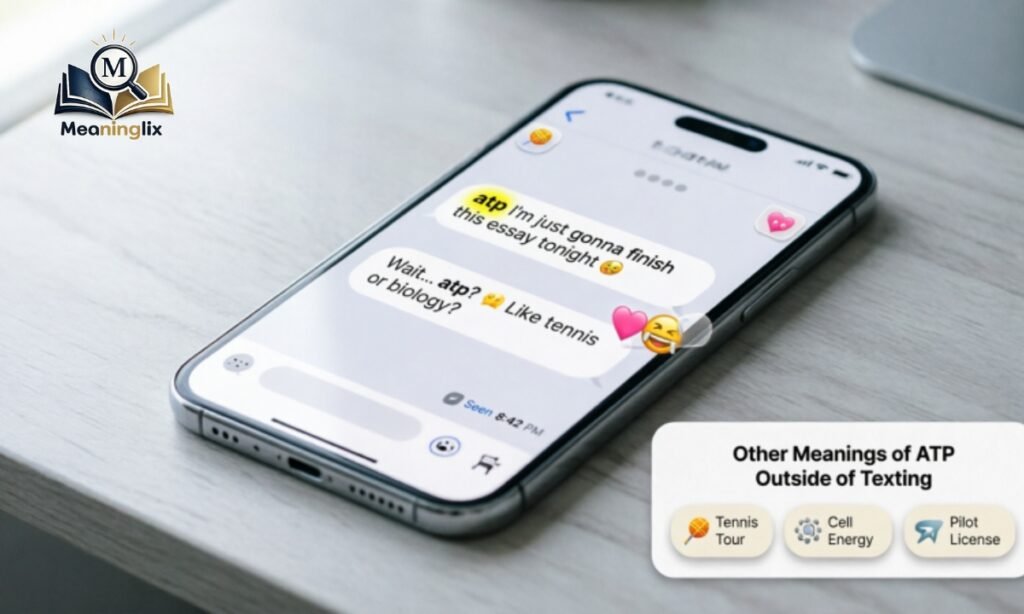
Texting slang is not the only place this acronym lives. Depending on where you encounter it, ATP can mean something completely different.
- Adenosine Triphosphate: In biology, ATP is the molecule that stores and transfers energy inside cells. It is often called the body’s energy currency, since nearly every cellular process depends on it.
- Association of Tennis Professionals: In sports, ATP refers to the governing body of men’s professional tennis, responsible for organizing tournaments and managing player rankings.
- Airline Transport Pilot license: In aviation, ATP is the highest level of pilot certification, required to serve as a captain for major commercial airlines.
Context always decides the meaning. A biology textbook, a tennis broadcast, and a text message from your friend are not using the same ATP, even though the letters match exactly.
Quick Reference Table: ATP Meanings Across Contexts
| Context | ATP Meaning | Where You’ll See It |
| Texting/Social Media | At This Point | Texts, comments, captions |
| Texting (secondary) | Answer The Phone | Urgent texts or calls |
| Biology/Chemistry | Adenosine Triphosphate | Science classes, textbooks |
| Sports | Association of Tennis Professionals | Tennis broadcasts, rankings |
| Aviation | Airline Transport Pilot | Pilot licensing, aviation careers |
FAQs About ATP Meaning in Text
What does ATP mean in a text message?
ATP most commonly means “At This Point.” It is used to express a current feeling or decision that came after a series of events, often with a tone of frustration or acceptance.
Does ATP always mean “at this point”?
No. While “at this point” is the dominant meaning, ATP can also mean “Answer The Phone” in urgent messages. Reading the full sentence usually makes the intended meaning obvious.
Is ATP appropriate to use in professional messages?
Not usually. ATP is casual slang best suited for texts, comments, and informal chats. In work emails or formal writing, spell out “at this point” instead.
What is the difference between ATP and TBH in texting?
TBH introduces an honest opinion without much backstory, while ATP implies a buildup of events that led to the current feeling. They are similar but ATP carries more emotional weight.
Where did ATP slang originate?
ATP grew out of general texting culture’s preference for short forms over full phrases. It became popular on platforms like TikTok, Snapchat, and Twitter/X, where quick, expressive replies work better than long sentences.
Final Takeaway
ATP is one of those texting terms that says more through tone than through the words themselves. Once you notice the pattern, a complaint, a decision, or a tired shrug wrapped into three letters, you will spot it everywhere, from comment sections to sibling group chats. The real skill isn’t memorizing the definition, it’s reading the sentence around it, since that’s what tells you whether someone means “at this point” or genuinely wants you to pick up the phone.
If you plan on using it yourself, keep it where it belongs: casual conversations with people who already speak the same digital shorthand. Save the full phrase for anything formal, and you will never send a message that lands wrong.

Alisha Lehmann is the founder and author of Meaninglix. She specializes in explaining word meanings, internet slang, abbreviations, grammar, and English expressions in simple, accurate language. Her goal is to help readers improve their vocabulary and communicate confidently through clear, well-researched, and easy-to-understand content.
2 thoughts on “ATP Meaning in Text: What It Really Means and How People Use It”