
If you’ve ever paused mid-sentence wondering whether to type “combating vs. combatting,” you’re not alone. This is one of the most common spelling debates in English, and the short answer is: “combating” is the standard spelling in both American and British English, while “combatting” is an accepted but less common variant seen mainly in older or British texts.
The confusion around combating vs. combatting comes down to a quirky consonant-doubling rule that English doesn’t apply consistently. In this guide, we’ll break down exactly when to use each spelling, what major dictionaries say, and how to never second-guess yourself on this again.
Table of Contents
Combating vs. Combatting Oxford Dictionary
According to the Oxford English Dictionary, “combating” is listed as the standard and primary spelling of the present participle and gerund form of “combat.” The OED does acknowledge “combatting” as a valid variant, but it notes this double-T version shows up mostly in older or historical British publications rather than contemporary writing.
Other major dictionaries line up with this same guidance:
| Dictionary | Preferred Spelling | Notes on the Variant |
| Oxford English Dictionary | Combating | Combatting listed as a historical British variant |
| Merriam-Webster | Combating | Doesn’t prioritize combatting |
| Cambridge Dictionary | Combating | Combatting noted as acceptable but less common |
| Collins Dictionary | Combating | Combatting is a secondary option |
So when people ask “combating or combatting Oxford Dictionary,” the real answer is that Oxford treats this less as a strict British vs. American divide and more as a case of one dominant, modern spelling with an older alternative still lingering in circulation.
Click Here To Read Another Topic
Combating vs. Combatting: Understanding the Root Word “Combat”
To understand why combating vs. combatting even exists as a debate, you need to look at the root word itself. “Combat” comes from the Old French word “combattre,” meaning to fight or struggle against something. It functions as both a noun and a verb in modern English.
- As a noun: “Soldiers entered combat at dawn.”
- As a verb: “We combat misinformation daily.”
It’s the verb form that creates the spelling puzzle. When English speakers add “-ing” to a verb, they’re forming either a present participle or a gerund, and that’s exactly where the combating vs. combatting confusion begins.
Why Both Spellings Exist
Both spellings exist because English consonant-doubling rules weren’t applied consistently as the language evolved. Normally, when a short verb ends in a single consonant preceded by a single vowel, you double that consonant before adding “-ing” — think “run” becoming “running.”
But “combat” breaks this pattern in an interesting way. It’s a two-syllable word (com-BAT), and depending on which syllable takes the stress, different style guides and regions came to different conclusions about whether to double the final “t.” That inconsistency is the entire reason combating vs. combatting became a genuine spelling fork rather than a clear-cut rule.
Combating in American English
American English has settled firmly on one side of the combating vs. combatting debate.
✔️ Correct in American English: combating
In the United States, “combating” is the spelling you’ll see in newspapers, academic journals, government documents, and everyday professional writing. AP Style, Chicago Manual of Style, and APA all favor “combating” as the standard form. If you’re writing for a US audience, this is the spelling to use every time.
❌ Usually incorrect: combatting
While not technically a spelling crime, “combatting” is considered nonstandard in American English. Using it in a resume, business report, or academic paper written for a US audience can come across as an error rather than a stylistic choice, so it’s best avoided.
Combatting in British English
British English is a bit more flexible when it comes to combating vs. combatting.
Acceptable in British English: combatting
Some British publications, particularly older texts and certain institutional style guides, use “combatting” with the doubled consonant. You may still encounter this spelling in UK government documents or academic writing that follows more traditional British conventions.
Also acceptable: combating (used but less common)
Even in the UK, “combating” is widely used and accepted. In fact, modern British usage increasingly favors “combating” over “combatting,” meaning the gap between American and British preferences is narrower than many other US/UK spelling pairs (like “color” vs. “colour”).
How Pronunciation Affects Spelling
Pronunciation plays a direct role in the combating vs. combatting debate because English consonant-doubling rules are tied to stress patterns.
Stress pattern:
The word “combat” is pronounced with stress on the first syllable: COM-bat. The general rule in English states that you double the final consonant before adding “-ing” only when the stress falls on the last syllable of the word (like “reFER” becoming “referring”). Since the stress in “combat” falls on the first syllable, the traditional rule suggests the “t” should not be doubled — which supports “combating” as the more logically consistent spelling.
Understanding “Combating” and “Combatting” as Verb Forms
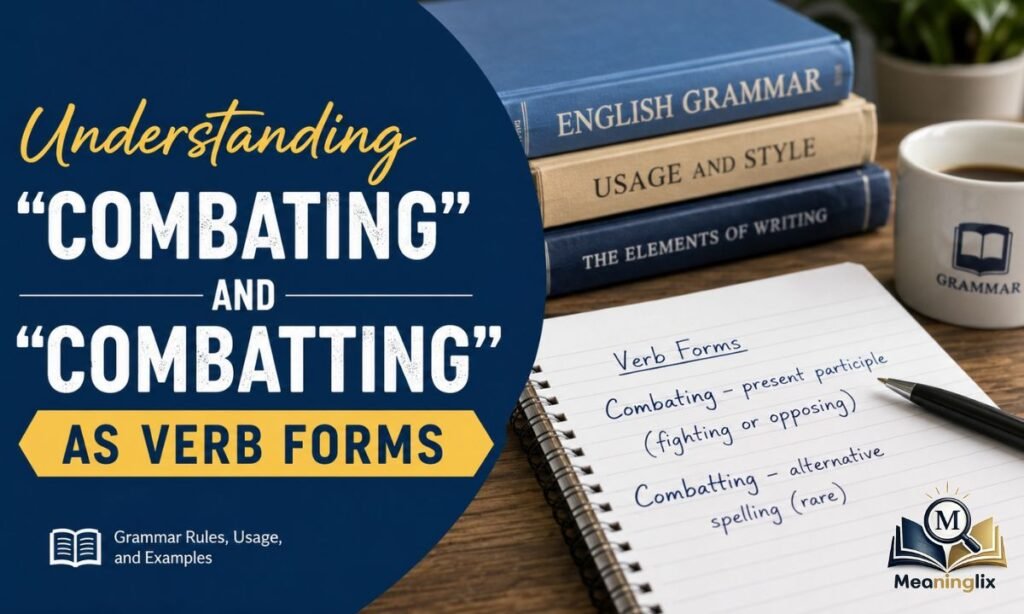
Both spellings serve the same grammatical function, whether you write combating or combatting in a sentence.
Present participles
As a present participle, “combating” (or “combatting”) describes an ongoing action or modifies a noun. Example: “The team combating the outbreak worked around the clock.”
Gerunds
As a gerund, the same word acts as a noun. Example: “Combating climate change requires global cooperation.” In both grammatical roles, the combating vs. combatting choice comes down to spelling preference, not meaning or function.
Real-World Usage Examples
Seeing combating vs. combatting in real sentences makes the distinction easier to internalize.
American Context
- “The agency is combating fraud through new verification systems.”
- “Local nonprofits are combating homelessness with expanded shelter access.”
- “The CDC released new guidelines for combating seasonal flu outbreaks.”
British Context
- “The council remains committed to combatting antisocial behaviour.”
- “New legislation aims at combating (or combatting) knife crime in urban areas.”
- “The report outlines strategies for combatting misinformation online.”
Case Study: Combating Climate Change vs Combatting Climate Change

Few phrases highlight the combating vs. combatting debate better than discussions around climate policy, where both spellings appear depending on the source.
US Environmental Research Paper
American research papers and federal publications consistently use “combating climate change.” This phrasing appears throughout US Environmental Protection Agency materials and academic journals, reflecting standard American English conventions.
UK Government Report
UK government reports show more variation. Some older or more traditional documents use “combatting climate change,” while newer publications increasingly favor “combating climate change” — mirroring the broader shift in British English toward the single-T spelling.
Historical Development of Both Spellings
The combating vs. combatting split has roots that go back centuries, shaped by multiple language influences.
Key historical influences:
- French origin: The source word “combattre” used a doubled consonant, which influenced early English spellings.
- Simplification trend: As “combat” became fully assimilated into English, spelling conventions trended toward simplifying suffixed forms, favoring “combating.”
- Regional style guide divergence: British and American style guides developed independently after the 18th and 19th centuries, occasionally preserving older doubled-consonant forms in the UK.
- Dictionary standardization: Modern dictionaries on both sides of the Atlantic have increasingly converged on “combating” as the primary listed spelling.
How to Choose the Correct Spelling
Choosing between combating vs. combatting doesn’t have to be complicated once you know your audience and context.
✔️ Choose combating if:
- You’re writing for a US audience or publication
- You’re following AP, Chicago, or APA style
- You want the spelling most search engines and modern dictionaries recognize as standard
- You’re unsure which one to pick (it’s the safer, more universally accepted default)
✔️ Choose combatting if:
- You’re specifically following a British institutional or historical style guide
- Your organization’s house style explicitly calls for the doubled consonant
- You’re quoting or referencing older British source material
Bonus Tip
When in doubt, default to “combating.” It’s recognized across American and British dictionaries, aligns with modern usage trends, and won’t raise red flags with spellcheckers or editors.
Common Consonant Doubling Rules
The combating vs. combatting confusion is really a symptom of a broader English spelling rule that trips up plenty of other words too.
Double the final consonant when:
- The word is one syllable, ends in consonant-vowel-consonant, and you’re adding a vowel suffix (run → running)
- The word has multiple syllables, but the stress falls on the final syllable (refer → referring, admit → admitting)
Do NOT double when:
- The stress falls on an earlier syllable (visit → visiting, not “visitting”)
- The word ends in two consonants or two vowels plus a consonant (read → reading)
Table: Comparison of Consonant Doubling
| Base Word | Stress Pattern | Correct “-ing” Form | Doubles Consonant? |
| Run | Single syllable | Running | Yes |
| Refer | reFER (last syllable) | Referring | Yes |
| Visit | VIsit (first syllable) | Visiting | No |
| Combat | COMbat (first syllable) | Combating | No (standard) |
| Admit | adMIT (last syllable) | Admitting | Yes |
Frequently Asked Questions
Which one is correct, combating or combatting?
Both are technically correct, but “combating” is the standard, dictionary-preferred spelling in American and modern British English. “Combatting” is an accepted variant used mainly in older or British texts.
What does combatting mean?
“Combatting” means exactly the same thing as “combating” it’s the present participle or gerund form of the verb “combat,” meaning to fight against or actively work to stop something.
How do you spell combatting in the UK?
British English accepts both “combating” and “combatting,” though modern UK usage increasingly favors “combating,” with “combatting” appearing more often in traditional or historical writing.
Is combating one T or two?
“Combating” uses one T, and it’s the more widely recommended spelling. “Combatting” uses two Ts and is considered an acceptable but less common alternative.
Conclusion
The debate between combating vs. combatting ultimately comes down to a simple takeaway: “combating” is the safer, more universally accepted spelling for both American and British English audiences, while “combatting” remains a valid but less common variant tied largely to traditional British usage.
When you’re unsure which spelling fits your writing, defaulting to “combating” will keep your content aligned with modern dictionaries, style guides, and reader expectations.

Alisha Lehmann is the founder and author of Meaninglix. She specializes in explaining word meanings, internet slang, abbreviations, grammar, and English expressions in simple, accurate language. Her goal is to help readers improve their vocabulary and communicate confidently through clear, well-researched, and easy-to-understand content.
1 thought on “Combating vs. Combatting: The Powerful Spelling Guide 2026”