Texting a Spanish-speaking friend and suddenly your phone autocorrects “Hola or Ola”? You are not alone. This mix-up happens to native speakers, students, and even professional writers, because the two words look almost identical but mean completely different things.
Quick Answer: The correct greeting in Spanish is “Hola,” which means “hello.” “Ola” is a different word entirely, meaning “wave” (as in ocean wave). The confusion between Hola or Ola happens because they differ by just one silent letter, the “H,” which changes the spelling but not the sound in casual speech.
Table of Contents
Hola or Ola: Quick Comparison Table
| Feature | Hola | Ola |
|---|---|---|
| Grammatical Role | Interjection (greeting) | Common noun |
| Key Meaning | “Hello” or “Hi” | “Wave” (ocean/water) |
| Best Used For | Greetings, casual and formal conversation | Describing water, surfing, weather, or heat waves |
| Quick Example Sentence | “¡Hola! ¿Cómo estás?” | “La ola del mar era enorme.” |
This table already answers the core question behind Hola or Ola searches, but let’s break down each word so you never second-guess yourself again.
Click Here To Read Another Topic
Deep Dive: Understanding “Hola”

Hola is a Spanish interjection used to greet someone. It functions exactly like “hi” or “hello” in English. Grammatically, it stands alone and does not need a verb or subject to make sense.
The silent “H” at the beginning is a rule in Spanish spelling. Spanish speakers never pronounce the “H,” so Hola sounds like “OH-lah.” This silent letter is exactly why so many people misspell it as “Ola” when writing quickly.
You use Hola in almost every social situation. It works in texts, emails, phone calls, and face-to-face greetings.
Real-world examples:
- Casual texting: “Hola! ¿Nos vemos mañana?” (Hi! Are we meeting tomorrow?)
- Workplace greeting: “Hola equipo, buenos días a todos.” (Hello team, good morning everyone.)
- Answering the phone: “¿Hola? ¿Quién habla?” (Hello? Who’s speaking?)
- Formal introduction: “Hola, mi nombre es Carlos y soy el nuevo gerente.” (Hello, my name is Carlos and I am the new manager.)
Deep Dive: Understanding “Ola”
Ola is a noun, not a greeting. It refers to a wave, usually a wave of water in the ocean or sea. It can also describe a “wave” of something abstract, like a heat wave or a wave of people.
Because Ola has no silent “H,” its spelling matches its sound exactly. This makes it a completely separate word from Hola, even though they sound similar when spoken fast or informally.
Ola is common in weather reports, sports commentary (especially surfing), and descriptive writing.
Real-world examples:
- Beach description: “La ola rompió cerca de la orilla.” (The wave broke near the shore.)
- Weather report: “Una ola de calor afectará la región esta semana.” (A heat wave will affect the region this week.)
- Sports context: “El surfista atrapó una ola perfecta.” (The surfer caught a perfect wave.)
- Figurative use: “Hubo una ola de solicitudes después del anuncio.” (There was a wave of applications after the announcement.)
Key Differences & Golden Rule to Remember

The debate over Hola or Ola comes down to one simple memory trick: “H is for Howdy.”
If you are greeting someone, think of the English word “Howdy.” Both “Howdy” and “Hola” start with an H, and both are greetings. If you are talking about the ocean, remember that a wave “rolls” smoothly, just like the word Ola rolls off the tongue without any extra letters.
Another shortcut: Hola always appears at the start of a conversation. Ola never opens a conversation; it describes something physical or abstract.
Real-World Context & Usage Examples
Professional and Email Etiquette
In professional Spanish emails, always use Hola followed by a comma, such as “Hola, buenos días.” Never use “Ola” in a business greeting, since it would confuse the reader or look like a typo.
Casual Conversation
In texting and chatting with friends, Hola remains standard. Some regions shorten it playfully to “holi,” but “Ola” is never an accepted shortcut, even informally.
Formal Writing and Literature
In formal or descriptive writing, Ola appears frequently when describing nature, weather, or emotional “waves” of feeling, such as “una ola de nostalgia” (a wave of nostalgia).
Common Mistakes to Avoid
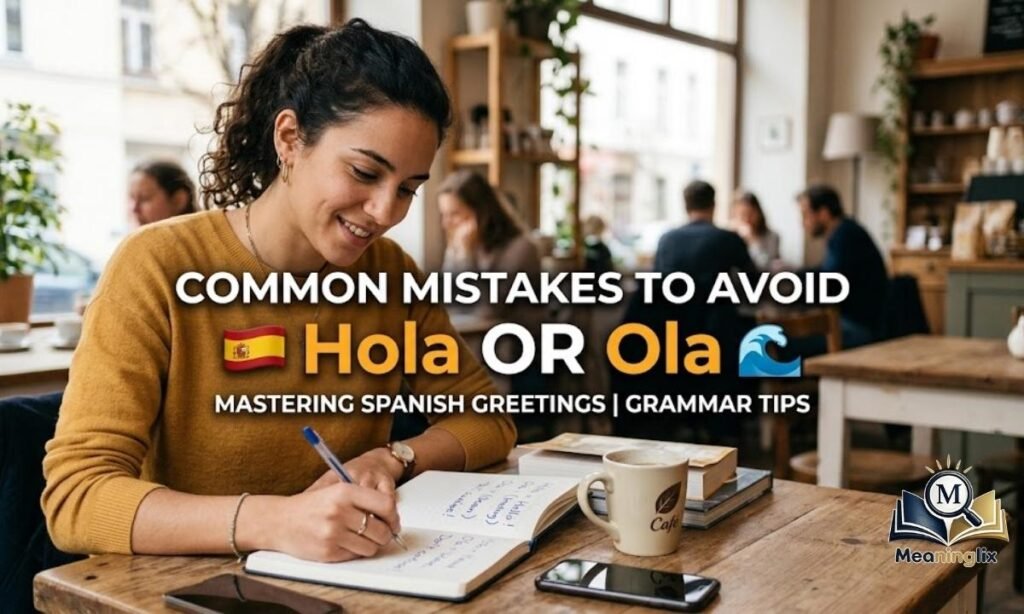
- Dropping the “H” out of habit. Many English speakers assume silent letters are optional. In Spanish, dropping the “H” from Hola creates a real, different word, so it is not just a stylistic choice.
- Using Ola as a greeting online. Autocorrect and fast typing often turn Hola into Ola in chats. Always double-check before sending a message, especially in professional settings.
- Assuming pronunciation reflects spelling. Since the “H” is silent, both words can sound alike out loud. This is exactly why the Hola or Ola confusion is a written mistake, not a spoken one.
Frequently Asked Questions (FAQs)
Is “Ola” a Spanish word too?
Yes. Ola is a valid Spanish word, but it means “wave,” not “hello.” It is completely unrelated to greetings.
Why do people confuse Hola or Ola so often?
Because the “H” in Hola is silent, both words sound almost identical when spoken. The confusion is purely a spelling issue, not a pronunciation one.
Which one is correct for saying hello in Spanish?
Hola is the only correct word for greeting someone in Spanish. Ola should never be used as a greeting.
Does English have an equivalent mix-up to Hola or Ola?
Yes, similar to how English speakers confuse “there,” “their,” and “they’re.” The words sound alike but serve completely different grammatical purposes.
Conclusion
When choosing between Hola or Ola, remember that only Hola works as a greeting, while Ola describes a wave. Keep the “H is for Howdy” trick in mind, and you will never confuse the two again, whether you’re texting a friend or writing a formal email.
Mastering the difference between Hola or Ola takes less than a minute, but it instantly improves your written Spanish accuracy. Practice spotting the silent “H,” and this common mix-up will disappear from your writing for good.

Alisha Lehmann is the founder and author of Meaninglix. She specializes in explaining word meanings, internet slang, abbreviations, grammar, and English expressions in simple, accurate language. Her goal is to help readers improve their vocabulary and communicate confidently through clear, well-researched, and easy-to-understand content.
1 thought on “Hola or Ola: The Powerful Grammar Guide 2026?”