You are scrolling through a group chat when a friend drops “IMAO, pineapple belongs on pizza.” You pause. Is that a typo for LMAO? Is it an insult? A joke?
It is a joke, most of the time. IMAO is a small piece of internet slang with a bold personality, and it is easy to misread because it looks almost identical to a far more common acronym. This guide explains what IMAO means, where it came from, how to use it, and how to avoid awkward mix-ups, with real examples you can copy.
Table of Contents
Quick Answer: What Does IMAO Mean in Text?
IMAO stands for “in my arrogant opinion.” It is a tongue-in-cheek twist on IMHO (“in my humble opinion”). People type it before a personal take to sound playfully confident, sarcastic, or jokingly self-important. It does not mean “laughing my ass off,” which is LMAO.
Quick facts:
- Full form: in my arrogant opinion
- Type: internet and texting acronym
- Tone: playful, cheeky, sometimes sarcastic
- Most common mix-up: LMAO
- Best used: casual chats, social media, friendly debates
What Does IMAO Stand For?
The letters break down like this:
- I = in
- M = my
- A = arrogant
- O = opinion
It was built as the cheeky opposite of IMHO. Where IMHO pretends to be modest, IMAO openly admits the speaker thinks they are right. That is the whole joke.
The acronym is older than most people expect. Early examples show up in Usenet discussion groups around 1989, in a debate about a jam band’s catalog, where users ranked different eras of the group. It appeared mostly in arguments and heated topics at first, and it carried a bit of force along with the irony. As it moved into everyday chat in the 1990s and 2000s, its tone softened. It never became as popular as IMHO, which is why many people still meet it for the first time as a confusing text.
Why Does “Arrogant” Matter?
The word “arrogant” is what sets IMAO apart from every other opinion acronym. Most opinion tags try to soften a statement. IMAO does the opposite.
By labeling your own view as arrogant, you are saying two things at once:
- “I am very sure about this.”
- “I know that sounds a bit much, so I am laughing at myself.”
That self-aware wink keeps the message friendly. Without it, a strong opinion can sound like a lecture. With it, you sound confident and funny instead of harsh.
| Also Read These Trending Slangs |
| JOI Meaning: Discover What It Really Means in Text! |
| IGU Meaning In Text: Discover What It Really Means! |
What Does IMAO Mean in a Text Message?
In a text message, IMAO flags a strong opinion that you are delivering with humor. It usually appears at the start of a sentence, though some people tack it on at the end.
Examples:
- “IMAO, that was the best episode of the season.”
- “Nobody makes better fries than that place, imao.”
The reader should take it as a lighthearted push, not a fight. If the rest of the message is warm, the acronym is warm too.
IMAO Meaning in Text From a Girl
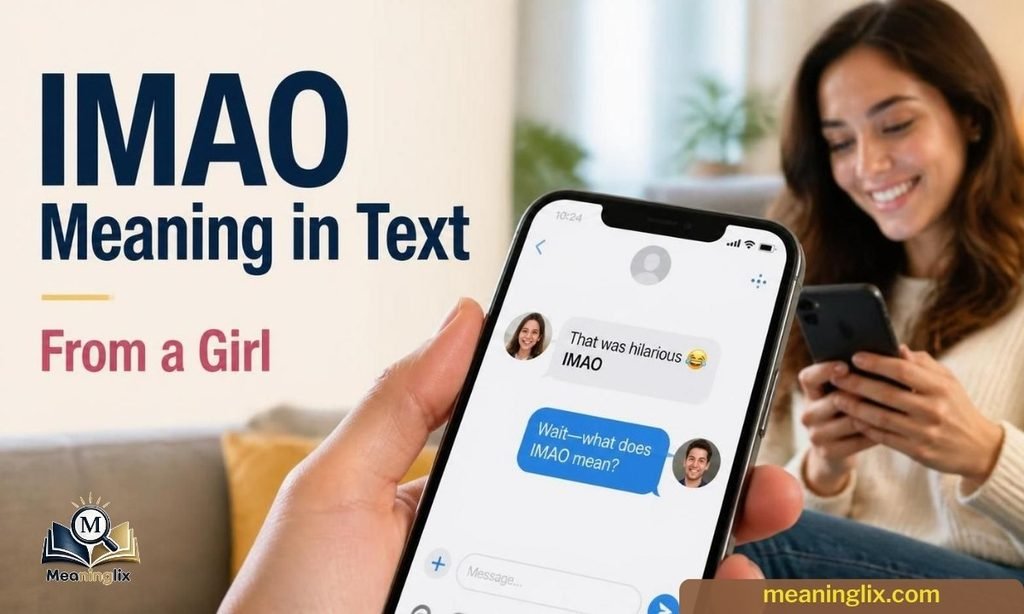
When a girl sends IMAO, the meaning does not change. It still stands for “in my arrogant opinion,” and gender has no effect on how the acronym works.
What matters is the conversation around it. Here is how to read the common situations:
- Friend chat: She is teasing or showing off about a favorite thing. Reply with a joke.
- Someone you are dating or getting to know: It is usually flirty banter. She is playing confident and inviting you to push back.
- Group chat: It is a light way to share a hot take without starting drama.
If you are unsure, look at her emojis and punctuation. Laughing emojis and exclamation marks point to playful. A flat, short reply with no emoji might mean she is actually irritated, so ask rather than guess.
IMAO Isn’t Automatically a Serious Insult
Because the word “arrogant” sounds negative, some people assume IMAO is rude. It usually is not.
Think about how people use the word “bossy” with friends or say “fight me” about pizza toppings. The harshness is fake. IMAO works the same way. The label is exaggerated on purpose, so the person receiving it knows not to take it at face value.
It can turn sharp when paired with a cold tone or an insulting comment, but the acronym itself is not the problem. The surrounding words are.
IMAO vs. IMHO: What’s the Difference?
IMHO means “in my humble opinion” (some people read the H as “honest”). It softens a view and invites discussion. IMAO does the reverse by amplifying your confidence for comedic effect.
| Feature | IMAO | IMHO |
| Full form | In my arrogant opinion | In my humble opinion |
| Tone | Cheeky, bold | Polite, modest |
| Goal | Joke about your confidence | Soften your view |
| Popularity | Less common | Very common |
| Best for | Banter with friends | Everyday discussion |
IMAO Is Essentially a Confidence Joke
The easiest way to remember IMAO is to treat it as a confidence joke. You are making a claim and laughing at how sure you sound.
Compare these two lines:
- “Cats are better than dogs.” (flat, could start an argument)
- “IMAO, cats are better than dogs.” (same claim, but now it is clearly a bit)
The second one invites a playful reply. That small shift is why people reach for the acronym.
Is IMAO the Same as LMAO?
No. They are completely different, and this is the biggest source of confusion.
IMAO
IMAO means “in my arrogant opinion.” It introduces a viewpoint and does not express laughter at all.
LMAO
LMAO means “laughing my ass off.” It reacts to something funny and shows strong amusement.
What About LMFAO?
LMFAO is the louder cousin of LMAO, with an extra intensifier in the middle. It signals even bigger laughter. It has nothing to do with opinions.
Why the mix-up happens: in most modern fonts, a capital “I” and a lowercase “l” look nearly the same. So “IMAO” and “lmao” can appear identical on a screen. Some people also type IMAO by mistake when they mean LMAO, which makes things even murkier. When in doubt, check the sentence. If it follows a joke and reacts to it, it is probably LMAO. If it introduces a take, it is IMAO.
| Acronym | Meaning | Used to |
| IMAO | In my arrogant opinion | Share a bold opinion |
| LMAO | Laughing my ass off | React to humor |
| LMFAO | Laughing my f***ing ass off | Show intense laughter |
How to Use IMAO in a Sentence
Placement is simple. Put it at the start, or at the end for a more casual feel. Keep the topic light.
Use IMAO Before a Personal Opinion
- “IMAO, the sequel was better than the original.”
- “IMAO, rainy days are perfect for staying in.”
Use IMAO for a Strong Preference
- “IMAO, nothing beats a hot cup of coffee in the morning.”
- “IMAO, window seats are the only real seats.”
Use IMAO for Playful Bragging
- “IMAO, my playlist is flawless.”
- “IMAO, I make the best pancakes in this friend group.”
Use IMAO During a Friendly Debate
- “IMAO, you are wrong, but I love you anyway.”
- “IMAO, that argument does not hold up, but nice try.”
IMAO Meaning in Text: Realistic Examples
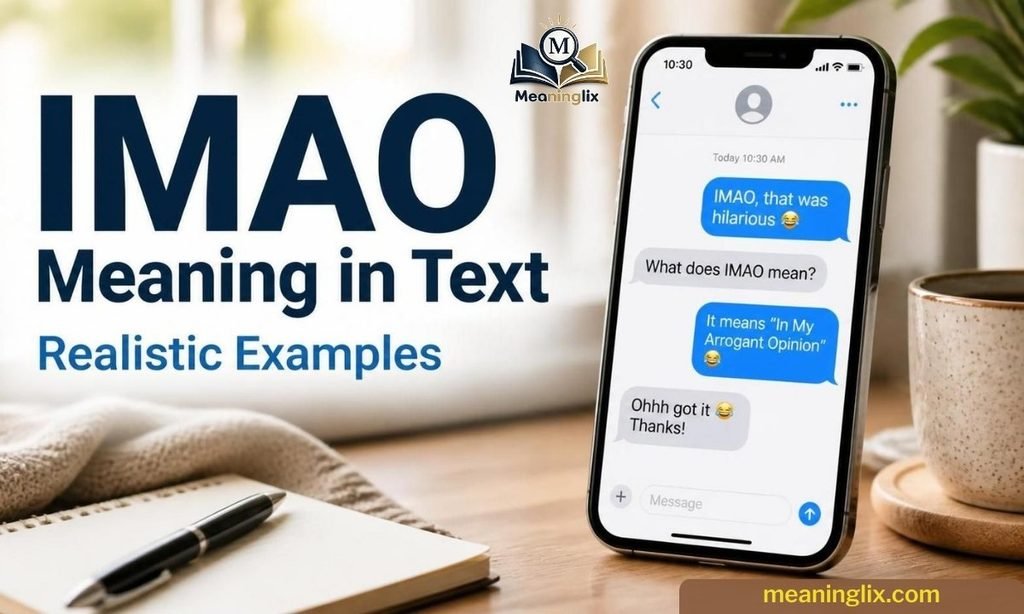
Here are examples across common topics, written the way real people text.
Example: Music
“IMAO, that album was her best work. Nothing else comes close.”
Example: Food
“IMAO, breakfast for dinner is the greatest invention ever.”
Example: Movies
“IMAO, the book ending was better, but the movie soundtrack wins.”
Example: Sports
“IMAO, we have the best defense in the league this year.”
Example: Gaming
“IMAO, that boss fight is the hardest in the whole series.”
Example: Friendly Bragging
“IMAO, I parallel parked that in one try. Applause accepted.”
What Tone Does IMAO Convey?
IMAO has a flexible tone. It leans on whatever context surrounds it.
Playful
The most common use. It teases, jokes, and keeps things light between friends.
Sarcastic
Sometimes people use it to mock overly confident opinions, including their own. For example: “IMAO, Mondays are the best day of the week.”
Confident
The speaker really does believe their view and wants it heard, but uses humor to avoid sounding stiff.
Genuinely Arrogant
Rare, but possible. In a heated argument, a person can use IMAO with a sharp edge. In that case the acronym is not a joke but a jab.
Context Determines the Meaning
Always look at the full picture: who is texting, what they said before, what emojis or punctuation follow, and how well you know them. The same four letters can be warm in one chat and cold in another.
When Should You Use IMAO?
IMAO works best when the stakes are low and the audience is friendly. Use it:
- In casual texts with friends or family
- In group chats and social media comments
- When sharing a fun hot take about food, music, or entertainment
- When you want to tease someone lightly
- When you want to poke fun at your own confidence
When Should You Avoid IMAO?
Skip it when tone can easily go wrong.
- In work emails or professional chats
- With people who may not know the acronym
- During serious or emotional conversations
- When someone is upset or grieving
- In any situation where “arrogant” could land as a real insult
A quick test: if you would not say “in my arrogant opinion” out loud to that person, do not type it.
IMAO vs. Other Opinion Acronyms
IMAO belongs to a family of opinion tags. Each one signals a different level of confidence.
| Acronym | Full form | Tone |
| IMO | In my opinion | Neutral |
| IMHO | In my humble opinion | Modest |
| IME | In my experience | Experience-based |
| IMNSHO | In my not so humble opinion | Mildly boastful |
| IMAO | In my arrogant opinion | Playfully bold |
| IMMAO | In my most arrogant opinion | Extra bold, exaggerated |
IMAO vs. IMO
IMO is the plain version. It simply labels a statement as your view, with no attitude attached. IMAO adds personality and humor.
IMAO vs. IMHO
IMHO sounds polite and cooperative. IMAO sounds cocky on purpose. Use IMHO to soften a disagreement and IMAO to joke through one.
IMAO vs. IME
IME (“in my experience”) grounds your point in something you lived through. It is about credibility, not attitude. IMAO has nothing to say about experience, only about confidence.
Is IMAO a Common Texting Acronym?
Not really. It is known, but it never became as widespread as LOL, OMG, or IMHO. Many people have never used it, and plenty of readers mistake it for LMAO.
That rarity cuts two ways. On one hand, using it can make you sound witty to people who know it. On the other, you may need to explain yourself. In 2026, as chat apps lean more on voice notes, reaction emojis, and short video replies, text acronyms like IMAO survive mostly in comment sections, group chats, and forums. If your audience is under 20, they may know it from memes or older internet culture rather than from daily use.
Can You Use IMAO in Formal Writing?
No. IMAO is slang, and it is deliberately jokey. It does not belong in emails to managers, school essays, reports, resumes, or client messages.
Better Formal Alternatives
If you want to state a strong view in a professional setting, try:
- “In my view,”
- “I firmly believe that”
- “From my perspective,”
- “My assessment is that”
- “Based on my experience,”
These are clear, confident, and appropriate for any workplace.
Common Misunderstandings About IMAO
“IMAO Means LMAO”
False. LMAO expresses laughter. IMAO introduces an opinion. The look-alike letters and the shared “MAO” ending cause most of the confusion.
“Anyone Who Uses IMAO Is Arrogant”
Not true. People use it because they know it sounds arrogant and want to joke about that. Truly arrogant people rarely label themselves as such.
“IMAO Always Sounds Sarcastic”
It can, but not always. Sometimes it is simply playful or confident. Tone depends on context.
“IMAO and IMHO Mean the Same Thing”
They share a structure but have opposite attitudes. One is humble, the other is boastful.
“IMAO Works in Every Situation”
It does not. Formal settings, serious talks, and unfamiliar audiences are all poor fits.
Case Study: How Context Changes the Meaning of IMAO
Take the same message, “IMAO, you made a mistake,” in three situations.
Situation 1: Two friends playing a board game. One jokes after a bad move. The tone is teasing. Reaction: laughter.
Situation 2: Coworkers in a project chat. The same words feel blunt and a little rude. Reaction: awkward silence or a defensive reply.
Situation 3: Someone texting a friend who is already upset. It lands as cold and judgmental. Reaction: hurt feelings.
The Lesson
The acronym did not change. The relationship, mood, and setting did. Before you send IMAO, ask yourself whether the person will read it as a joke. If you are not sure, rephrase.
How to Respond When Someone Texts “IMAO”
Your reply depends on how you feel about their opinion and how well you know them.
If You Agree
Keep it simple and warm.
- “Honestly, same.”
- “Facts. No notes.”
If You Disagree
Match their playful tone so it stays friendly.
- “Bold take. I respectfully disagree.”
- “IMAO, you are wrong, but go off.”
If They’re Clearly Joking
Play along.
- “Your confidence is unmatched.”
- “Wow, tell us how you really feel.”
If You Want to Tease Them
Use light humor.
- “Somebody woke up opinionated.”
- “Humble as always, I see.”
If You Don’t Understand the Acronym
Just ask. A quick “Wait, do you mean in my arrogant opinion or lmao?” clears it up in seconds, and nobody will think less of you.
IMAO Meaning in Social Media Conversations
On social platforms, IMAO shows up in comment threads, replies, and posts where people argue about movies, music, sports, and food. It signals that the commenter knows their take is spicy.
A few patterns you will see:
- Comment sections: short takes like “imao, this is her best song.”
- Reply threads: a cheeky answer to a hot take.
- Forums: longer debates where users mix IMAO and IMHO to switch tone.
Because lowercase text is common online, “imao” can easily be read as “lmao.” Social media readers often work out the meaning from the surrounding comments, so check the thread before replying.
Why People Use IMAO Instead of “In My Opinion”
People pick IMAO over a plain “in my opinion” for a few simple reasons:
- Humor. It adds a joke to a statement that might otherwise feel heavy.
- Personality. It shows you do not take yourself too seriously.
- Softening a strong claim. Calling your own view arrogant takes the edge off.
- Speed. Four letters beat four words, especially on a phone.
- Group identity. Using niche slang signals that you belong to a certain online crowd.
FAQs
What does “lmao” mean in text?
LMAO means “laughing my ass off.” People send it when something is very funny. It is stronger than LOL but not quite as intense as LMFAO.
What does imao mean?
IMAO means “in my arrogant opinion.” It is a playful twist on IMHO and is used to share a bold opinion in a joking, self-aware way.
What does IMAO stand for in Gen Z slang?
In Gen Z slang, IMAO still stands for “in my arrogant opinion.” Younger users mostly see it in memes, comment sections, and group chats, and many treat it as a cheeky way to share a hot take. Since it looks like LMAO, context is what keeps it clear.
What does imao and lmao mean?
IMAO means “in my arrogant opinion” and introduces a view. LMAO means “laughing my ass off” and reacts to something funny. One shares an opinion, the other shows laughter.
Conclusion
IMAO means “in my arrogant opinion,” a playful take on IMHO that lets you share a strong view without sounding stiff. It is usually a joke, rarely an insult, and almost always depends on tone and context to land well. Keep it for casual chats, friendly debates, and light bragging, and avoid it in work or serious conversations.
If you ever see IMAO and feel unsure, read the sentence around it. An opinion points to IMAO, and a reaction to something funny points to LMAO. When you still cannot tell, ask. A quick question beats a misread message every time.

Alisha Lehmann is the founder and author of Meaninglix. She specializes in explaining word meanings, internet slang, abbreviations, grammar, and English expressions in simple, accurate language. Her goal is to help readers improve their vocabulary and communicate confidently through clear, well-researched, and easy-to-understand content.
2 thoughts on “IMAO Meaning in Text: Discover What It Really Means!”