
If you have ever typed a sentence and paused, wondering whether it should read “input” or “imput,” you are not alone. This is one of the most common spelling mix ups in everyday writing, especially in technology, business, and academic contexts. The debate around Input vs. Imput keeps popping up in search bars because the two words look and sound almost identical when spoken quickly.
This guide settles the confusion once and for all. By the end, you will know exactly which spelling to use, why the mistake happens so often, and how to avoid it permanently.
Table of Contents
Input vs imput meaning
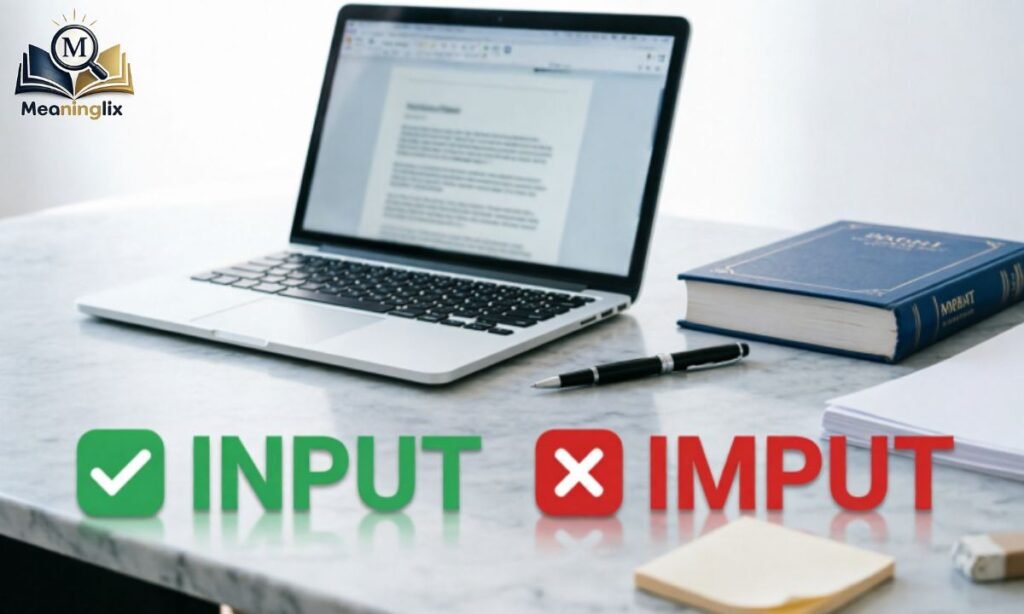
Input is a real, standard English word that means information, data, energy, or effort that goes into a system, process, or discussion. Imput is not a recognized word in any major English dictionary. When people search for Input vs. Imput, the answer is simple: only “input” is correct, and “imput” is a misspelling that likely comes from confusion with words like “impute” or “import.”
Click Here To Read More Grammar
The Correct Spelling: “Input” (Not “Imput”)
Let’s be direct. “Input” is the only accepted spelling. It appears in every major dictionary, including Merriam Webster, Cambridge, and Oxford, and it is used across countless fields such as computing, linguistics, economics, and everyday conversation.
“Imput” does not appear in any standard dictionary. It has no accepted definition, no grammatical function, and no historical usage in formal English writing. Whenever this topic comes up as Input vs. Imput, the correct choice is always “input.”
Here is a simple breakdown:
| Term | Status | Meaning |
| Input | Correct | Data, information, effort, or energy entered into a system or process |
| Imput | Incorrect | Not a recognized English word |
Understanding this distinction early makes the rest of the Input vs. Imput conversation much easier to follow.
Why Do People Misspell “Input” as “Imput”?

Spelling errors rarely happen randomly. There is almost always a linguistic reason behind them, and the Input vs. Imput confusion is no exception.
Here are the most common reasons this mistake occurs:
- Phonetic blending: When spoken casually, “input” can sound like it has an “m” sound due to the way the “n” and “p” blend together in fast speech.
- Confusion with similar words: Words like “impute,” “import,” and “impact” share a similar rhythm and structure, which can cause the brain to auto correct “input” into a word pattern it recognizes more strongly.
- Typing speed errors: Fast typists sometimes swap adjacent letters or insert an extra letter without noticing, especially on mobile keyboards.
- Non-native English influence: Learners transitioning from languages where nasal sounds shift before certain consonants may naturally lean toward the “m” sound.
- Autocorrect gaps: Some spell checkers do not flag “imput” as an error because it resembles a proper noun or technical term in certain software environments.
Recognizing these triggers is the first step toward permanently avoiding the mistake.
Input vs Imput
To make the comparison crystal clear, think of it this way: “input” follows the standard English prefix “in” combined with “put,” meaning something is placed into a system. “Imput” does not follow any recognizable prefix or root structure in English, which is exactly why it fails as a legitimate word.
When you are deciding between Input vs Imput, remember that only one option has linguistic logic behind it. “In” plus “put” literally describes the act of putting something in, whether that is data, energy, or an opinion.
How to Use “Input” Correctly
“Input” is a flexible word that functions as both a noun and a verb depending on the sentence.
Input as a Noun
As a noun, “input” refers to information, data, or contribution provided to a system, process, or discussion.
Examples:
- The team needs more input before finalizing the marketing plan.
- The computer processes input from the keyboard and mouse.
- Her input during the meeting changed the direction of the project.
Input as a Verb
As a verb, “input” means to enter data or information into a system, often digitally.
Examples:
- Please input your details into the online form.
- The technician will input the new settings tonight.
- Employees are required to input their hours daily.
Both uses are grammatically correct and widely accepted, which is another reason “input” remains the clear winner in the Input vs. Imput discussion.
Common Phrases and Collocations with “Input”
Certain word pairings appear frequently in professional and everyday English. Familiarizing yourself with these can strengthen both your writing and your understanding of correct usage.
- Provide input
- Seek input
- User input
- Data input
- Sensory input
- Input device
- Input field
- Valuable input
- Input required
- Input validation
Notice how none of these common collocations ever use “imput.” That absence alone reinforces why the Input vs. Imput debate always resolves in favor of the correct spelling.
Input vs Imput – Detailed Comparison
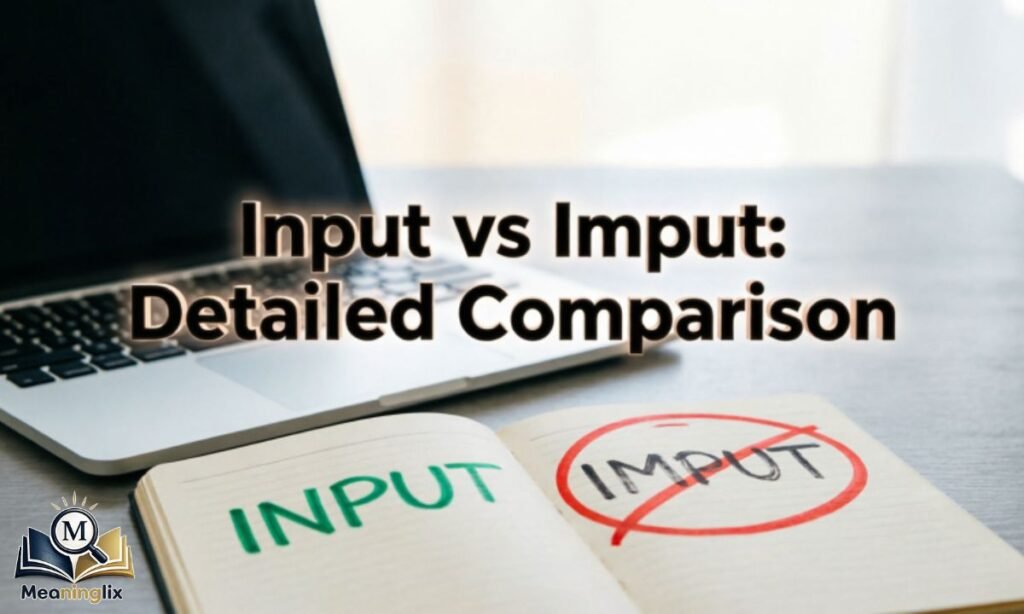
Here is a deeper side by side comparison to fully clarify the differences.
| Category | Input | Imput |
| Dictionary recognized | Yes | No |
| Grammatical function | Noun and verb | None |
| Common usage | Technology, business, academia, daily speech | Not used in formal writing |
| Origin | Old English roots (“in” + “put”) | No verified linguistic origin |
| Frequency in professional documents | Extremely high | Nearly nonexistent, usually a typo |
| Spell checker recognition | Fully recognized | Often flagged as incorrect |
This table makes the Input vs. Imput comparison easy to reference whenever you need a quick refresher.
Quick Tips to Remember the Correct Spelling
Here are some practical memory tricks to help you avoid the mistake permanently.
- Think “in” plus “put”: Remember that input simply means putting something in.
- Say it slowly: Slowing down your pronunciation helps you hear the “n” clearly instead of blending it into an “m” sound.
- Compare with “output”: Since nobody misspells “output” as “omput,” using this pairing can reinforce the correct spelling of “input” too.
- Use spell check actively: Most modern word processors will underline “imput” as an error, so pay attention to those flags.
- Practice with real sentences: Writing a few sentences daily using “input” correctly builds long term muscle memory.
These small habits make a noticeable difference over time, especially for professionals who write frequently in technical or business settings.
FAQ’s
Is “imput” ever the correct spelling for data entry?
No. “Imput” is never correct in any context, including data entry, technology, or casual writing. The only accepted spelling is “input.”
Why do people mistakenly spell it as “imput”?
This usually happens due to phonetic blending during fast speech, confusion with similar sounding words like “impute,” or simple typing errors, especially on mobile devices.
Are there any situations where “imput” is a real word?
No recognized dictionary lists “imput” as a valid word in any context, formal or informal. It is always considered a misspelling of “input.”
How can I prevent myself from typing “imput” by mistake?
Slow down while typing, rely on spell check tools, and practice writing full sentences with “input” until the correct spelling becomes automatic.
How do you spell the plural of input?
The plural form is “inputs,” used when referring to multiple pieces of data, contributions, or resources entering a system.
Conclusion
The Input vs. Imput debate has a clear and simple answer. “Input” is the only correct spelling, supported by every major dictionary and used consistently across technology, business, and everyday communication. “Imput” is a common misspelling that usually results from phonetic confusion or fast typing, not an actual alternative spelling.
By understanding the meaning, structure, and common usage patterns of “input,” along with practical memory tricks, you can confidently avoid this mistake in your writing from now on. Whenever the question of Input vs. Imput comes up again, you will already know the answer.

Alisha Lehmann is the founder and author of Meaninglix. She specializes in explaining word meanings, internet slang, abbreviations, grammar, and English expressions in simple, accurate language. Her goal is to help readers improve their vocabulary and communicate confidently through clear, well-researched, and easy-to-understand content.
1 thought on “Input vs. Imput: The Ultimate Spelling Guide 2026”