Pre vs Post: You’ve probably typed “pre approved” and then paused, wondering if it should be “post approved” instead. Or maybe you’ve seen “pretest” and “posttest” in the same paragraph and felt a tiny flicker of doubt. That doubt is normal, and it’s exactly what this guide fixes.
Pre means before something happens, and post means after it happens. That’s the whole rule in one sentence. “Pre” comes from Latin, meaning “in front of” or “earlier than,” while “post” also comes from Latin, meaning “after” or “behind.” Once you lock that timeline into your head, every word built from these prefixes becomes easy to predict.
Now let’s dig into where these two little prefixes came from, how they behave in real sentences, and where even confident writers still trip up.
Table of Contents
What Does “Pre” Mean?
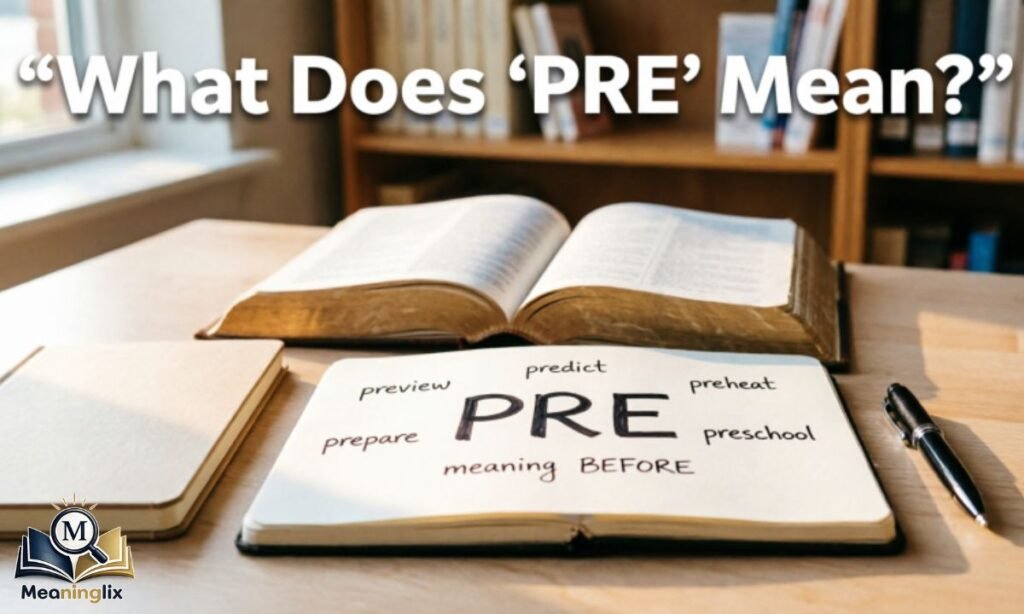
Pre signals that something happens before a main event, action, or condition. It’s a prefix, not a full word, so it always attaches to another term to shift its meaning earlier in time.
Think of “preheat.” You heat the oven before you actually bake anything. The action described by “heat” hasn’t started yet in the real sense; you’re just getting ready for it.
Other everyday examples include:
- Preview (see before the full release)
- Prepay (pay before receiving the service)
- Preschool (school before elementary school)
- Precaution (a step taken before a problem occurs)
Notice the pattern? Each word describes an action that sets the stage for something bigger that comes later.
What Does “Post” Mean?
Post flips the timeline. It means after, following, or later than a specific point.
“Postgame” is the conversation that happens once the game is already over. “Postpone” literally means to place an event after its original time. And “postmortem,” used in medicine and business alike, refers to an examination that happens after death or after a project ends.
A few more common ones:
- Postpartum (the period after childbirth)
- Postscript (a note added after the main letter, also known as P.S.)
- Postgraduate (studies pursued after finishing a graduate degree)
- Post-mortem review (analysis done after a project wraps up)
If “pre” is the setup, “post” is the wrap-up. Simple as that.
Pre vs Post: Quick Comparison Table
Sometimes a table clears things up faster than three paragraphs ever could Pre vs Post.
| Feature | Pre | Post |
| Meaning | Before, earlier than | After, later than |
| Origin | Latin “prae” | Latin “post” |
| Timing | Happens first | Happens second |
| Example word | Preheat | Postgame |
| Common field | Planning, preparation | Review, analysis, follow up |
| Opposite of | Post | Pre |
Keep this table bookmarked. It answers 90 percent of the “which one do I use” moments you’ll ever run into.
Where Do Pre vs Post Come From?

Both prefixes trace back to Latin, and honestly, Latin gave English a lot of shortcuts for describing time. “Prae” meant “before” or “in front,” and it slipped into English through French and directly from Latin texts centuries ago.
“Post” came the same route. Roman writers used it to mean “behind” or “after,” and English absorbed it almost unchanged, which is rare for a borrowed word.
Here’s a fun historical detail most articles skip: Latin speakers didn’t just use these as prefixes attached to nouns. They used “prae” and “post” as standalone prepositions in full sentences, similar to how English uses “before” and “after” today. Over time, English grammar fused them directly onto root words instead of leaving them as separate terms, which is why we now write “prewash” as one word instead of “wash before.”
Are Pre vs Post Used in the Bible or Historical Texts?
Yes, (Pre vs Post ) and this is where it gets interesting for anyone curious about the deeper roots.
Biblical scholars and translators regularly use “pre” and “post” when discussing timelines, such as “pre exilic” (before the Babylonian exile) and “post exilic” (after the Babylonian exile) periods in Hebrew scripture. These terms help historians mark clear before and after points around major events like the exile, the resurrection, or the writing of specific texts.
You’ll also see “pre Christian era” and “post Christian era” used in historical scholarship to describe periods relative to a defining event, even outside strictly religious writing. This shows the prefixes aren’t just modern shortcuts. They’ve been doing serious historical heavy lifting for centuries, helping scholars organize events around a fixed point in time.
How Do You Use Pre vs Post Correctly in a Sentence?
The grammar rule is refreshingly simple: attach the prefix directly to the word it modifies, usually without a space, and sometimes with a hyphen depending on the word and style guide you follow.
Correct usage examples:
- “The doctor scheduled a preop consultation for Tuesday.”
- “We reviewed the numbers during the postmortem meeting.”
- “She felt nervous during the pretest jitters.”
- “The team held a postgame interview near the locker room.”
A quick style note: newer or less common combinations often keep a hyphen, like “pre-approval” or “post-surgery,” while older, more established words drop it entirely, like “preview” or “postpone.” When you’re unsure, check a current dictionary rather than guessing, since usage shifts over time.
“Pre Approved” or “Post Approved”: Which One Is Correct? ( Pre vs Post )
This one trips up a lot of people in finance and shopping contexts. The correct phrase is almost always “pre approved,” because it describes approval that happens before you formally apply or before the final decision is confirmed.
“Another single-space mix-up? Check out our myself vs. my self guide too.”
“Post approved” isn’t standard English. Once something is approved, you’d simply say it “was approved” or is “post approval,” describing the stage after approval, not the approval itself. So a credit card company sends a “pre approved” offer, and once you accept it, you’re in the “post approval” process, not “post approved.”
Take Effect or Take Affect: Which Is Correct?

Since this confusion often shows up right alongside pre and post timing questions, let’s clear it up here too.
“Take effect” is correct. “Effect” is a noun meaning a result, and “take effect” means a rule, law, or change officially starts working. “Affect” is almost always a verb meaning to influence something, so “take affect” is a common but incorrect phrase.
Example: “The new tax law will take effect on January 1st, and it will affect small business owners the most.” See how effect is the noun tied to the starting point, while affect is the verb describing the influence? Once you separate noun from verb, this mistake disappears for good.
Common Mistakes People Make With Pre vs Post
Even experienced writers slip up here, so don’t feel bad if you’ve made one of these before.
- Mixing up direction: Writing “postview” instead of “preview” when describing something shown in advance.
- Adding unnecessary hyphens: Writing “pre-view” when “preview” has been one solid word for decades.
- Confusing pre approved with post approved, as covered above.
- Using “post” when they mean “after” a specific date instead of after an event, which usually calls for a phrase like “as of” instead.
- Forgetting subject-verb agreement after attaching the prefix, like writing “The postgame conference were held” instead of “was held.”
Most of these mistakes come from rushing, not from a lack of understanding. Slow down for one extra second before hitting publish, and you’ll catch nearly all of them.
Pre vs Post: Which One Should You Use?
Ask yourself one question: has the main event already happened ( Pre vs Post )?
If the answer is no, and you’re describing something that happens beforehand, use pre. If the answer is yes, and you’re describing something that follows, use post.
A simple mental trick: picture a finish line. Everything leading up to it is “pre,” and everything after crossing it is “post.” That single image solves almost every mix-up.
Related Terms You Should Know ( Pre vs Post )
A couple of nearby concepts often show up in the same conversation as pre and post:
- Prefix vs suffix: “Pre” and “post” are prefixes because they attach to the front of a word. A suffix, like “-ing” or “-ed,” attaches to the end instead.
- Antonym pairs: Pre and post function as natural opposites, much like “before” and “after” or “start” and “finish.”
Keeping these related ideas in mind helps you spot patterns faster the next time you run into an unfamiliar word built from either prefix.
Frequently Asked Questions ( Pre vs Post )
Is it “pre” or “post” pandemic?
Both exist and mean different things. “Pre pandemic” describes life or conditions before the pandemic started, while “post pandemic” describes the period after it ended or significantly slowed down. You choose based on which side of the timeline you’re describing.
Does “post” always mean after a date?
No. “Post” usually means after an event, not strictly a date. For example, “postgame” refers to after the game ends, not after a specific calendar date. When you specifically mean after a date, phrases like “as of” or “effective” often read more naturally.
Can “pre” and “post” be used without a hyphen?
Yes, and many common words never use one at all, such as “preview,” “postpone,” and “prepay.” Newer or less familiar combinations sometimes keep the hyphen for clarity, but there’s no universal rule forcing you to include it.
Final Thoughts
Once you separate these Pre vs Post two prefixes by timeline instead of trying to memorize word lists, the confusion disappears almost instantly. Pre means before, post means after, and every example you’ll ever run into follows that same straight line.
Next time you’re stuck between “pre” and “post,” picture that finish line again. It’s a small trick, but it works every single time.

Alisha Lehmann is the founder and author of Meaninglix. She specializes in explaining word meanings, internet slang, abbreviations, grammar, and English expressions in simple, accurate language. Her goal is to help readers improve their vocabulary and communicate confidently through clear, well-researched, and easy-to-understand content.
2 thoughts on “Pre vs Post: What’s the Real Difference? Perfect Guide 2026”