
You are writing an email or a report. You need a word for “making something stronger.” You type “reenforce.” Then you pause. Does that extra “e” belong there, or should it be “reinforce”?
This mix-up happens because both words sound almost identical when spoken. Your brain hears “ree-in-force” and isn’t sure how to spell it. The confusion is common, but the answer is simple.
“Reinforce” is the correct and standard spelling in modern English. It means to make something stronger or more effective, such as reinforcing a wall or reinforcing an idea. “Reenforce” is not a recognized standard spelling and is considered a misspelling in almost every dictionary and style guide. When comparing reinforce vs reenforce, always choose reinforce.
Table of Contents
Quick Comparison Table
| Feature | Reinforce | Reenforce |
| Grammatical Role | Verb (standard, dictionary-recognized) | Nonstandard spelling variant |
| Key Meaning | To strengthen, support, or add force to something | Same intended meaning, but incorrect spelling |
| Best Used For | All formal, academic, business, and casual writing | Never recommended; avoid entirely |
| Quick Example Sentence | “We need to reinforce the bridge before winter.” | “We need to reenforce the bridge before winter.” (incorrect) |
Click Here To Read More Grammar
Deep Dive: Reinforce (The Correct Spelling)

Reinforce is a verb built from the prefix “re-” (again) and the root “force.” Together, they describe the act of adding more strength or support to something that already exists. This is the version you will find in every major dictionary, including Merriam-Webster, Cambridge, and Oxford.
Grammatically, reinforce works as a regular transitive verb. That means it needs an object, the thing being strengthened. You reinforce a wall, a habit, a belief, or a team.
Here is why it matters in the reinforce vs reenforce debate: dictionaries, editors, and grammar checkers all recognize only one spelling as correct. That spelling is reinforce.
Real-world examples of reinforce in action:
- Workplace: “The manager reinforced the new safety policy during the meeting.”
- Casual writing: “I keep reinforcing good habits by writing them down every morning.”
- Academic writing: “The study reinforces earlier findings about sleep and memory.”
- Construction context: “Workers reinforced the foundation with steel bars before pouring concrete.”
Notice how reinforce fits naturally into any tone, from casual texts to formal reports. That flexibility is one reason it remains the only accepted choice in the reinforce vs reenforce comparison.
Deep Dive: Reenforce (The Common Misspelling)

Reenforce looks logical at first glance. Many English words do add “re-” directly onto a root word, like “redo” or “rewrite.” Some writers assume “force” should follow the same pattern with a double “e.”
However, reenforce is not an accepted English word. It does not appear as a standard entry in Merriam-Webster, Oxford, or Cambridge dictionaries. When people search reinforce vs reenforce, this is usually because they’ve seen “reenforce” somewhere and want to confirm if it’s real.
The confusion often comes from a related but different word: re-enforce (with a hyphen). This hyphenated form technically means “to enforce again,” as in enforcing a rule or law a second time. It is a narrow, rarely used construction and should not be confused with the everyday word reinforce.
Examples where reenforce is mistakenly used (and the correct fix):
- Incorrect: “Please reenforce the door lock.” Correct: “Please reinforce the door lock.”
- Incorrect: “The coach wants to reenforce our training routine.” Correct: “The coach wants to reinforce our training routine.”
- Incorrect: “This chart reenforces the sales trend.” Correct: “This chart reinforces the sales trend.”
In every one of these cases, reinforce is the word you actually want. Reenforce should not appear in your writing at all.
Key Differences and the Golden Rule to Remember
The core difference in reinforce vs reenforce comes down to one fact: only one of them is a real, dictionary-approved word.
Golden rule: Think of the word “force” by itself. You already spell it with one “e” at the start of the root. Simply add “re-” in front of it: re + force = reinforce. There is no reason to add a second “e.”
A simple memory trick: picture a rein (as in horse reins) plus force. “Rein-force” gives you the correct spelling pattern instantly. If you ever type “reenforce,” stop and swap in “reinforce” before you hit send.
Real-World Context and Usage Examples
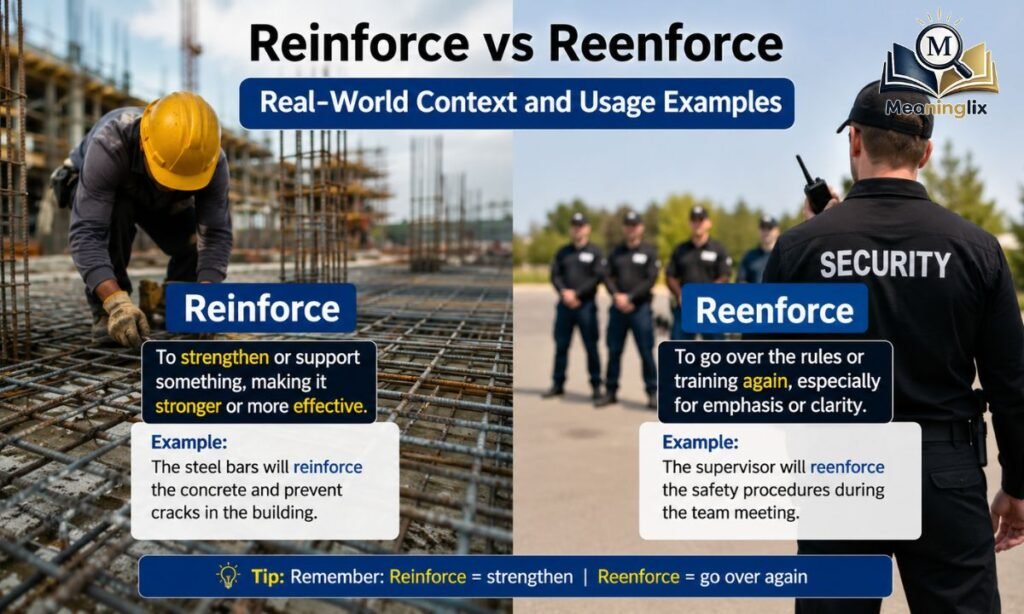
Professional and email etiquette: Business writing demands accuracy, since spelling errors can affect how credible you seem. Always write “reinforce” in emails, reports, and presentations. For example, “This report reinforces the need for additional staff training.”
Casual conversation: In everyday speech, the spelling issue rarely comes up since you’re speaking, not writing. But in texts or social media posts, stick with reinforce to keep your writing clean and correct.
Formal and academic writing: Academic papers, research summaries, and formal essays require strict grammar accuracy. Reviewers and professors will flag “reenforce” as a spelling mistake. Always default to reinforce in essays, theses, and published work.
Common Mistakes to Avoid
- Adding an extra “e” out of habit. Many writers assume doubling letters sounds more formal. It does not. Fix it by remembering the simple rule: re + force, one “e” only.
- Confusing reenforce with re-enforce. The hyphenated form re-enforce technically exists in narrow legal or policy contexts, meaning to enforce a rule again. It is not interchangeable with the everyday word reinforce, and it’s rarely needed in normal writing.
- Trusting autocorrect blindly. Some tools do not flag reenforce as an error, especially in casual typing apps. Double-check with a dictionary if you’re ever unsure.
Frequently Asked Questions (FAQs)
Is “reenforce” ever correct in English?
No. Reenforce is not listed as a standard word in major dictionaries. The correct spelling is always reinforce, whether you’re writing formally or casually.
What is the difference between reinforce and re-enforce with a hyphen?
Reinforce means to strengthen or support something, like reinforcing a wall or an idea. Re-enforce, with a hyphen, is a rare form meaning to enforce a rule or law again. These are different words with different meanings, even though they look similar.
Why do so many people confuse reinforce vs reenforce?
The confusion happens because the words sound nearly identical when spoken aloud. Since English spelling doesn’t always match pronunciation, writers guess at the spelling and sometimes add an unnecessary extra “e.”
How can I remember the correct spelling of reinforce?
Break the word into “rein” and “force.” Picturing a horse’s reins paired with the word force helps many learners lock in the correct spelling pattern permanently.
Conclusion
When it comes to reinforce vs reenforce, the choice is clear: reinforce is the only correct, dictionary-recognized spelling, and reenforce should be avoided in all forms of writing. Keep the simple “re + force” rule in mind, and you’ll never second-guess this word again.
Whether you’re writing a business email, an academic paper, or a quick text message, reinforce is the safe, accurate, and professional choice every time.

Alisha Lehmann is the founder and author of Meaninglix. She specializes in explaining word meanings, internet slang, abbreviations, grammar, and English expressions in simple, accurate language. Her goal is to help readers improve their vocabulary and communicate confidently through clear, well-researched, and easy-to-understand content.
2 thoughts on “Reinforce vs Reenforce: The Powerful Spelling Guide 2026”