Typing fast on your phone or writing an email in a hurry can easily lead to a spelling slip. One of the most common mix-ups in English writing is Envolved or Involved. Many people search for this because the wrong version looks like it could be right, especially since it sounds almost identical when spoken.
Quick Answer: The correct spelling is Involved, not “Envolved.” “Envolved” is a common misspelling with no meaning in standard English dictionaries. Involved is a real word meaning connected to, participating in, or affected by something. Whenever you compare Envolved or Involved, remember that only “Involved” is grammatically and officially correct.
Table of Contents
Quick Comparison Table
| Feature | Envolved | Involved |
| Grammatical Role | Not a word (misspelling) | Verb (past tense/adjective) |
| Key Meaning | No dictionary meaning | Connected to, part of, or affected by something |
| Best Used For | Never use this spelling | Describing participation, connection, or complexity |
| Quick Example Sentence | ❌ “She was envolved in the project.” | ✅ “She was involved in the project.” |
When you look at Envolved or Involved side by side, the table makes it obvious. Only one word passes the spelling test, and that word is “Involved.”
Click Here To Read More Grammar
Deep Dive: Why “Envolved” Is Incorrect
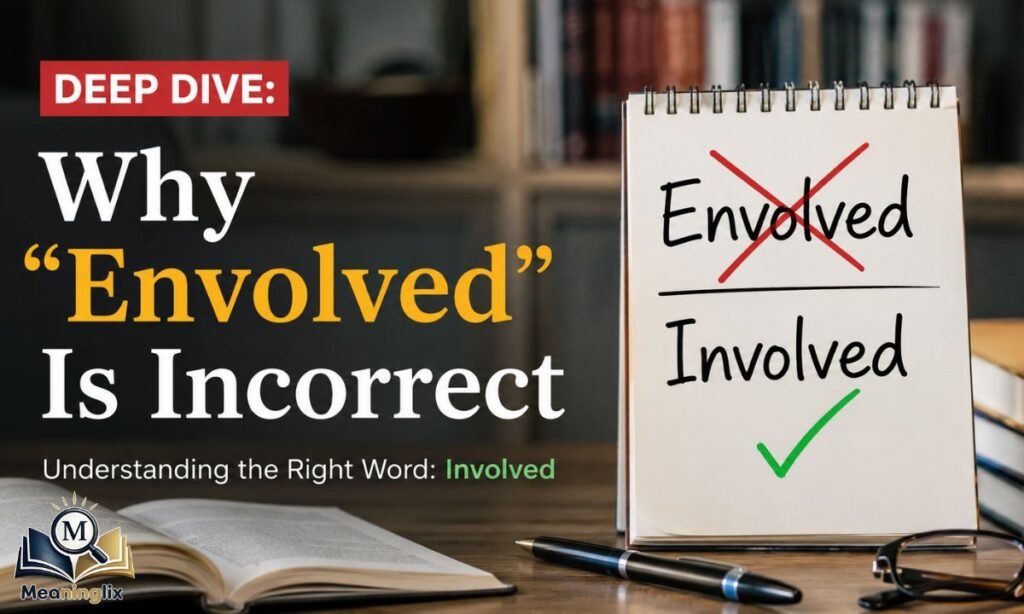
“Envolved” is not listed in any major English dictionary, including Merriam-Webster, Oxford, or Cambridge. It shows up because people confuse the prefix “en-“ with “in-,” two prefixes that sound similar but behave differently in English spelling.
The word “involved” comes from the Latin root “involvere,” meaning to roll into or wrap up. Over time, English kept the “in-” prefix, not “en-.” That is the exact reason why comparing Envolved or Involved always ends the same way: “Involved” wins.
Here is why this mistake happens so often:
- Autocorrect confusion: Some keyboards do not catch it because “envolved” looks close enough to a real word.
- Sound-alike prefixes: Words like “envelop” and “encase” use “en-,” so people assume “involved” follows the same pattern.
- Fast typing: In casual texting or chat, spelling errors like this pass unnoticed.
Real-world example of the mistake:
- ❌ “I don’t want to get envolved in office politics.”
- ✅ “I don’t want to get involved in office politics.”
There is no situation, formal or casual, where “envolved” is the correct choice. Every time you see Envolved or Involved written together, treat “envolved” as a red flag.
Deep Dive: Understanding “Involved” Correctly
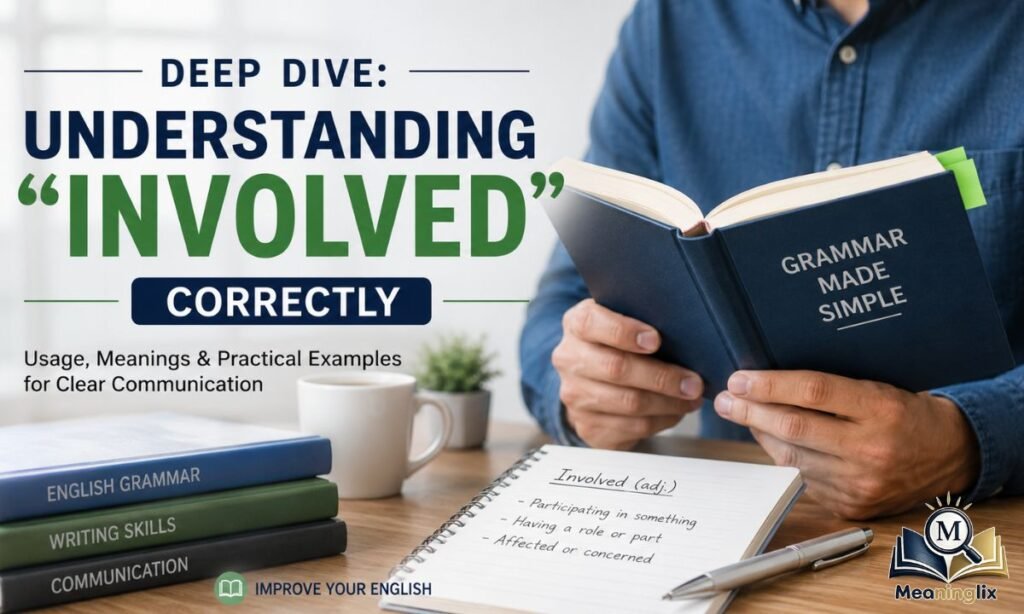
“Involved” is the past tense and past participle of the verb “involve.” It can also function as an adjective describing someone connected to a task, situation, or relationship.
Grammar Function
- As a verb: “The project involved three departments.”
- As an adjective: “She is deeply involved in community work.”
When to Use “Involved”
Use “involved” when you want to describe participation, connection, complexity, or emotional investment in something.
Real-World Examples
- Workplace: “All team members were involved in the client presentation.”
- Casual writing: “I got involved in a fun cooking class last weekend.”
- Academic context: “The study involved over 500 participants across three countries.”
- Relationships: “He has been involved with the charity for five years.”
Each of these examples shows how naturally “involved” fits into different types of writing. This is exactly why understanding Envolved or Involved matters for clear communication.
Key Differences and the Golden Rule to Remember
Here is a simple memory trick to settle Envolved or Involved for good:
Golden Rule: Think of the word “IN” as in “INvolved,” because being involved means you are placed IN something, a group, a task, or a situation.
Another easy trick: If you can replace the word with “included” or “connected,” you need “involved,” never “envolved.”
- “She is involved in the meeting” = “She is included in the meeting.” ✅
- “She is envolved in the meeting” = ❌ Makes no sense with any replacement word.
Real-World Context and Usage Examples
Professional and Email Etiquette
In business writing, using “involved” correctly builds credibility. For example: “Please keep me involved in future decisions regarding this account.”
Casual Conversation
In daily speech, involved often shows personal interest or activity: “I want to get more involved in my kid’s school events.”
Formal Writing
Academic and legal writing rely heavily on “involved” to describe parties, processes, or participants: “All parties involved must sign the agreement before proceeding.”
Across every single context, from emails to essays, the debate of Envolved or Involved always resolves in favor of the correctly spelled word.
Common Mistakes to Avoid ( Envolved or Involved )
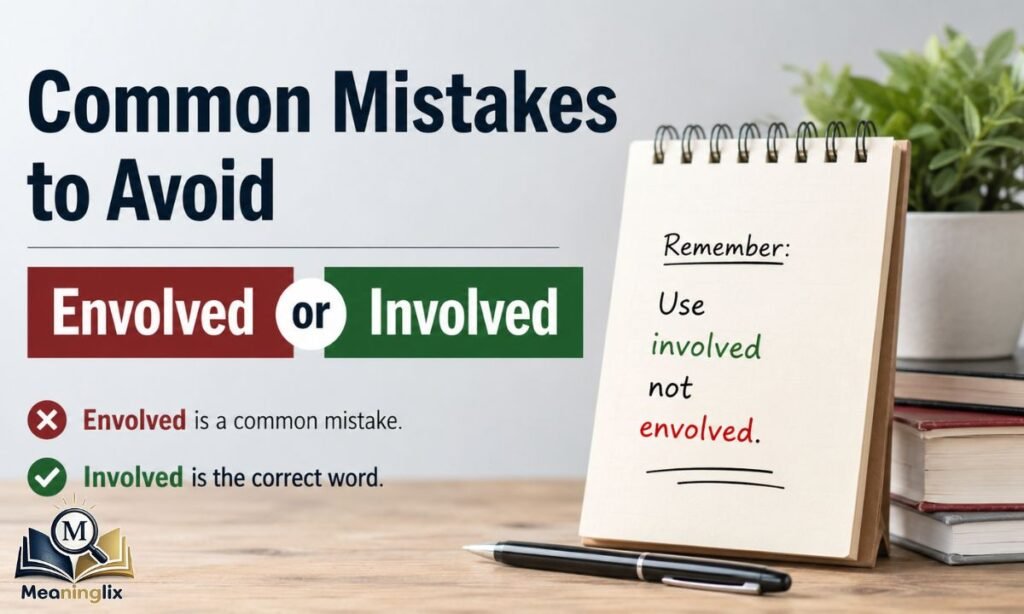
- Using “envolved” in professional emails This spelling error can hurt your credibility instantly. Always double-check before sending important messages.
- Assuming spellcheck will catch it Some tools miss uncommon misspellings like “envolved” because it looks close to real English patterns. Manual proofreading helps.
- Confusing “involved” with “evolved” “Evolved” relates to gradual development or change, while “involved” relates to participation. These two words look similar but mean completely different things.
Frequently Asked Questions
Is “envolved” a real word?
No. “Envolved” is not a recognized English word in any standard dictionary. It is a common misspelling of “involved.”
What does “involved” mean?
“Involved” means being connected to, included in, or actively participating in something. It can describe tasks, relationships, or situations.
How do you spell “involved” correctly?
The correct spelling is I-N-V-O-L-V-E-D. Remember it starts with “IN,” not “EN.”
Why do people confuse envolved with involved?
People mix up the prefixes “en-” and “in-” because they sound alike. Words like “envelop” use “en-,” which leads to spelling confusion with “involved.”
Conclusion
When comparing Envolved or Involved, only one spelling is correct: Involved. Use the “IN” memory trick every time you write, and you will never second-guess this spelling mistake again.

Alisha Lehmann is the founder and author of Meaninglix. She specializes in explaining word meanings, internet slang, abbreviations, grammar, and English expressions in simple, accurate language. Her goal is to help readers improve their vocabulary and communicate confidently through clear, well-researched, and easy-to-understand content.
1 thought on “Envolved or Involved: Which Spelling Is Correct? (With Perfect Examples) 2026”