Its vs. It’s
You’re typing a sentence, you get to “it,” and suddenly you freeze. Does the apostrophe go in or not? Here’s the short answer: its (no apostrophe) shows ownership, and it’s (with an apostrophe) is short for “it is” or “it has.”
The mix-up happens because apostrophes usually mean possession think Sarah’s car or the dog’s leash but “its” breaks that pattern on purpose. Once you see why, the confusion disappears.
Table of Contents
The Quick Answer “Its vs. It’s”
- Its = belonging to it (possessive pronoun, no apostrophe)
- It’s = “it is” or “it has” (contraction, always has an apostrophe)
If you can swap in “it is” or “it has” and the sentence still makes sense, you want it’s. If the sentence is describing something that belongs to “it,” you want its. That one test settles almost every case.
What “Its” Actually Means
Its is a possessive pronoun, in the same family as his, her, and their. It tells you that something belongs to, or is associated with, a person, animal, or object that has no specific gender.
- The company raised its prices in March.
- The bird built its nest in the oak tree.
- My phone lost its charge overnight.
Notice that a noun always follows “its” prices, nest, charge. That noun is the thing being owned or described. There’s no apostrophe here for the same reason there’s no apostrophe in his or hers: possessive pronouns already show ownership through their spelling, not through punctuation.
See Also : Altogether vs All Together
What “It’s” Actually Means
It’s is a contraction, a shortened way of writing two words as one. It stands for either it is or it has, and the apostrophe marks the letters that were dropped.
- It’s raining again. (It is raining again.)
- It’s been a long week. (It has been a long week.)
- I think it’s time to leave. (It is time to leave.)
This is the same pattern you see in other contractions like she’s (she is), there’s (there is), or who’s (who is). The apostrophe always replaces missing letters it never signals ownership in a pronoun.
Why This Mistake Happens So Often “Its vs. It’s”
Most English possessives use an apostrophe: Maria’s laptop, the team’s schedule, the cat’s toy. Your brain learns that pattern and applies it everywhere, including to “it.” But personal pronouns follow a different rule. His, hers, ours, theirs, and its are already possessive without any apostrophe. Adding one turns them into something else entirely usually a contraction instead of a possessive.
Add in the speed of texting, emailing, and typing on autopilot, and it’s easy to see why even careful writers occasionally slip.
The One-Second Test “Its vs. It’s”
Before you commit to an apostrophe, try this: replace the word with “it is” or “it has.” If the sentence still reads naturally, use it’s. If it sounds wrong or nonsensical, use its.
- “The dog wagged it is tail.” That doesn’t work, so it’s its: The dog wagged its tail.
- “It is a beautiful morning.” That works fine, so it’s it’s: It’s a beautiful morning.
This single trick resolves the vast majority of its/it’s mix-ups, no memorization required.
Its vs. It’s at a Glance
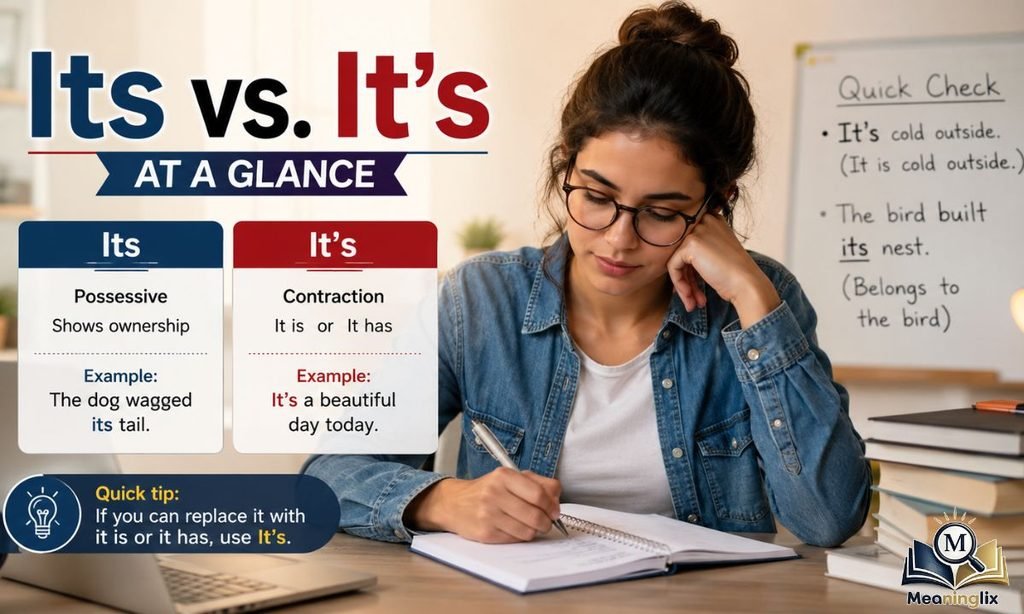
| Term | Correct Use | Meaning | Typical Use | Example |
| Its | Possessive pronoun | Belonging to it | Showing ownership | The team celebrated its win. |
| It’s | Contraction | It is / it has | Combining words in speech or informal writing | It’s a great idea. |
Real-Life Examples in Context “Its vs. It’s”
Everyday conversation “Its vs. It’s”
- Correct: “It’s freezing outside today.”
- Incorrect: “Its freezing outside today.” (This drops the meaning “it is,” so the apostrophe is needed.)
Workplace writing “Its vs. It’s“
- Correct: “The company updated its return policy last month.”
- Incorrect: “The company updated it’s return policy last month.” (No contraction is intended, this is possession.)
Text messages “Its vs. It’s“
- Correct: “It’s been forever since we talked!”
- Incorrect: “Its been forever since we talked!” (Missing apostrophe changes “it has” into an incomplete phrase.)
Academic writing
- Correct: “The study reevaluated its methodology after the first trial.”
- Incorrect: “The study reevaluated it’s methodology after the first trial.”
Social media “Its vs. It’s“
- Correct: “It’s official the new season drops on Friday!”
- Incorrect: “Its official that the new season drops on Friday!”
The Mistake People Make Most
The single most common error is writing it’s when its is actually needed, treating the pronoun like a regular possessive noun. Because almost every other possessive in English takes an apostrophe, writers instinctively add one to “its” without thinking.
The fix is the substitution test above. If “it is” or “it has” doesn’t fit naturally in the sentence, the apostrophe doesn’t belong there either. A simple memory trick: “it’s” always secretly means two words. If you can’t expand it into “it is” or “it has,” leave the apostrophe out.
Its’ Is Never Correct
You may occasionally see its’, with an apostrophe after the s. This form does not exist in standard English. Possessive pronouns like its, his, hers, and theirs never take an apostrophe in any position. If you see “its'” in a sentence, it’s a typo with no exceptions.
Practical Guidance for Getting It Right Every Time
- Read the sentence and try substituting “it is” or “it has.”
- If the substitution works, use it’s.
- If the substitution sounds off, use its.
- If a noun immediately follows the word a thing being owned that’s a strong sign you need its.
- When proofreading, search your document for “it’s” and check each instance individually. This habit alone catches most errors before you hit send.
Related Pronouns That Follow the Same Rule
The its/it’s pattern isn’t unique. Other possessive pronouns skip the apostrophe too, which is worth remembering the next time you second-guess yourself:
- Your (possessive) vs. you’re (you are)
- Their (possessive) vs. they’re (they are)
- Whose (possessive) vs. who’s (who is)
In every pair, the version without an apostrophe shows ownership, and the version with an apostrophe is a contraction. Learning this pattern once helps you avoid several common grammar mistakes at the same time.
Frequently Asked Questions
Is “its” or “it’s” correct in formal writing?
Both are grammatically correct; they just serve different purposes. Formal writing tends to favor its for possession and often avoids contractions like it’s altogether in favor of the full “it is” or “it has,” though this is a style preference rather than a strict grammar rule.
What is the difference between its and it’s?
Its shows possession, meaning something belongs to “it,” as in “The store closed its doors early.” It’s is a contraction meaning “it is” or “it has,” as in “It’s closing early today.” The difference comes down to ownership versus a shortened phrase.
How can I remember its vs. it’s without looking it up?
Try mentally expanding the word into “it is” or “it has.” If that expansion makes sense in the sentence, use it’s. If it doesn’t, use its. This test works in nearly every situation.
Is “its'” ever correct?
No. Its’ is not a real word in standard English. Possessive pronouns like its never take an apostrophe, in any position.
The Bottom Line
Its shows ownership. It’s is short for “it is” or “it has.” When in doubt, try substituting “it is” or “it has” into your sentence if it fits, keep the apostrophe; if it doesn’t, drop it.
This single habit will clear up one of the most common mix-ups in English writing, whether you’re texting a friend, writing a report, or posting online.

Alisha Lehmann is the founder and author of Meaninglix. She specializes in explaining word meanings, internet slang, abbreviations, grammar, and English expressions in simple, accurate language. Her goal is to help readers improve their vocabulary and communicate confidently through clear, well-researched, and easy-to-understand content.
1 thought on “Its vs. It’s: The Simple Guide to Get It Right”