
If you’ve ever typed a sentence, stared at it, and thought “wait, is that one O or two?” you’re not alone. Lose and loose are two of the most commonly confused words in English, and the mix-up shows up everywhere from text messages to work emails.
Here’s the quick answer: lose is a verb that means to fail to keep or fail to win something, while loose is an adjective that means not tight or not fastened. The words even sound different once you know what to listen for, which makes the difference easier to lock in than you’d think.
Table of Contents
The Quick Answer “Lose vs. Loose”
Lose rhymes with “choose” and is almost always a verb. You lose a game, lose your keys, or lose your patience.
Loose rhymes with “goose” and is almost always an adjective. A shirt can be loose, a screw can be loose, and a dog can get loose.
If you remember nothing else from this article, remember this: lose = losing something (verb), loose = not tight (adjective). Everything else below just builds on that.
What Does “Lose” Mean?
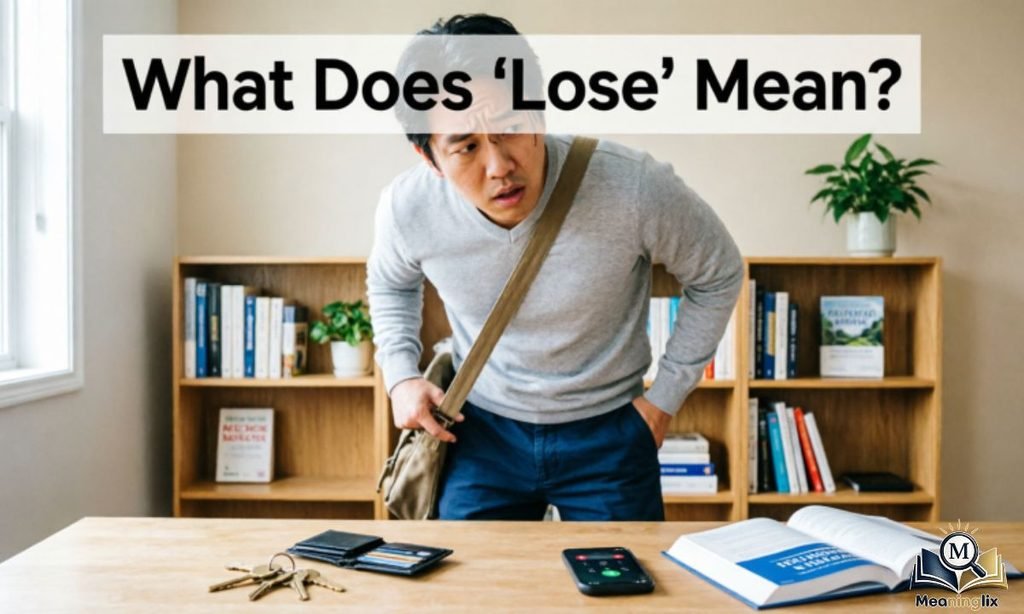
Lose is a verb with three main uses:
- To fail to win Our team might lose the match tonight.
- To be unable to find something I always lose my phone in the couch cushions.
- To stop having or possessing something She didn’t want to lose her job during the layoffs.
Because lose is always an action, it can never describe a noun the way an adjective does. You wouldn’t say “a lose shirt” any more than you’d say “a run shirt” the grammar just doesn’t work.
Read Also : In Behalf Of vs. On Behalf Of
What Does “Loose” Mean?
Loose is primarily an adjective meaning not tight, not fastened, or not restrained. A few examples:
- These jeans feel loose since I started running.
- The dog got loose and ran into the yard.
- There’s a loose wire behind the TV.
Loose can also work as an adverb (the horses ran loose in the field) and, less commonly, as a verb meaning “to release” (the archer loosed an arrow). In everyday writing, though, you’ll almost always meet loose in its adjective role, describing something that isn’t held firmly in place.
Why People Mix Up Lose vs. Loose
The confusion isn’t really about meaning it’s about spelling and pronunciation working against each other. Most English readers expect a double O to sound like “oo” as in “moon,” and it does in loose.
But lose, despite having only one O, is pronounced with a Z sound, like “looz.” That single missing letter changes both the sound and the part of speech, which trips people up even when they know the meanings perfectly well.
Autocorrect doesn’t help much either. Since both words are spelled correctly on their own, spell-checkers rarely flag the mistake; you have to catch it yourself.
Lose vs. Loose at a Glance
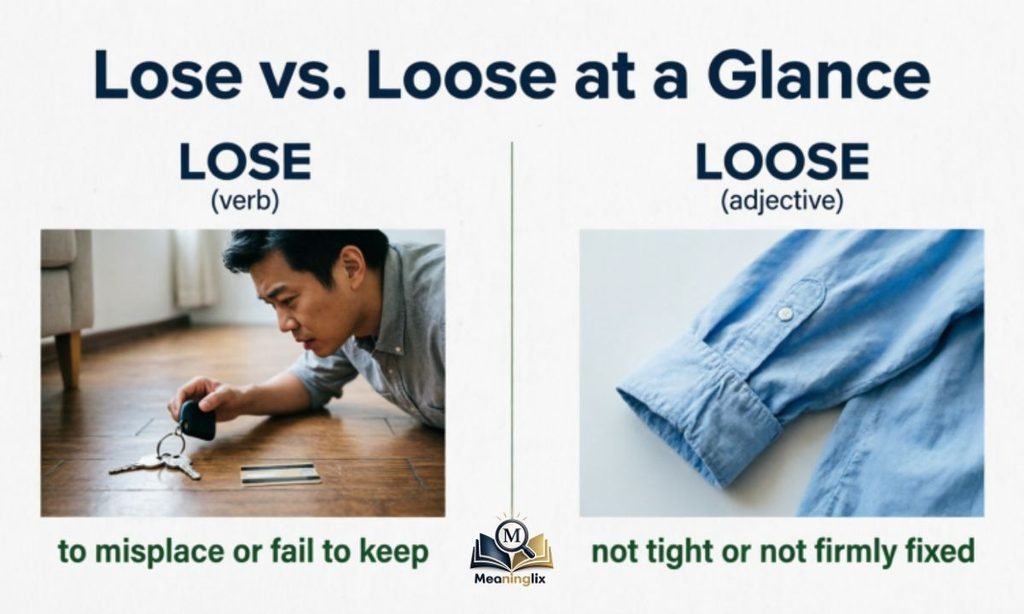
| Word | Part of Speech | Meaning | Example |
| Lose | Verb | To fail to win, misplace, or stop having something | Don’t lose your ticket. |
| Loose | Adjective (sometimes adverb/verb) | Not tight, not fastened, free | The knot came loose. |
A quick shortcut: if the word is doing an action, it’s lose. If the word is describing something, it’s loose.
How to Remember the Difference “Lose vs. Loose”
Here are a few memory tricks that actually work:
- Count the O’s. Loose has two O’s, like two loops of rope long and loose. Lose has one O, like something that’s gone missing.
- Rhyme it. Loose rhymes with goose, moose, and juice. Lose rhymes with choose, snooze, and news. If your sentence needs the “z” sound, you need to lose.
- Swap test. Try replacing the word with “misplace” or “fail to win.” If the sentence still makes sense, you need to lose. I don’t want to (misplace) my keys, so it’s lose.
Pick whichever trick clicks for you, and it’ll become automatic within a few tries.
See Also : Altogether vs All Together
Lose vs. Loose in Real Sentences
Everyday conversation “Lose vs. Loose“
- Correct: “I hope we don’t lose power during the storm.”
- Incorrect: “I hope we don’t loose power during the storm.” (Losing power is an action, so it needs the verb lose.)
Text messages “Lose vs. Loose“
- Correct: “My phone case is so loose it might fall off.”
- Incorrect: “My phone case is so lose it might fall off.” (Describing the case, so it needs the adjective loose.)
Workplace communication “Lose vs. Loose“
- Correct: “We can’t afford to lose another client this quarter.”
- Incorrect: “We can’t afford to loose another client this quarter.”
Academic writing “Lose vs. Loose“
- Correct: “The experiment aimed to determine why the compound became loose under heat.”
- Incorrect: “The experiment aimed to determine why the compound became lose under heat.”
Social media “Lose vs. Loose“
- Correct: “Set your dog loose in a fenced yard, never near traffic.”
- Incorrect: “Set your dog lose in a fenced yard, never near traffic.”
Notice the pattern: whenever the sentence describes an action of losing something, use lose. Whenever it describes something that isn’t tight or contained, use loose.
Read More : Who’s vs. Whose
Common Mistakes to Avoid “Lose vs. Loose”
The most frequent error is writing loose when you mean the verb lose, for example, “I don’t want to loose my temper.” Because loose looks like it should be the “stronger” or more complete word with its extra letter, writers often reach for it by instinct, even when the sentence calls for an action rather than a description.
The reverse mistake writing lose when you mean loose happens less often but still shows up, especially in fast typing or texting, where the missing letter simply gets dropped. “My belt is too lose” should read “My belt is too loose.”
A simple habit fixes both: before hitting send, ask whether the word is doing something (lose) or describing something (loose). That one question resolves almost every case.
Related Word: “Loosen”
You may also run into loosen, a verb meaning to make something less tight.
- Loosen the cap before you try to open the jar.
- He loosened his tie after the long meeting.
Loosen is not interchangeable with lose or loose; it specifically describes the action of reducing tightness, not the state of being untight (loose) or the act of losing something (lose). Keeping these three words distinct in your head makes each one easier to use correctly.
Practical Tips for Getting It Right Every Time
- Read the sentence aloud. If it needs the “z” sound, you need to lose.
- Ask what the word is doing. Action = lose. Description = loose.
- Watch for the phrase “get loose” or “come loose.” These describe something becoming untight, so they always use loose, never lose.
- Double-check before publishing. Since spell-checkers won’t catch this error, a quick manual read-through is worth the extra ten seconds.
Frequently Asked Questions
Is “loose” ever correct as a verb?
Yes, though rarely. Loose can mean “to release” or “to set free,” as in the soldiers loosed a volley of arrows. This usage is mostly limited to formal or literary writing. In everyday English, loose functions almost exclusively as an adjective.
What is the difference between lose and loose in one sentence?
Lose is a verb meaning to fail to win or to misplace something, while loose is an adjective meaning not tight or not fastened. For example: I might lose my grip because my gloves are too loose.
How do you rememberWho’s vs. Whose which spelling is correct?
Count the O’s: two O’s in loose match its longer, “looser” sound, while lose has just one O and a shorter, tighter spelling. Pairing that visual trick with the rhyme test (loose rhymes with goose; lose rhymes with choose) covers almost every situation.
Is “loose” British English and “lose” American English?
No both words are standard in American and British English, and neither is a regional spelling. The confusion comes purely from their similar look and sound, not from any difference between American and British usage.
Final Takeaway “Lose vs. Loose”
The difference between lose and loose comes down to one clear rule: lose is an action, loose is a description. Once you connect “lose with verbs like “misplace” or “fail to win,” and loose with adjectives like “not tight” or “free,” the two words stop blending together.
Run a sentence through the swap test whenever you’re unsure, and you’ll pick the right word every time no double-checking a dictionary required.

Alisha Lehmann is the founder and author of Meaninglix. She specializes in explaining word meanings, internet slang, abbreviations, grammar, and English expressions in simple, accurate language. Her goal is to help readers improve their vocabulary and communicate confidently through clear, well-researched, and easy-to-understand content.
2 thoughts on “Lose vs. Loose: Easy Trick to Never Get Them Wrong”