Have you ever typed the sentence “I’m proud of myself” and then paused, wondering if it should actually be “my self”? You’re not imagining things this is one of the most quietly confusing pairs in the English language. The two forms look almost identical, sound exactly the same out loud, and yet they belong to two completely different worlds: one is a grammar rule, and the other is a concept about who you are.
Mixed up two words before? See our breakdown of acception vs. exception next.
This guide breaks down everything you need to know about myself vs my self the grammar, the meaning, the common mistakes, and the deeper identity-related use of “self” that shows up in psychology, philosophy, and everyday reflection. By the end, you’ll never have to second-guess which one to use again.
Table of Contents
Myself vs My Self: What’s the Real Difference?
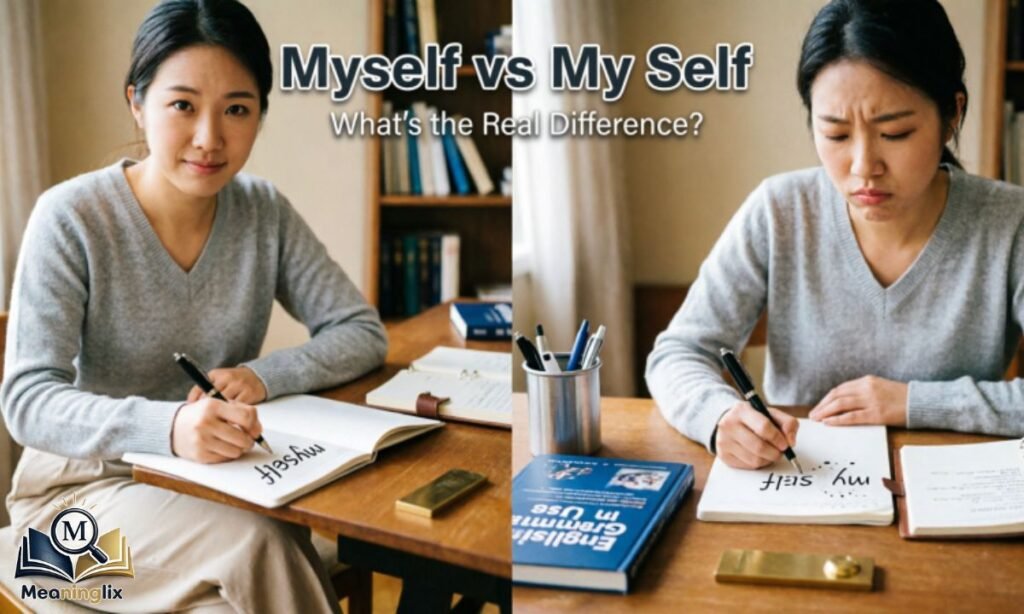
At the simplest level Myself vs My Self:
- Myself is a single word. It’s a reflexive or intensive pronoun used in grammar.
- My self is two separate words. It’s a possessive (“my”) plus a noun (“self”), usually referring to identity, personality, or inner being.
One is about sentence structure. The other is about who you are as a person. A single space is the only thing separating a grammar rule from a philosophical idea and that space changes the entire meaning of the sentence.
| Feature | Myself | My Self |
| Word type | Reflexive/intensive pronoun | Possessive + noun phrase |
| Number of words | One | Two |
| Common context | Everyday grammar, writing, speech | Psychology, philosophy, journaling |
| Refers to | An action returning to the subject | Personal identity or inner consciousness |
| Formality | Standard in all English | Rare, mostly reflective or literary |
| Example | “I taught myself to cook.” | “I’m reconnecting with my self.” |
Proud of Myself vs My Self
This is one of the most searched versions of this confusion, and the answer is simple: it’s “I’m proud of myself.” Since “myself” refers back to the subject (“I”) in a grammatically reflexive way, the single-word form is correct here. “Proud of my self” isn’t standard English although in a poetic or introspective piece of writing, someone might deliberately split the words to emphasize pride in their inner identity rather than an achievement. For everyday writing, emails, and conversation, stick with “myself.”
What “Myself” Really Means in English

“Myself” belongs to a small family of words in English called reflexive pronouns, which also includes yourself, himself, herself, itself, ourselves, yourselves, and themselves. Each one reflects the action of a sentence back onto the person performing it.
“Myself” specifically connects to the first-person subject “I.” It cannot appear in a sentence unless “I” (or an implied first-person subject) is already present.
“Myself” as a Reflexive & Intensive Pronoun
“Myself” isn’t just one kind of word it plays two distinct grammatical roles, and understanding both is the key to using it correctly every time.
Two main functions of “myself”:
- Reflexive use when the subject and the object of the sentence are the same person, and the action “bounces back” onto the doer.
- Intensive (emphatic) use when “myself” is added purely to emphasize that the subject, and no one else, performed the action.
If you can remove “myself” from a sentence and the core meaning still makes sense, it’s likely being used for emphasis. If removing it leaves the sentence incomplete or confusing, it’s reflexive.
Correct Examples in Everyday Sentences ( Myself vs My Self )
Reflexive Use
- I hurt myself while jogging.
- She reminded herself to lock the door.
- I taught myself how to play the piano.
- I caught myself daydreaming during the meeting.
- I convinced myself to apply for the job.
In each case, the subject performs the action, and that same subject receives it. Take away “myself,” and the sentence loses its meaning: “I hurt” or “I taught” simply isn’t complete on its own.
Intensive Use
- I built this shelf myself.
- I myself don’t agree with the new policy.
- I heard the announcement myself.
- I’ll handle the client call myself.
- I wrote the entire report myself.
Here, “myself” isn’t required for the sentence to function it’s there purely to stress that the subject did the action personally, without help from anyone else.
Incorrect Uses of “Myself” (Very Common!)
The single biggest myself-related mistake is using it as a substitute for “I” or “me” to sound more formal or polished. It doesn’t work that way, and grammar-conscious readers notice immediately.
| Incorrect | Correct | Why |
| Please contact John or myself. | Please contact John or me. | “Myself” can’t replace an object pronoun without a reflexive/intensive reason. |
| My manager and myself will attend. | My manager and I will attend. | “Myself” can’t replace a subject pronoun either. |
| If you have questions, reach out to myself. | If you have questions, reach out to me. | No “I” is doing an action back onto itself here. |
| Myself and Sarah completed the project. | Sarah and I completed the project. | “Myself” cannot function as a sentence subject. |
A simple rule of thumb: “myself” only works if “I” has already appeared, or clearly could appear, as the subject of that same clause. If you’re tempted to use “myself” just because it feels more professional, that’s usually a sign to swap it for “I” or “me” instead.
Understanding “My Self” (Two Separate Words)
Now for the other half of this comparison. “My self,” written as two distinct words, steps outside of standard grammar rules entirely. Instead of functioning as a pronoun, it becomes a noun phrase “my” (a possessive) modifying “self” (a noun that stands for identity, personality, or inner consciousness).
This form is rare in everyday writing. You won’t find it in business emails or grammar textbooks as a “correct” alternative to “myself.” Instead, it shows up in specific, more reflective contexts where the writer wants to talk about the inner “self” as a distinct entity almost as if it’s a separate thing they possess or are exploring.
What “My Self” Actually Means
Think of “self” here the same way you’d think of words like identity, soul, personality, or inner being. “My self” is simply “my identity” or “my inner being,” phrased slightly differently for emotional or philosophical effect.
A useful test: if you can swap “self” for “identity” or “true self” and the sentence still makes sense, you’re likely in “my self” territory rather than grammatical “myself” territory.
Examples
- I’m slowly reconnecting with my self after a difficult year.
- Meditation helps me understand my self on a deeper level.
- There’s a difference between my public persona and my true self.
- I lost touch with my self during those stressful months.
- Journaling lets me explore my self without judgment.
Notice that none of these sentences involve an action bouncing back grammatically. They’re about identity, awareness, and inner experience not verbs and objects.
Where “My Self” Is Commonly Used
“My self” isn’t something you’ll encounter in a typical grammar class, but it appears frequently across a few specific fields where the concept of “self” as an entity really matters.
Psychology
In psychology, “self” often describes identity, self-concept, or the inner sense of who a person is. Writers and therapists may use “my self” to distinguish the conscious, reflective identity from the roles a person plays day to day for example, “I’m learning to accept my self, flaws included.”
Philosophy
Philosophy has explored the nature of “the self” for centuries, questioning what makes a person the same individual over time. In this context, “my self” refers to personal identity and consciousness as a philosophical subject, not a grammatical structure think of discussions around selfhood, existence, and continuity of identity.
Literature
Writers, especially poets and novelists, sometimes deliberately split “myself” into “my self” for stylistic or emotional effect. This isn’t a grammar error in creative writing it’s an intentional choice to slow the reader down and highlight the idea of an inner, separate identity. Even Shakespeare occasionally treated it as two words in his era, since the reflexive pronoun hadn’t fully standardized into one word yet.
Why “Myselves” Is Incorrect Always
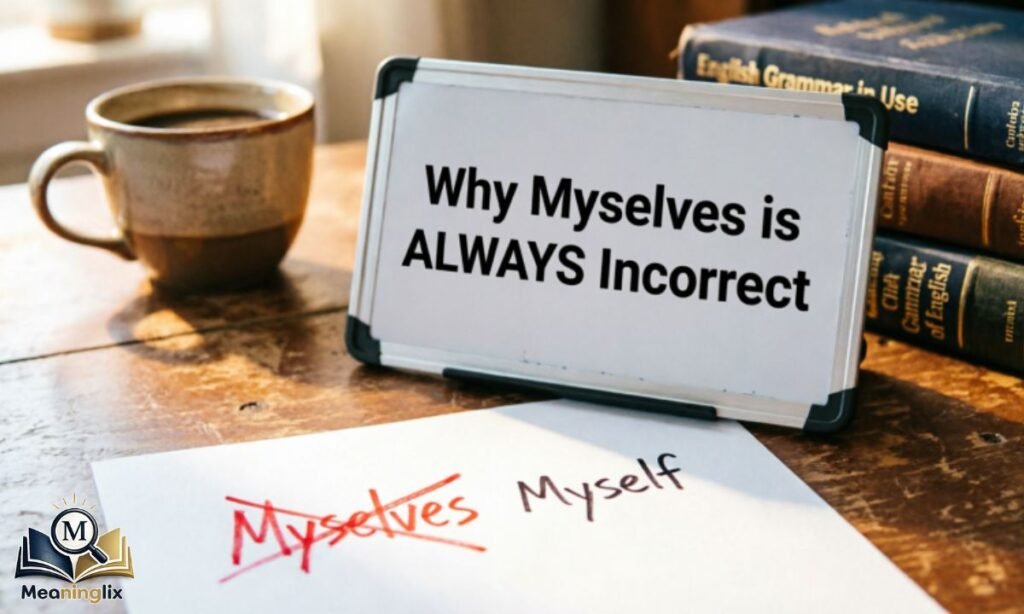
One error worth calling out clearly: “myselves” does not exist in standard English. Because “myself” ties directly to the singular first-person pronoun “I,” and “I” has no plural form, there’s no grammatical way to pluralize “myself.”
When multiple people are involved, English switches to a completely different word: ourselves.
- ❌ We hurt myselves during the hike.
- ✅ We hurt ourselves during the hike.
- ❌ We completed the project by myselves.
- ✅ We completed the project by ourselves.
No matter how natural “myselves” might sound in casual speech, it’s never considered correct in formal or standard English writing.
How “Myself” Functions in Grammar
To really lock in the difference between myself vs my self, it helps to understand the grammatical mechanics behind “myself” a little more closely.
Reflexive Structure: Subject = Object
In a reflexive sentence, the subject performing the action and the object receiving the action are literally the same person. This is the core requirement for reflexive pronouns like “myself.”
Structure: Subject (I) + Verb + Reflexive Object (myself)
- I dressed myself for the interview.
- I introduced myself to the new team.
- I pushed myself to finish the marathon.
If you tried to remove “myself” from any of these, the sentence would either lose meaning or sound incomplete proof that the reflexive pronoun is doing essential grammatical work.
Intensive Structure: Adding Emphasis ( Myself vs My Self )
Intensive (or emphatic) pronouns look identical to reflexive ones, but their job is completely different. Instead of receiving the action, they simply emphasize that the subject acted alone, directly, or without assistance.
Structure: Subject (I) + Verb + Object (optional) + Myself (for emphasis)
- I painted the fence myself.
- I myself was surprised by the results.
- I’ll finish the presentation myself.
Because intensive pronouns are optional, you can delete them without breaking the sentence. That’s the fastest way to tell reflexive and intensive use apart.
Identity & Philosophy: The Non-Reflexive “Self”
Once you step away from grammar and toward “my self” as two words, “self” starts functioning as a standalone noun a concept in its own right, not a grammatical tool tied to a specific verb.
“Self” as a Concept
In this sense, “self” represents the entirety of who someone is: their personality, values, memories, consciousness, and inner experience. It’s the subject of entire fields of study, from developmental psychology to Eastern philosophy and mindfulness practices.
Common self-related concepts you might come across include:
- Self-concept how a person perceives their own identity
- Self-awareness the ability to recognize your own thoughts and emotions
- True self vs. false self the difference between authentic identity and a socially constructed persona
- Sense of self an overall feeling of who you are, distinct from any single action or role
When someone writes “my self,” they’re usually engaging with one of these deeper ideas rather than describing a simple grammatical action.
How Spacing Changes Meaning ( Myself vs My Self )
It’s remarkable how much weight a single space can carry. Compare these two nearly identical sentences:
- I love myself. This describes general self-care, confidence, or acceptance in an everyday, grammatical sense.
- I love my self. This leans more poetic or introspective, suggesting a deeper appreciation for one’s inner identity, separate from outward actions.
Both sentences are technically “about” the same person, but the tone and depth shift the moment the space appears. This is exactly why “my self” tends to show up in journals, therapy-related writing, and reflective essays rather than everyday conversation.
Common Errors and How to Avoid Them ( Myself vs My Self )
Even confident English speakers slip up with myself vs my self regularly. Here are the four most frequent mistakes.
Using “Myself” Instead of “Me” or “I”
This is by far the most common error, especially in professional emails. People assume “myself” sounds more polished than “me,” but it actually signals a grammar mistake to careful readers.
- ❌ Please forward the invoice to myself.
- ✅ Please forward the invoice to me.
Using “My Self” When “Myself” Is Correct
Occasionally, someone splits “myself” into two words out of habit or autocorrect confusion, even in a purely grammatical sentence.
- ❌ I hurt my self while lifting boxes.
- ✅ I hurt myself while lifting boxes.
Adding “Myself” to Sound Formal
Some writers sprinkle “myself” into sentences purely for a formal tone, without any reflexive or emphatic reason behind it.
- ❌ The report was reviewed by myself before submission.
- ✅ The report was reviewed by me before submission.
Confusing Identity With Grammar ( Myself vs My Self )
Writers sometimes use “myself” when they actually mean the deeper, identity-focused idea of “self,” which weakens the emotional tone of reflective writing.
- Weaker: I’m working on loving myself more.
- More reflective: I’m working on loving my self more.
Neither version is “wrong” here, but the second carries more introspective weight a good example of how the choice between the two forms can shape tone, not just correctness.
Quick Decision Guide to Remember the Difference ( Myself vs My Self )
Ask yourself: Is it about grammar or identity?
If your sentence involves an action, a verb, and a subject doing something to or for itself, you’re in “myself” territory. If your sentence is about personality, consciousness, or inner identity, you’re likely looking at “my self.”
Fast Test
- Can you remove the word and still have a grammatically complete sentence? If yes, it’s likely intensive “myself.”
- Does the subject perform an action that returns to itself? If yes, it’s reflexive “myself.”
- Could you replace “self” with “identity” or “inner being” and keep the same meaning? If yes, it’s “my self.”
One-Line Rule
If it’s about doing, use “myself.” If it’s about being, consider “my self.”
Real-Life Examples & Micro Case Studies
Case Study 1: Email at Work
A marketing coordinator drafts a client email and writes, “Please loop in the design lead or myself with any questions.” A quick review catches the error since “myself” isn’t functioning reflexively or emphatically here, it should read, “Please loop in the design lead or me.” This is one of the most common workplace grammar slips, often driven by a desire to sound formal.
Case Study 2: Personal Journal Entry
While journaling after a stressful month, someone writes, “I’m trying to find my self again.” Here, “my self” is intentional and fitting. The writer isn’t describing a grammatical action but a deeper process of reconnecting with their identity and emotional stability.
Case Study 3: Classroom Grammar
An English teacher explains reflexive pronouns using the sentence, “I taught myself to solve the equation.” Students practice identifying that the subject (“I”) and the object (“myself”) are the same person, reinforcing the reflexive structure in a purely grammatical context.
Case Study 4: Meditation Coaching
A mindfulness coach tells a client, “This practice will help you come back to your self.” Because the coaching conversation centers on inner awareness and identity rather than action, “your self” (the second-person equivalent of “my self”) fits the philosophical, reflective tone of the session.
Frequently Asked Questions ( Myself vs My Self )
Is it correct to say “my own self”?
Yes, “my own self” is used informally and in reflective or poetic writing to add emphasis to identity, though “myself” alone is standard in everyday grammar.
Which is correct, yourself or your self?
“Yourself” is the standard reflexive/intensive pronoun for grammar, while “your self” (two words) refers to someone’s identity, similar to “my self.”
What does my self mean?
“My self” refers to a person’s identity, inner being, or consciousness, commonly used in psychology, philosophy, and reflective writing.
How to use yourself and your self?
Use “yourself” in reflexive or emphatic sentences like “You should treat yourself,” and use “your self” when discussing someone’s identity, as in “Focus on your self, not your title.”
Conclusion
At first glance, myself vs my self looks like a tiny typing decision in just one space, barely noticeable. But as this guide has shown, that single space marks the boundary between grammar and identity, between an action and a state of being. “Myself” belongs to everyday English: emails, conversations, instructions, and stories about what someone did. “My self” belongs to a quieter, more reflective space: journals, therapy sessions, philosophy discussions, and moments of introspection.
The next time you’re unsure which one to use, ask a simple question: Am I describing an action, or am I describing who I am? Actions call for “myself.” Identity calls for “my self.” Once that distinction clicks, you’ll never mix them up again and your writing, whether it’s a work email or a deeply personal journal entry, will say exactly what you mean.

Alisha Lehmann is the founder and author of Meaninglix. She specializes in explaining word meanings, internet slang, abbreviations, grammar, and English expressions in simple, accurate language. Her goal is to help readers improve their vocabulary and communicate confidently through clear, well-researched, and easy-to-understand content.
1 thought on “Myself vs My Self: The Battle That Changes Everything 2026”