Today’s is almost always the word you want. It shows possession, as in “today’s weather” or “today’s news.” Todays is not a standard English word, so you will rarely see it used correctly.
This mix-up happens because apostrophes feel optional to a lot of writers. People text fast, skip punctuation, and the habit carries over into emails and articles. Once you learn the simple rule behind this apostrophe, you will never second-guess it again.
Table of Contents
Quick Answer
Today’s is the correct form almost every time you need this word. It uses an apostrophe to show that something belongs to today, like “today’s schedule.” Todays only appears as a plural noun, and that use is extremely rare in real writing.
Which Is Correct: Todays or Today’s?

Today’s is correct in nearly all everyday writing. It works as a possessive form, meaning something belongs to or relates to today. Todays is a plural noun form and almost never fits a normal sentence. If you are unsure, choose today’s and you will be right most of the time.
Click Here To Read : Accept vs Except
Difference Between Both Words
The confusion comes down to one small mark: the apostrophe. Today’s uses an apostrophe before the “s” to show possession. Todays drops the apostrophe and turns “today” into a plural noun, which barely ever makes sense in normal speech.
Here is a simple comparison to make the difference clear.
| Word | Meaning | Usage | Example | Correct Situation |
| Today’s | Belonging to today | Possessive adjective | Today’s meeting starts at noon. | Use when something belongs to or relates to today |
| Todays | More than one “today” (rare) | Plural noun | Not commonly used in standard writing | Avoid unless writing a highly unusual sentence about multiple “todays” |
Definitions
Today’s is the possessive form of the word “today.” It tells the reader that something belongs to, happens on, or relates to the current day. You will see it before nouns, such as “today’s forecast” or “today’s headlines.”
Todays treats “today” like a countable noun and adds a plural “s.” Since “today” refers to one specific day, it cannot logically have a plural in everyday writing. This form only shows up in odd or poetic sentences, and even then it feels awkward.
When to Use Today’s
Use today’s whenever you want to show ownership or connection to the current day. It always comes before a noun, acting like an adjective.
Here are five original examples:
📌 Today’s lesson covers the difference between adjectives and adverbs.
📌 I already read today’s newspaper over breakfast.
📌 Today’s traffic was worse than usual on the highway.
📌 Please check today’s date before submitting the form.
📌 Today’s episode was the best one of the entire season.
Read Also : In Front or Infront
When to Use Todays
Todays almost never appears in standard sentences because “today” is not a countable noun. Grammar guides do not recommend using this form in regular writing. The only time it might show up is in very informal or experimental phrasing, and even then, most editors would correct it.
Here are five sentences that show why this form usually fails:
📌 Incorrect: I have two todays planned for this project.
📌 Incorrect: The company shared its todays report with the team.
📌 Incorrect: Every one of my todays feels the same lately.
📌 Incorrect: She listed several todays on her calendar by mistake.
📌 Incorrect: His plan covered all the todays of the coming week.
Each of these should use today’s or should be rewritten to avoid the plural form completely.
Side-by-Side Comparison
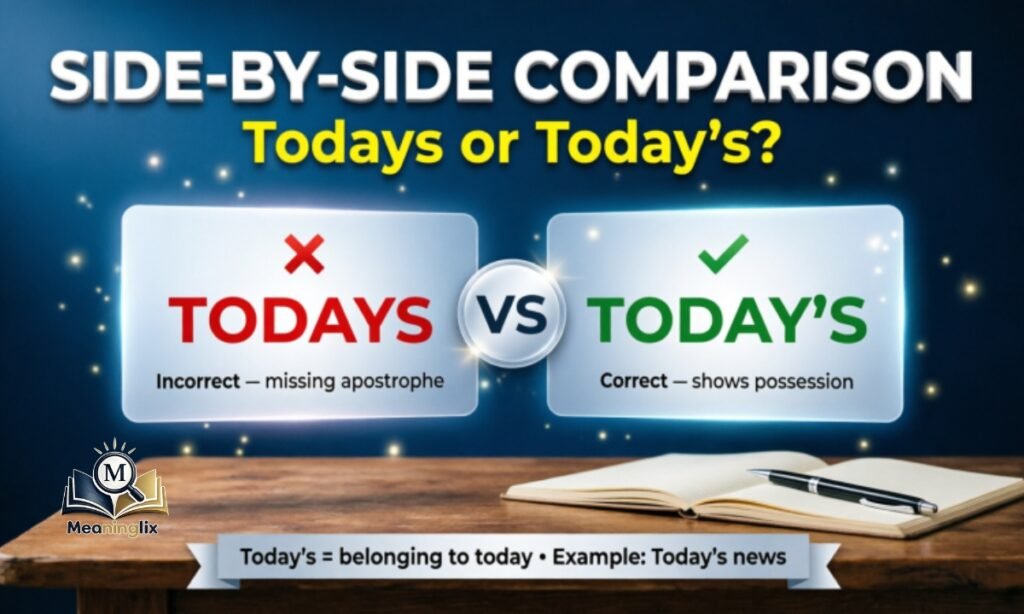
| Feature | Today’s | Todays |
| Grammar Type | Possessive adjective | Plural noun (rare) |
| Apostrophe Used | Yes | No |
| Common in Writing | Very common | Almost never used |
| Example Sentence | Today’s meeting was productive. | Not a natural sentence in most contexts |
| Recommended Use | Use for anything belonging to the current day | Avoid in standard writing |
Common Mistakes
Writers often drop the apostrophe out of habit, especially when typing quickly on a phone. This mistake is similar to confusing its and it’s, where possession and contraction rules get mixed up.
Some people also confuse today’s with a contraction, thinking it means “today is.” While today’s can sometimes mean “today is” in casual speech (like “today’s a great day”), this is different from the possessive use, which describes ownership.
Another common error is skipping the apostrophe entirely when writing headlines or titles, since capital letters can make the missing punctuation less noticeable.
Easy Trick to Remember
Here is a simple trick: if you can replace the word with “of today,” you need the apostrophe.
For example, “today’s weather” means “the weather of today.” That test works almost every time, so keep it in your back pocket.
If the sentence does not make sense with “of today,” you likely need a different word or phrase altogether, not todays.
Read Also : Into or In To
Real-Life Examples

Below are ten original sentences that show natural, correct usage in everyday context.
📌 Today’s homework assignment is due before class ends.
📌 I forgot to check today’s exchange rate before booking my flight.
📌 Today’s guest speaker used to work at a major tech company.
📌 The coach reviewed today’s game plan with the entire team.
📌 Today’s sunset looked especially bright over the mountains.
📌 She printed today’s agenda for the morning meeting.
📌 Today’s lunch special includes soup and a fresh salad.
📌 I want to finish today’s tasks before starting anything new.
📌 Today’s workout felt tougher than yesterday’s session.
📌 The teacher explained today’s grammar rule using clear examples.
Read Now: Breath vs Breathe
Common Questions
Is “todays” correct?
No, todays is not standard English in almost every situation. Stick with today’s unless you are intentionally writing an unusual plural form.
Can I use “todays” instead of “today’s”?
No, you should not swap these two words. Today’s shows possession, while todays attempts to pluralize a word that usually cannot be pluralized in normal use.
Why do people confuse them?
Many writers forget apostrophe rules when typing quickly. Since both words sound identical when spoken, the mistake often slips through without notice.
Similar Grammar Confusions
Readers who search for this topic often look up these related word pairs too:
- Its vs It’s
- Yesterday’s vs Yesterdays
- Tomorrow’s vs Tomorrows
- Who’s vs Whose
- Weekend’s vs Weekends
Frequently Asked Questions
Is “today’s” always possessive?
Not always, since today’s can also work as a contraction meaning “today is,” like in “today’s the day.” Context tells you which meaning applies. Both uses require the apostrophe, so the spelling stays the same either way.
What does “today’s” mean in a sentence?
Today’s means something belongs to or relates to the current day. For example, “today’s weather” means the weather that belongs to today. This possessive form appears before a noun almost every time.
Is there ever a correct use for “todays”?
Standard grammar guides do not support todays as a normal English word. The word “today” refers to a single day, so it typically resists pluralization. Writers should choose today’s or rephrase the sentence instead.
How do I know when to add an apostrophe to “today”?
Ask yourself if the sentence means “belonging to today” or “today is.” If either meaning fits, add the apostrophe and write today’s. If neither fits, you probably need a different word entirely.
Does British English treat “today’s” differently?
No, American and British English both use today’s the same way. The apostrophe rule for possession stays consistent across both versions of English. This makes the rule reliable no matter where your readers are located.
Key Takeaways
✅ Today’s is the correct form for nearly every sentence.
✅ Use today’s to show possession or to mean “today is.”
✅ Todays is a rare plural form that fits almost no normal writing.
✅ A quick trick: try replacing the word with “of today” to test for the apostrophe.
✅ This mistake is common because both words sound exactly the same out loud.
Conclusion
Choosing between today’s and todays comes down to one small but important rule. Today’s shows possession or works as a contraction for “today is,” and it fits almost every sentence you will write about the current day. Todays treats the word as a plural noun, which rarely makes sense in standard English.
Once you remember the simple “of today” trick, this choice becomes automatic. Clear, correct grammar builds trust with your readers, whether you are writing an email, an article, or a quick text message. Keep this rule in mind, and today’s writing will always look polished and professional.

Alisha Lehmann is the founder and author of Meaninglix. She specializes in explaining word meanings, internet slang, abbreviations, grammar, and English expressions in simple, accurate language. Her goal is to help readers improve their vocabulary and communicate confidently through clear, well-researched, and easy-to-understand content.
2 thoughts on “Todays or Today’s? The Powerful Grammar Rule Explained 2026”