Shown vs Showed:
If you’ve ever paused halfway through a sentence, unsure whether to write “I have showed you” or “I have shown you,” you’re not alone. This is one of the most common mix-ups in English grammar, and it trips up native speakers just as often as English learners.
If prefixes trip you up too, check out our guide on Pre vs. Post: What’s the Difference? for another common mix-up worth mastering.
The short answer: “showed” is the simple past tense of the verb “show,” while “shown” is the past participle, used with helping verbs like has, have, and had, or in passive voice constructions. But the “why” behind this rule and the exceptions that make it tricky deserve a proper explanation.
In this guide, you’ll learn exactly when to use each form, see dozens of real-world examples, avoid the mistakes that make writing look unpolished, and pick up a few memory tricks that make the rule stick for good. By the end, you won’t need to second-guess yourself again.
Table of Contents
Understanding the Verb “Show”: Why It’s an Irregular Verb

Most English verbs follow a predictable pattern. You take the base form, add “-ed,” and you’re done. Walk becomes walked. Talk becomes talk. Simple.
“Show” doesn’t play by those rules. It’s an irregular verb, meaning its past forms don’t follow the standard “-ed” pattern in every case. Specifically:
- Base form: show
- Simple past tense: showed
- Past participle: shown
Notice that the simple past tense does follow the regular pattern (show + ed = showed), but the past participle breaks away from it entirely, ending in “-n” instead. This half-regular, half-irregular behavior is exactly what causes so much confusion.
Show belongs to a small family of English verbs that behave this way, including sow (sowed/sown), grow (grew/grown), and know (knew/known). Once you notice the pattern, you’ll start recognizing it everywhere.
Here’s the quick breakdown Shown vs Showed:
| Verb Form | Word | Used For |
| Base form | show | Present tense actions |
| Simple past | showed | Completed past actions (no helper needed) |
| Past participle | shown | Perfect tenses and passive voice (needs a helper verb) |
Understanding this three-part structure is the foundation for everything else in this guide.
Shown vs Showed Sentences
Before diving into the rules, it helps to see both words in action side by side. Here are natural, everyday sentences using each form correctly:
Using “showed”:
- She showed me her new apartment yesterday.
- The teacher showed the class how to solve the equation.
- He showed real courage during the interview.
- They showed up early for the meeting.
Using “shown”:
- She has shown remarkable progress this semester.
- The results were shown on the projector screen.
- He had shown no interest in the project until now.
- The documentary has been shown in over 40 countries.
Notice the pattern already forming: sentences with “showed” stand on their own, while sentences with “shown” always lean on a helping verb like has, have, had, was, or been.
When to Use “Showed”: Understanding the Simple Past Tense
“Showed” is the go-to word when you’re describing a completed action that happened at a specific point in the past and there’s no helping verb attached to it.
Think of “showed” as self-sufficient. It doesn’t need backup. It stands alone in a sentence and simply states that something happened and finished.
Use “showed” when:
- The action is completed and tied to a clear past time (yesterday, last week, in 2020)
- There’s no helping verb like has, have, or had before it
- You’re writing in active voice, where the subject performs the action
Examples:
- My manager showed me the quarterly report last week.
- The kids showed off their new bikes to the neighbors.
- The witness showed no hesitation when answering questions.
- Sales figures showed a sharp increase in Q3.
Quick Test
Ask yourself: “Is there a helper verb like has, have, had, was, or were sitting right before this word?”
If the answer is no, and the sentence describes a finished past action on its own, “showed” is correct.
Try it: “Yesterday, the app ___ a new update.” Since there’s no helping verb and the action is a single completed event, “showed” is the right choice.
Common Errors With “Showed”
The most frequent grammar mistake with this verb pair happens when writers pair “showed” with a helping verb, a combination that simply doesn’t exist in standard English.
❌ Incorrect: “I have showed you this already.”
✔ Correct: “I have shown you this already.”
The word “have” is a helping verb signaling the present perfect tense. Present perfect tense always requires the past participle, which is “shown” never “showed.”
❌ Incorrect: “The movie was showed last night.”
✔ Correct: “The movie was shown last night.”
Here, “was” is a form of the verb “to be,” and it introduces passive voice. Passive voice constructions also require the past participle, so “shown” is the only correct option.
Here’s a quick cheat sheet Shown vs Showed :
| If your sentence has… | Use this form |
| No helping verb | showed |
| has / have / had | shown |
| is / am / are / was / were / be / being / been | shown |
| A single, standalone completed action | showed |
| A connection to the present or a passive structure | shown |
Memorizing this table alone will eliminate the vast majority of shown/showed errors in your writing.
“Shown”: The Past Participle Explained Clearly
“Shown” is the past participle form of “show.” Past participles have two major jobs in English: they help build perfect tenses, and they help build passive voice. In both cases, “shown” cannot appear alone; it always needs a helping verb to support it.
Here’s the core rule to remember: wherever you see has, have, had, is, was, were, or been, followed by a form of “show,” the correct word is “shown.”
This applies across all three perfect tenses:
- Present perfect: has/have + shown
- Past perfect: had + shown
- Future perfect: will have + shown
Examples in Perfect Tenses
- She has shown tremendous dedication to her studies.
- They have shown no signs of slowing down.
- By the time we arrived, he had already shown the guests around.
- By next year, the company will have shown consistent growth for a decade.
Examples in Passive Voice
- The evidence was shown to the jury.
- New products are shown at the annual trade fair.
- The painting has been shown in three major galleries.
- Visitors are shown a short safety video before the tour begins.
In every one of these sentences, removing the helping verb would break the grammar entirely. You can’t say “she shown tremendous dedication” ; it needs that “has” to make sense.
Using “Shown” in Passive Voice (With Examples)
Passive voice shifts the focus from the person doing the action to the person or thing receiving it. Instead of “The teacher showed the diagram,” passive voice turns it into “The diagram was shown by the teacher.”
This structure is common in academic writing, news reporting, and business communication, where the result matters more than who performed the action.
The formula for passive voice with “show” is:
Subject + form of “to be” + shown (+ by + agent, optional)
Examples:
- The data is shown in Figure 2.
- Guests were shown to their rooms by the staff.
- The winning design was shown to investors last month.
- New symptoms are being shown in recent case studies.
- The findings had been shown to a panel of experts before publication.
Passive voice with “shown” is especially common in formal and academic contexts because it emphasizes objectivity: the information being displayed matters more than who displayed it. This is one reason “shown” appears so frequently in reports, research papers, and instructional writing.
Shown vs Showed : Side-by-Side Comparison
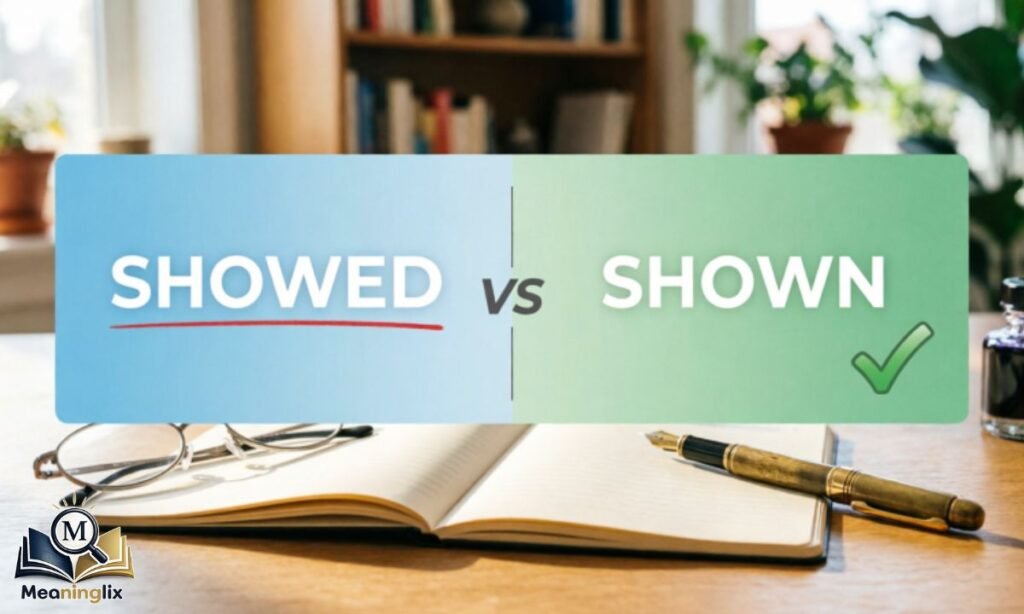
Let’s break down exactly what each word does, so there’s zero ambiguity going forward.
What “Showed” Does
- Functions as the simple past tense
- Works independently, without any helping verb
- Describes a single, completed action tied to a specific past moment
- Common in casual storytelling and straightforward narration
What “Shown” Does
- Functions as the past participle
- Always requires a helping verb (has, have, had, is, was, were, been)
- Builds perfect tenses and passive voice constructions
- Common in formal writing, reports, and academic contexts
Quick Comparison Table Shown vs Showed :
| Feature | Showed | Shown |
| Grammatical role | Simple past tense | Past participle |
| Needs a helper verb? | No | Yes |
| Common tense | Simple past | Present/past/future perfect, passive voice |
| Voice | Active | Active or passive |
| Example | She showed me the file. | She has shown me the file. |
| Formality level | Neutral, everyday | Slightly more formal/technical |
Example Sentences Comparing Both Shown vs Showed :
- He showed me the results yesterday. → He has shown me the results before.
- The film showed at the local cinema. → The film was shown at the local cinema.
- I showed interest in the offer. → I have shown interest in similar offers.
Each pair conveys a related idea, but the grammar shifts depending on whether a helping verb is present.
Language Nuances: When “Showed” Is Sometimes Used as a Past Participle
Here’s where things get slightly more nuanced. While “shown” is the standard and preferred past participle in modern English, “showed” occasionally appears in that same role particularly in older texts, some regional dialects, or informal spoken English.
For example, you might come across a sentence like:
- “She had showed me the painting before it was stolen.”
Technically, this construction is considered non-standard in contemporary writing, but it isn’t entirely foreign to English. Some verbs, like “show,” have historically allowed a bit of flexibility between their past tense and past participle forms, similar to how “sow” can have “sowed” or “sown” as its past participle.
That said, for anything you’re writing today emails, essays, articles, business documents, or academic papers “shown” is the form you should use as the past participle. Reserve “showed” strictly for simple past tense, and your grammar will always be safe, professional, and unambiguous.
Memory Tricks to Remember the Difference Shown vs Showed
If the rules still feel a little abstract, these simple mnemonics can help lock the difference into memory for good.
Trick 1: “Shown needs a buddy.”
Shown never appears alone. It always has a helping verb has, have, had, is, was, were, or been standing right next to it.
Trick 2: “Showed stands alone.”
Showed doesn’t need any backup. It’s a complete, independent past-tense verb all by itself.
Trick 3: “Shown = past participle = passive voice.”
Whenever you spot passive voice (something is being done to the subject), shown is almost always the correct choice.
Trick 4: “If you can replace it with eaten, use shown.”
Think of another irregular verb pair: eat/ate/eaten. “Eaten” always needs a helper (“has eaten,” “was eaten”), just like “shown.” If your sentence structure would work with “eaten,” it works with “shown.”
Trick 5: A Quick Quote (Shown vs Showed)
Here’s a simple rhyme worth remembering: “No helper, use showed. With a helper, it’s shown.”
Repeat it a few times, and this rule becomes automatic.
Quick Practice Section Shown vs Showed
Test yourself with these fill-in-the-blank sentences. Choose showed vs shown for each.
- She ___ me her new car last weekend.
- They have ___ great improvement this year.
- The results were ___ to the entire team.
- He ___ up late for the meeting.
- By the time she called, I had already ___ him the documents.
- The photos ___ clear signs of damage.
- The exhibit has been ___ in five cities so far.
- My brother ___ me how to change a tire.
Answers:
- showed
- shown
- shown
- showed
- shown
- showed
- shown
- showed
If you got most of these right, you’ve already internalized the core rule: no helper verb means “showed,” and a helper verb means “shown.”
FAQs ( Shown vs Showed )
What is the difference between Shown vs Showed?
“Showed” is the simple past tense used alone, while “shown” is the past participle used with helping verbs like has, have, or had, or in passive voice.
Is shown correct grammar?
Yes, “shown” is correct when paired with a helping verb (has, have, had, is, was, were, been) in perfect tenses or passive constructions.
What is the difference between show and shows?
“Show” is used with plural subjects or “I/you,” while “shows” is used with third-person singular subjects (he, she, it) in present tense.
What is the difference between show and indicate?
“Show” is a general, everyday word for displaying or revealing something, while “indicate” is more formal and often implies pointing to evidence or data.
Conclusion ( Shown vs Showed )
The difference between “Shown vs Showed” comes down to one simple question: is there a helping verb in the sentence? If not, use “showed” for a clean, standalone past-tense action. If a helper like has, have, had, is, was, were, or been shows up, “shown” is the correct choice every time.
This distinction matters more than it might seem. Getting it right instantly makes your writing sound more polished, whether you’re drafting a business email, writing an academic paper, or just texting a friend. With the rules, examples, and memory tricks covered in this guide, you now have everything you need to use “shown” and “showed” correctly and confidently in any context.

Alisha Lehmann is the founder and author of Meaninglix. She specializes in explaining word meanings, internet slang, abbreviations, grammar, and English expressions in simple, accurate language. Her goal is to help readers improve their vocabulary and communicate confidently through clear, well-researched, and easy-to-understand content.