
If you have ever stared at a paint swatch or a rainbow and wondered why three shades that look so similar have three different names, you are not alone. The debate over violet vs. indigo vs. purple has confused artists, students, and designers for generations, and the confusion is completely understandable since these colors sit right next to each other on the color wheel.
Violet vs. indigo vs. purple comes down to one key fact: violet and indigo are real wavelengths of light found in the visible spectrum, while purple is not a spectral color at all but a mix your brain creates by blending red and blue light. Violet sits at the very edge of the rainbow near 380 to 450 nanometers, indigo occupies a narrow band around 445 to 464 nanometers, and purple only exists as a combination of colors, never as a single wavelength.
Understanding this distinction changes how you use these colors in art, design, branding, and everyday conversation. Let’s break down exactly what separates them, with real examples you can picture instantly.
Table of Contents
Scientific Definitions Violet vs. Indigo vs. Purple : The Real Spectrum Positions
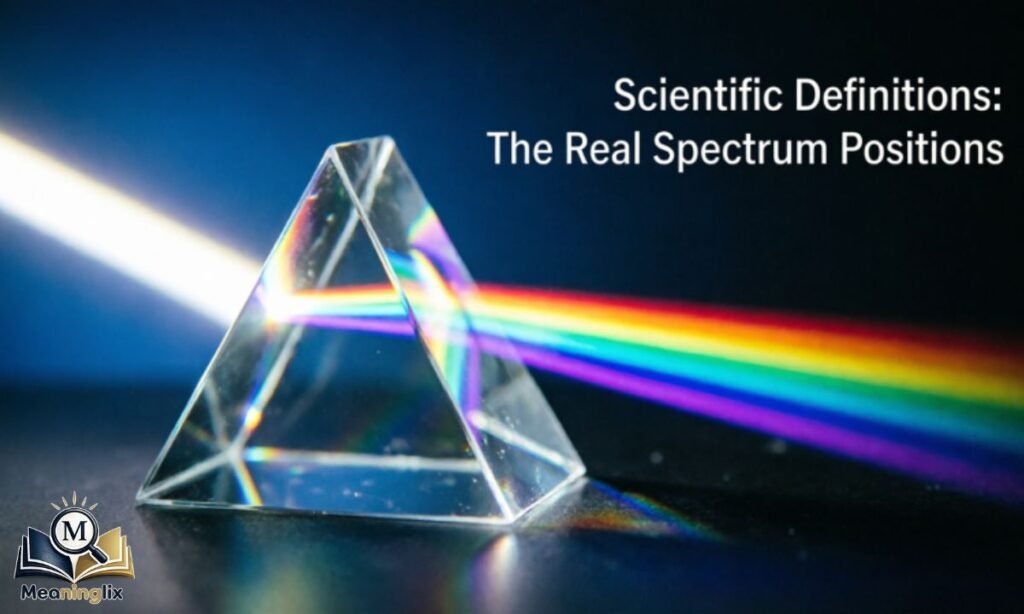
Light behaves differently than pigment, and this is where most of the confusion around violet vs. indigo vs. purple begins. A spectral color is a single wavelength of visible light that the human eye can detect directly, like the bands you see in a rainbow. Violet and indigo both qualify as spectral colors because they appear naturally when white light is split through a prism.
Purple, on the other hand, is what scientists call a non-spectral color. There is no single wavelength of light that produces purple. Instead, your eyes and brain combine red and blue signals to create the sensation of purple, which is why it only appears when colors are mixed rather than isolated in a spectrum.
Click Here To Read another Topic
Violet vs purple vs indigo vs magenta
Adding magenta into the mix makes things even more interesting. Magenta, like purple, is a non-spectral color created by combining red and blue light or pigment, but magenta leans more toward pink than blue. When comparing violet vs purple vs indigo vs magenta, remember that violet and indigo are true light wavelengths, while purple and magenta are both products of color mixing, with magenta sitting closer to the red end of that mix.
Violet: A True Spectral Color
Violet is the shortest wavelength visible to the human eye, typically falling between 380 and 450 nanometers. This places it at the very end of the visible spectrum, just before ultraviolet light becomes invisible to us. A classic example of violet is the color of fresh violet flowers or the deep blue-purple glow at the edge of a rainbow.
Indigo: The Controversial Color
Indigo is often called the most debated color in the rainbow. Isaac Newton originally included it as one of the seven colors in his spectrum, largely because he wanted the number of colors to match the seven notes of a musical scale. Many modern color scientists argue that indigo is simply a transitional shade between blue and violet and is too narrow a band to deserve its own category. A good visual reference for indigo is a dark denim jean or the ink used in traditional indigo dye vats.
Purple: A Color Your Brain Creates
Unlike violet and indigo, purple has no fixed wavelength. It exists only because your brain interprets a mix of red and blue light signals as a distinct hue. This makes purple a perceptual color rather than a physical one. Grape skins, lavender fields, and amethyst gemstones are all familiar examples of purple in everyday life.
Visual Differences: How to Tell Violet, Indigo, and Purple Apart
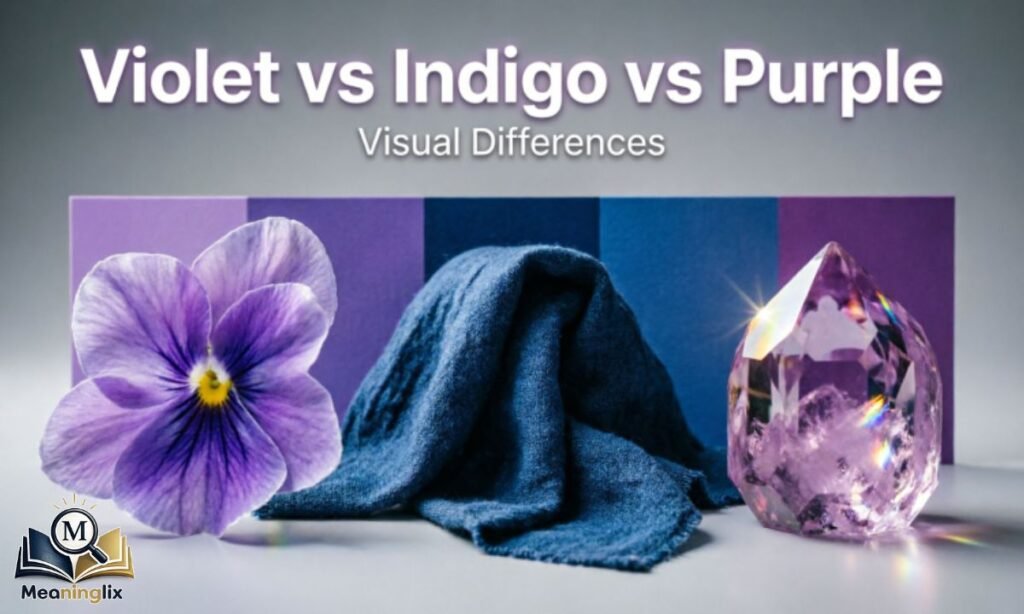
The easiest way to understand violet vs. indigo vs. purple visually is to look at where blue and red pull the color in each direction.
Quick Identification Table
| Color | Spectral Status | Dominant Tone | Common Example |
| Violet | True spectral color | Cool, blue-leaning | Violet flowers, prism edge |
| Indigo | Debated spectral color | Deep blue-violet | Denim jeans, indigo dye |
| Purple | Non-spectral (mixed) | Balanced red-blue | Grapes, lavender |
| Magenta | Non-spectral (mixed) | Red-leaning | Fuchsia flowers, pink-purple ink |
How to Spot the Difference Fast
- If it looks closer to blue with a hint of red, it is likely violet.
- If it looks like dark denim or ink with almost no red visible, it is likely indigo.
- If red and blue feel equally balanced, it is likely purple.
- If it leans warm and pink, it is probably magenta, not purple.
Historical and Cultural Context
Violet: The Color of Mystics and Royal Gardens
Violet has long been associated with spirituality, imagination, and mysticism. Ancient gardens often featured violet flowers as symbols of modesty and devotion, and the color later became linked to creativity and higher thinking in art movements throughout history.
Indigo: A Dye That Shaped Civilizations
Indigo dye has one of the richest histories of any color on this list. Extracted from the indigo plant, it became one of the most valuable trade goods in ancient India, Africa, and later Europe. Entire trade routes and economies were built around indigo production, and it remains famous today as the dye used to color denim fabric.
Purple: The True Royal Shade
Purple earned its royal reputation through Tyrian purple, an extremely expensive dye made from sea snails in ancient Phoenicia. Producing even a small amount required thousands of snails, making purple garments a luxury only emperors and nobles could afford. This scarcity cemented purple as the ultimate symbol of wealth and power.
Symbolism and Emotional Interpretation
Violet Symbolism
Violet is often associated with imagination, spirituality, and gentle creativity. It carries a softer emotional tone than deeper shades on this list.
Indigo Symbolism
Indigo is linked to intuition, wisdom, and deep introspection. It is frequently associated with calm confidence and inner focus.
Purple Symbolism
Purple represents luxury, ambition, and royalty. It is the color most commonly chosen to convey status and creativity in branding.
Color Mixing in Art and Design
Mixing Violet
To mix violet, combine more blue than red, since violet leans cooler than standard purple. A ratio favoring blue creates a more accurate spectral violet.
Mixing Indigo
To mix indigo, start with blue and add a small amount of violet or a touch of black to deepen the tone without losing its blue foundation.
Mixing Purple
To mix purple, combine red and blue in roughly equal parts. Adjusting the ratio slightly toward red creates a warmer purple, while more blue creates a cooler one.
Creating Accurate Shades: Ratio, Temperature, and Medium
Ratios Matter
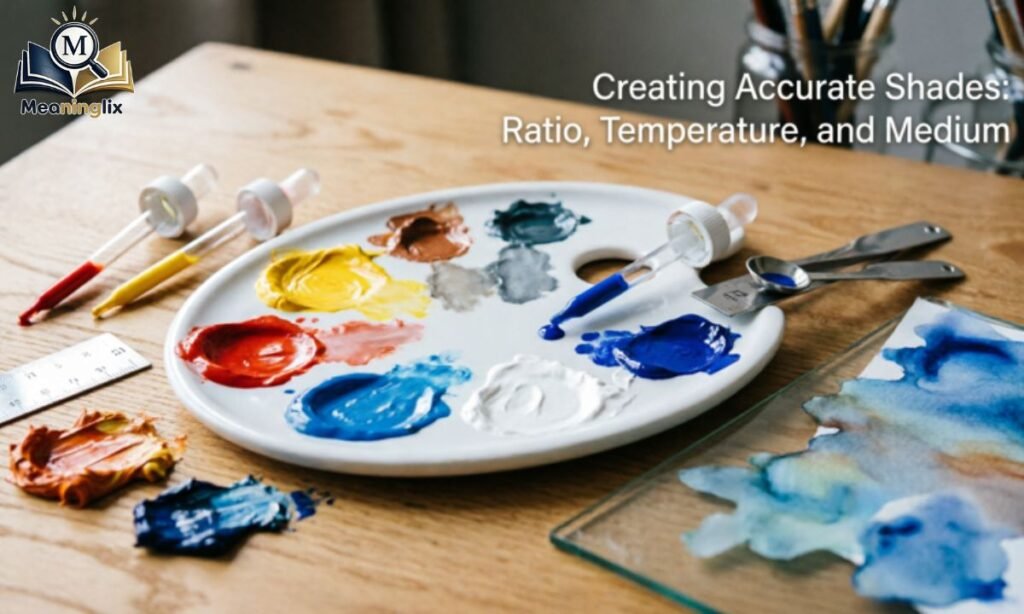
Small changes in red-to-blue ratio dramatically shift the outcome when comparing violet vs. indigo vs. purple in physical mixing. A 60 percent blue to 40 percent red mix leans violet, a 50-50 mix leans purple, and adding black or navy pushes the result toward indigo.
Temperature Adjustments
Adding white lightens any of these shades into a pastel, while adding black or gray mutes them into a more muted, dusty version. Warmer reds push toward magenta, and cooler blues push toward true violet.
Medium-Specific Tips
- In paint, use ultramarine blue for indigo and violet, and add a touch of magenta for true purple.
- In digital design, use HEX codes for precision, since screen colors render differently than printed pigment.
- In fabric dyeing, natural indigo requires oxidation exposure to develop its signature deep blue tone.
These Colors in Nature (violet vs. indigo vs. purple)
Violet in Nature
Violet flowers, certain butterfly wings, and the outer edge of rainbows showcase natural violet tones.
Indigo in Nature
Deep blue evening skies, some beetle shells, and traditional indigo textile dyes reflect indigo in the natural world.
Purple in Nature
Grapes, plums, eggplants, and lavender fields are some of the most recognizable natural purple examples.
Practical Identification Guide (violet vs. indigo vs. purple)
Checklist
- Does it appear in a light spectrum or prism? If yes, it is violet or indigo.
- Does it only exist as a pigment mix? Then it is purple or magenta.
- Is blue clearly dominant? Lean toward violet or indigo.
- Is red equally present? Lean toward purple.
Everyday Examples (violet vs. indigo vs. purple)
Violet flowers, indigo denim, and purple grapes offer instant visual anchors whenever you need to compare these shades quickly.
Designer Tip (violet vs. indigo vs. purple)
When working on branding or interior design in 2026, many designers are leaning into deeper indigo and violet tones for a calming, premium aesthetic, while purple remains the go-to choice for bold, luxury-focused branding. A common mistake beginners make is assuming indigo and navy blue are identical, when indigo actually carries a distinct violet undertone that navy lacks.
FAQs (violet vs. indigo vs. purple)
What’s the main difference between violet and purple?
Violet is a real wavelength of light found in the visible spectrum, while purple is created only by mixing red and blue and does not exist as a single wavelength.
Is indigo actually in the rainbow?
Indigo was included by Isaac Newton as one of the seven spectrum colors, though many modern scientists debate whether it is distinct enough from blue and violet to warrant its own category.
What are the 7 shades of purple?
Common shades include lavender, orchid, plum, mauve, amethyst, byzantium, and royal purple, each varying in saturation and how much red or blue dominates the mix.
Why say indigo instead of purple?
Indigo refers specifically to a deep blue-violet tone historically tied to a natural dye, while purple describes a broader, more balanced mix of red and blue.
Why is violet not called purple?
Violet is a spectral color with its own wavelength, while purple is a non-spectral color that only appears through mixing, making them scientifically distinct despite looking similar.
Conclusion (violet vs. indigo vs. purple)
The comparison of violet vs. indigo vs. purple ultimately comes down to science and perception. Violet and indigo are genuine wavelengths of visible light, with indigo remaining a topic of ongoing scientific debate, while purple exists purely as a mental blend of red and blue.
Knowing these differences helps you choose more accurate colors in art, design, and everyday description, whether you are mixing paint, dyeing fabric, or simply trying to describe the exact shade of a sunset or flower correctly.

Alisha Lehmann is the founder and author of Meaninglix. She specializes in explaining word meanings, internet slang, abbreviations, grammar, and English expressions in simple, accurate language. Her goal is to help readers improve their vocabulary and communicate confidently through clear, well-researched, and easy-to-understand content.
1 thought on “Violet vs. Indigo vs. Purple: What’s the Difference? (With Perfect Color Examples)”