
If you’ve ever paused mid-sentence wondering whether you want Desert vs Dessert after dinner, you’re not alone. These two words look almost identical, sound similar in some forms, and yet mean completely different things.
The short answer: dessert (two S’s) is the sweet course you eat after a meal, while desert (one S) is a dry, sandy region or, as a verb, means to abandon someone. The mix-up happens because English rarely doubles letters for a reason that’s obvious to the eye, so the spelling feels arbitrary until you learn the trick behind it.
Table of Contents
The Quick Answer “Desert vs Dessert”
Dessert = the sweet treat after dinner (cake, pie, ice cream). Desert = a dry, barren landscape (the Sahara, the Mojave) OR a verb meaning to leave/abandon.
That’s the entire rule in one sentence. Everything below explains why the spelling works this way, how the pronunciation differs, and how to stop second-guessing yourself in emails, essays, and texts.
What Does “Dessert” Mean?

Dessert is a noun that refers to the sweet course served at the end of a meal. Think cake, cookies, pudding, or a scoop of ice cream. It’s almost always a noun, and in everyday American English, it’s the word people reach for after finishing dinner.
- “We saved room for dessert.”
- “What’s for dessert tonight?”
The word comes from the French desservir, meaning “to clear the table” a fitting origin, since dessert is what arrives once the main dishes are cleared away.
What Does “Desert” Mean?
Desert actually carries two separate meanings, and this is where a lot of the confusion starts.
- As a noun (pronounced DEH-zert, stress on the first syllable): a dry region with little rainfall and sparse vegetation, like the Sahara or the Mojave.
- As a verb (pronounced dih-ZERT, stress on the second syllable): to abandon a person, place, or duty.
- “The hikers crossed the desert at dawn.” (noun)
- “He would never desert his teammates.” (verb)
So “desert” isn’t just one concept wearing two hats, it’s genuinely two different words that happen to share a spelling.
Why Do People Confuse Desert vs Dessert?
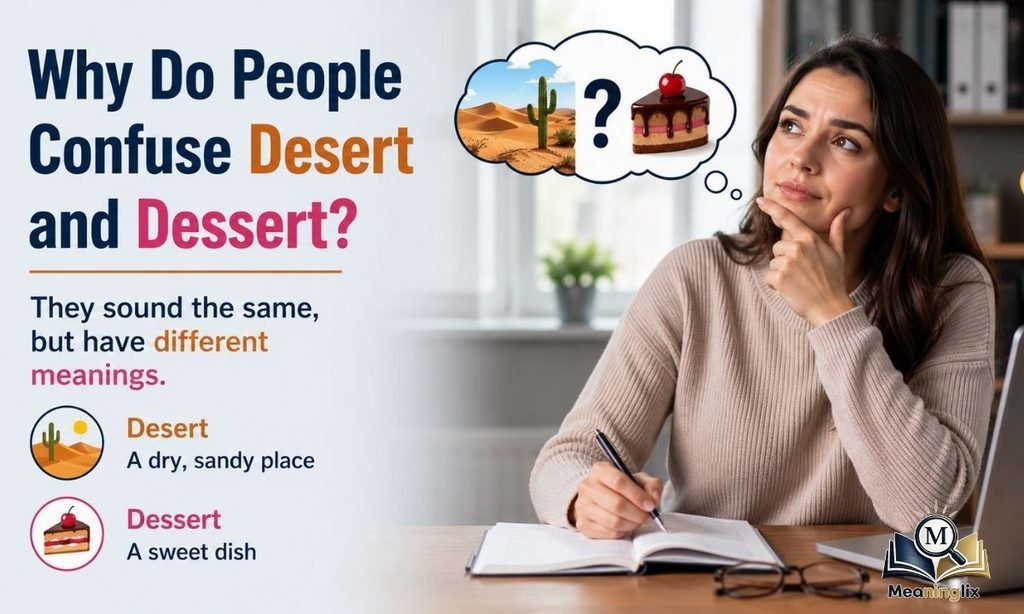
The confusion comes down to three things working against readers at once:
- Nearly identical spelling. Only one letter separates them, and it’s easy to drop or add an S without noticing.
- Overlapping sounds. The verb form of “desert” (dih-ZERT) sounds almost exactly like “dessert” (dih-ZERT), even though the noun form of “desert” sounds different (DEH-zert).
- No visual logic. Unlike words where doubled letters signal a clear pattern, there’s nothing in the spelling of either word that hints at its meaning. You simply have to memorize which is which.
Once you see that the sound overlap only applies to the verb form of “desert,” the mystery starts to clear up.
Desert vs Dessert: Quick Comparison Table
| Term | Correct? | Meaning | Typical Use | Example |
| Dessert | ✅ | Sweet course after a meal | Food, menus, casual conversation | “Let’s order dessert.” |
| Desert (noun) | ✅ | Dry, arid land | Geography, travel, science | “Camels thrive in the desert.” |
| Desert (verb) | ✅ | To abandon or leave | Relationships, duty, military context | “Don’t desert your post.” |
| Desert (double meaning confusion) | ❌ | N/A | Misused when writer means “dessert” | “I want a big desert after dinner.” (incorrect) |
Read More : Principal vs Principle
How to Remember the Difference “Desert vs Dessert”
The most popular memory trick, and the one grammar guides return to again and again, is this: dessert has two S’s because you always want seconds. Sweet things make you want more, so let the double S remind you of double servings.
For the noun “desert,” picture a single, endless stretch of sand with just one S, just one landscape, going on and on. That single S mirrors the sparse, empty feel of the terrain itself.
A second trick works for the verb: if someone deserts you, they leave with just one goodbye again, just one S.
Common Mistakes People Make “Desert vs Dessert”
Writing “desert” when they mean the sweet course
This is the single most frequent error. Someone writes “I’d like some desert, please” when they actually want cake or pie. Because “desert” is shorter and more commonly typed (thanks to autocorrect learning geography terms early), it often slips out by habit.
Incorrect: “For desert, we had chocolate mousse.” Correct: “For dessert, we had chocolate mousse.”
Writing “dessert” when they mean the dry landscape
Less common, but it happens, especially when writers overcorrect after learning the “two S’s” rule and start adding an extra S everywhere.
Incorrect: “The Sahara Dessert is the largest hot desert in the world.” Correct: “The Sahara Desert is the largest hot desert in the world.”
Confusing “desert” the verb with “dessert”
Because “desert” (verb) and “dessert” sound alike, writers sometimes swap them in sentences about loyalty or abandonment.
Incorrect: “He would never dessert his family.” Correct: “He would never desert his family.”
Misusing “just deserts”
Here’s a genuinely tricky one: the phrase meaning “getting what you deserve” is spelled just deserts, not “just desserts,” even though it’s pronounced like “desserts.” This phrase comes from an older meaning of “desert” related to what someone deserves, not the food or the landscape.
- “After months of dishonesty, he finally got his just deserts.”
Yes, it looks wrong. It isn’t. This is one of the few cases in English where the “correct” spelling feels counterintuitive even to careful writers.
Real-Life Examples in Context “Desert vs Dessert”
Everyday conversation Desert vs Dessert: “Should we skip dessert tonight, or are you in the mood for something sweet?”
Academic or school writing Desert vs Dessert: “The Atacama Desert in Chile is considered one of the driest places on Earth.”
Workplace communication Desert vs Dessert: “The team felt deserted after leadership left mid-project without a transition plan.”
Text messages Desert vs Dessert: “omg this dessert is soooo good, you have to try it”
Social media caption Desert vs Dessert: “Sunset over the desert never gets old. 🏜️”
Formal writing Desert vs Dessert: “Soldiers who desert their post during active duty face serious legal consequences.”
Notice how context almost always makes the intended meaning obvious once you know which spelling matches which idea.
Desert vs Dessert: American English and Pronunciation

In American English, stress placement is the clearest spoken clue:
- DEH-zert (stress on first syllable) → the dry landscape.
- dih-ZERT (stress on second syllable) → both the sweet food and the verb meaning to abandon.
This means that out loud, “dessert” and the verb “desert” are pronounced the same way. Only spelling and context separate them in writing, which is exactly why this pair trips up even fluent English speakers.
Practical Guidance for Writing It Correctly
Before hitting send on an email, caption, or essay, run through this quick checklist:
- Are you talking about food? Use dessert.
- Are you talking about sand, dryness, or a barren region? Use desert (one S).
- Are you talking about abandoning someone? Use desert (one S), even though it sounds like dessert.
- Are you writing the phrase about getting what someone deserves? Use “just deserts,” not “just desserts.”
If you’re still unsure, say the sentence out loud and picture the meaning. If it involves food, hunt for that second S.
Related Terms Worth Knowing
- Deserted an adjective describing an empty or abandoned place, as in “a deserted street.”
- Desertion is the noun form describing the act of abandoning something, often used in legal or military contexts.
- Desserts (plural) more than one sweet course or treat, as in “the bakery displayed dozens of desserts.”
- Deserts (plural, geography) more than one arid region, as in “the world’s largest deserts.”
Recognizing these related forms helps you apply the same one-S/two-S logic no matter how the word is used in a sentence.
FAQs “Desert vs Dessert”
Is “desert” or “dessert” correct for the sweet food after a meal?
Dessert is correct. It’s spelled with two S’s, and it refers specifically to the sweet course served at the end of a meal, such as cake, pie, or ice cream.
What is the difference between desert and dessert?
Desert (one S) refers to a dry, sandy landscape or the verb meaning to abandon someone. Dessert (two S’s) refers to a sweet food eaten after a meal. For example: “They crossed the desert before stopping for dessert in town.”
Why is “just deserts” spelled with one S if it sounds like dessert?
“Just deserts” uses the older meaning of “desert,” related to what a person deserves, not the food or the landscape. It’s pronounced like “desserts” but spelled with one S because it comes from a completely different word history.
Is there a British English difference between desert and dessert?
No. Both American and British English spell these words the same way. The confusion is universal to English spelling, not specific to one dialect.
Final Takeaway “Desert vs Dessert”
The words look alike, but the meanings couldn't be more different. Reach for dessert whenever food is involved, and picture that extra S as an invitation for seconds. Reach for desert whenever you mean sand, drought, or abandonment, and remember that a single S matches a single, empty stretch of land.
Once that mental image sticks, you’ll spell it correctly every time no dictionary required.

Alisha Lehmann is the founder and author of Meaninglix. She specializes in explaining word meanings, internet slang, abbreviations, grammar, and English expressions in simple, accurate language. Her goal is to help readers improve their vocabulary and communicate confidently through clear, well-researched, and easy-to-understand content.
2 thoughts on “Desert vs Dessert: Easy Guide to Get It Right Every Time”