If you have ever paused mid-sentence wondering whether to write “invision” or “envision,” you are not alone. This is one of the most common spelling confusions in modern English, and it trips up students, professionals, and even experienced writers. The good news is that the answer is simple once you understand where the confusion comes from.
Envision is the correct word, and “invision” is a misspelling. Envision means to imagine or picture something in your mind, especially a future outcome or possibility. “Invision” only exists as a proper noun, referring to the design software company InVision, and it should never be used as a substitute for the verb “envision.”
Table of Contents
Envision Is the Correct Word
When comparing invision vs. envision, there is really no contest. Envision is the standard, dictionary-recognized English verb. It appears in Merriam-Webster, Oxford, and Cambridge dictionaries. “Invision,” on the other hand, does not exist as a standalone English word in any major dictionary.
The confusion in the invision vs. envision debate usually comes down to how the words sound when spoken quickly. Because the prefixes “in-” and “en-” are pronounced almost identically in casual speech, many people assume both spellings are interchangeable. They are not. Only envision carries the correct meaning and correct spelling.
If you are writing an email, essay, resume, or article, envision is always the safe and accurate choice. Whenever you face the invision vs. envision question again, remember that envision wins every time in standard English usage.
Click Here To Read Another Topic
Invision vs. Envision Meaning
Understanding the invision vs. envision meaning starts with breaking down the actual word structure. Envision is built from the prefix “en-” (meaning “to put into” or “to cause to be”) combined with “vision” (the ability to see or imagine). Together, envision means to form a mental picture or vision of something, typically something that does not yet exist.
“Invision” does not follow any recognized English word-formation pattern. There is no standard prefix “in-vision” that carries meaning in the same way. This is a major reason grammar experts and style guides consistently flag it as incorrect.
Why Invision Is Wrong
Here are the core reasons “invision” fails as a legitimate word choice:
- It does not appear in any standard English dictionary as a verb
- The prefix “in-” combined with “vision” has no accepted grammatical meaning
- It is frequently confused with the brand name InVision, a digital product design platform
- Spell-check tools and grammar checkers consistently flag it as an error
- Professional editors and academic reviewers treat it as a spelling mistake
If you search online, you may find “invision” used casually in forums, social media, or informal writing. This does not make it correct. It simply reflects a widespread but incorrect assumption based on how the word sounds.
What Does Envision Mean and Usages
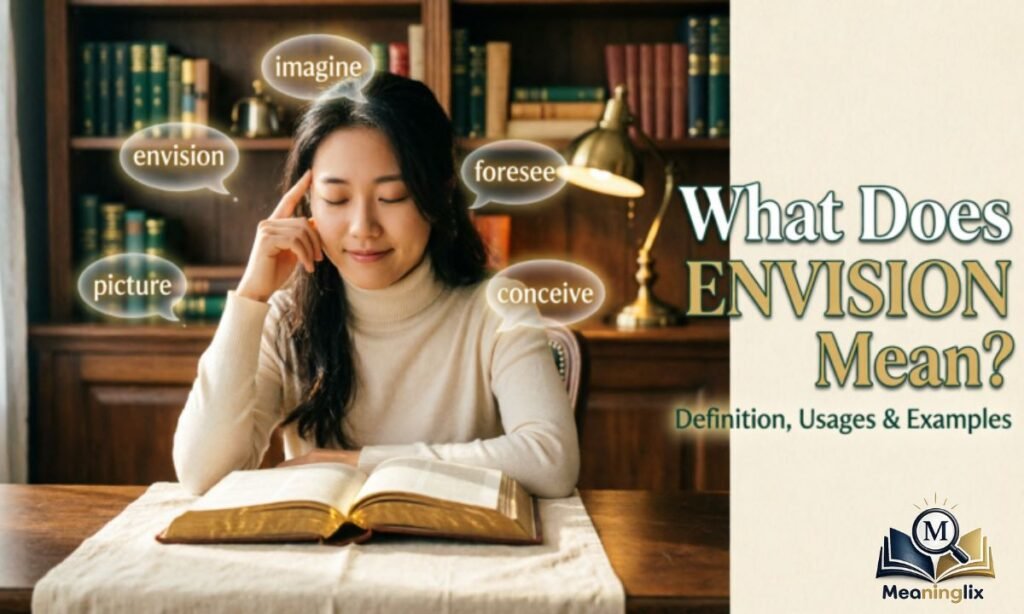
So what does envision actually mean, and how is it used? Envision is a transitive verb that means to imagine a possible future event, situation, or outcome, often with clarity and detail. It is commonly used when someone pictures a goal, plan, vision, or scenario before it happens.
Typical usages include:
- Envisioning a future career path
- Envisioning the outcome of a project
- Envisioning a redesigned product or space
- Envisioning long-term company goals
- Envisioning personal growth or lifestyle changes
Envision is often used in goal-setting language, strategic planning, creative visualization, and motivational writing. It carries a slightly more formal and forward-looking tone compared to simpler words like “imagine” or “picture.”
Synonyms of Envision
If you want to vary your writing while keeping the same meaning, here are strong synonyms of envision:
| Synonym | Best Used For |
| Imagine | General mental visualization |
| Picture | Casual, descriptive contexts |
| Foresee | Predicting future outcomes |
| Visualize | Creative or strategic planning |
| Anticipate | Expecting a future result |
| Conceive | Forming an original idea or plan |
| Contemplate | Thoughtful, reflective imagining |
Using these alternatives can help you avoid repetition, especially in longer pieces of writing where “envision” might otherwise appear too frequently.
Why People Write Invision
There are several practical reasons the invision vs. envision mistake happens so often:
- Phonetic similarity – “In” and “en” sound nearly the same in fast, casual speech.
- Brand influence – InVision, the popular design and prototyping software, has trained many professionals, especially in tech and design fields, to see “Invision” as a normal-looking word.
- Autocorrect gaps – Some basic spell-checkers do not always flag “invision” clearly, especially in casual writing apps.
- Visual similarity – The words look almost identical at a glance, differing by only one letter.
- Regional pronunciation habits – In some accents, the distinction between “in” and “en” sounds is minimal, reinforcing the error.
Recognizing these patterns helps explain why this mistake continues into 2026, even among educated writers and professionals.
How to Use Envision in a Sentence
Correct usage becomes much easier with real examples. Below are practical demonstrations of how to use envision in a sentence across different settings.
Envision Examples in Professional Writing
- “Our team can envision a more efficient workflow once the new software is implemented.”
- “The architect helped the client envision the finished building before construction began.”
- “Leadership continues to envision long-term growth across international markets.”
Envision Examples in Everyday Conversation
- “I can really envision us living in a bigger house someday.”
- “Try to envision how relaxed you’ll feel after this trip.”
- “She could envision exactly how the party decorations would look.”
Envision in Business and Academic Writing
- “The company’s mission statement envisions a future built on sustainability.”
- “Researchers envision new applications for this technology within the next decade.”
- “Students were asked to envision potential solutions to the case study problem.”
Across all three categories, envision consistently signals forward-thinking imagination, making it a valuable word for planning, strategy, and creative discussions.
FAQ’s (Invision vs. Envision)
What does it mean to envision something?
To envision something means to form a clear mental picture of it, usually related to a future event, goal, or possibility, before it actually happens.
What does invision mean?
“Invision” has no standard meaning in English as a common verb. It is only recognized as a proper noun referring to InVision, a design software company. As a verb, it is considered incorrect.
What does “envision” mean?
Envision means to imagine or picture a future outcome, situation, or goal in your mind, often with a sense of clarity and purpose.
How do you use Invision in a sentence?
“Invision” should only be used when referring specifically to the InVision software brand, such as: “Our design team uses Invision for prototyping.” It should never replace the verb “envision.”
How do you use envision in a sentence?
You can use envision to describe imagining a future outcome, such as: “I envision a stronger, more connected team by next year.”
Can you say “invision” in British English?
No. British English dictionaries, including Oxford, also recognize only “envision” as correct. “Invision” is not accepted in British or American English as a standard verb.
What is the difference between envision vs. invision?
The core difference in envision vs. invision is that envision is a real, dictionary-approved verb meaning to imagine something, while invision is either a misspelling or a reference to a specific software brand name.
Conclusion (Invision vs. Envision)
When it comes to invision vs. envision, the correct choice is always envision. It is the properly spelled, dictionary-recognized verb used to describe imagining a future goal, outcome, or vision. “Invision” only holds meaning as a brand name and should never be used as a substitute in everyday, professional, or academic writing.
By understanding the invision vs. envision meaning, learning why invision is wrong, and reviewing real-world usage examples, you can confidently avoid this common spelling mistake going forward. Whether you are writing a business plan, a casual message, or an academic paper, choosing envision ensures your writing stays clear, accurate, and professional.

Alisha Lehmann is the founder and author of Meaninglix. She specializes in explaining word meanings, internet slang, abbreviations, grammar, and English expressions in simple, accurate language. Her goal is to help readers improve their vocabulary and communicate confidently through clear, well-researched, and easy-to-understand content.
1 thought on “Invision vs. Envision: Which Is Correct? (2026 Updated)”