If you have ever paused mid sentence wondering whether to write “meantime” or “mean time,” you are not alone. These two look almost the same on paper and sound identical out loud, yet they mean very different things.
Getting this small detail wrong can make an email, report, or caption look less polished than you intended.
Table of Contents
Quick Answer “Meantime Or Mean Time”
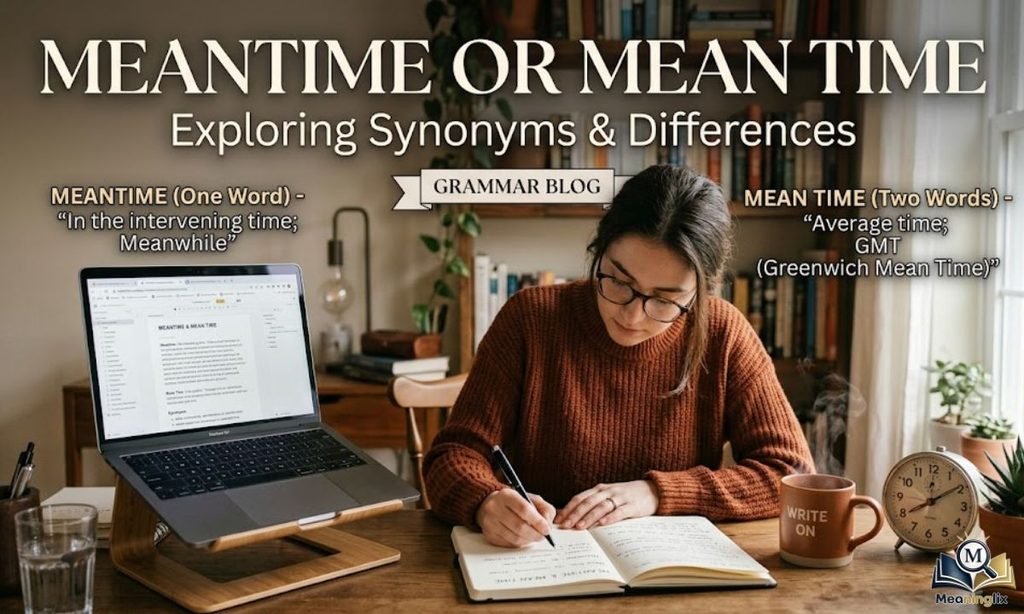
Meantime (one word) means the period between two events, similar to “meanwhile.” Mean time (two words) is a technical term for an average duration, often used in math, science, and engineering, as in Greenwich Mean Time. If you are writing about waiting for something, you almost always want “meantime.”
Meantime Or Mean Time

Simple Background ( meantime or mean time )
Both forms exist in English, and both are correct in their own context. The confusion happens because they sound the same when spoken, so people copy what they hear without noticing the spacing matters. In writing, though, the space is the whole story.
Clear Explanation Of The Difference
Think of it this way: “meantime” is about waiting, and “mean time” is about averaging. One describes a stretch of time between two moments. The other describes a calculated number based on multiple time values. Once you separate these two ideas in your head, choosing the right form becomes automatic.
What Is “Meantime”?
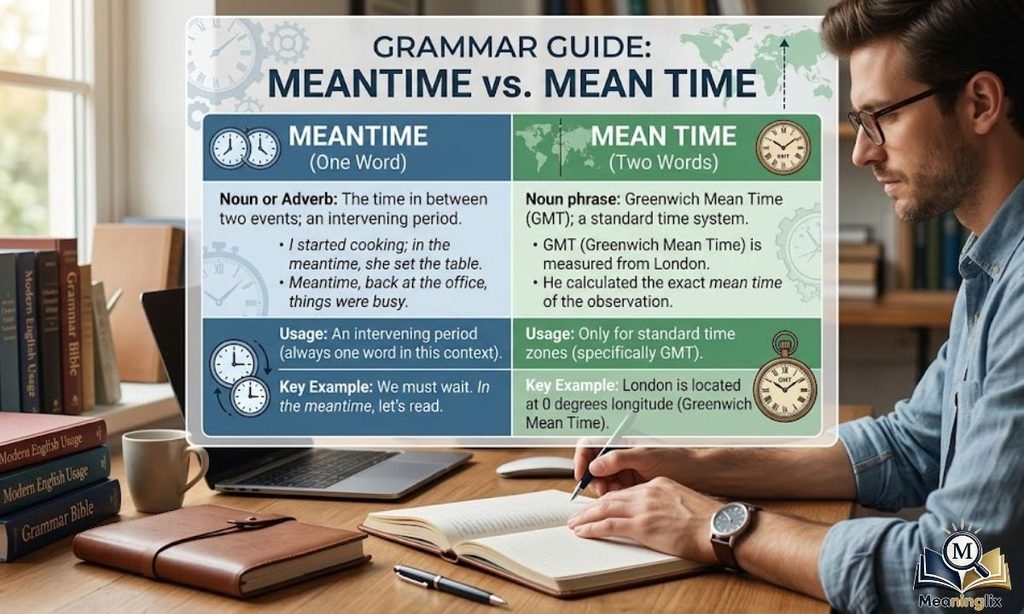
“Meantime” is a noun and, less commonly, an adverb. As a noun, it almost always shows up inside the phrase “in the meantime,” meaning the time between now and something that is about to happen. As an adverb, it can stand alone at the start of a sentence, working much like “meanwhile.”
Example:
- The delivery will arrive tomorrow. In the meantime, feel free to browse our other products.
- She’s finishing her degree. Meantime, she’s working part time to cover rent.
What Is “Mean Time”?
“Mean time” is a two word phrase where “mean” carries its statistical sense of average, not its everyday sense of unkind. It shows up in mathematics, engineering, astronomy, and time zone naming.
Example:
- The mean time between equipment failures was calculated at 400 hours.
- Greenwich Mean Time is used as a reference point for global time zones.
Meantime Or Mean Time Synonym
A close synonym for “meantime” is “meanwhile.” Both describe what happens during a waiting period, and in most sentences you can swap one for the other without changing the meaning. “Mean time,” on the other hand, has no casual synonym since it refers to a specific calculated average, so words like “average time” or “mean duration” are the closest equivalents.
Meantime Meaning In Maths
In math and statistics, you will not typically see the word “meantime” used at all. Instead, you will see “mean time,” which refers to the arithmetic average of a set of time based measurements. For example, if you record how long five tasks take to complete, the mean time is the sum of those durations divided by five.
For The Meantime Or In The Meantime
Both “for the meantime” and “in the meantime” are used in everyday English, though “in the meantime” is far more common and generally considered the more standard choice. “For the meantime” leans slightly more casual and is often heard in spoken conversation rather than formal writing.
Example:
- We’re waiting on the vendor’s response. In the meantime, let’s finalize the other sections.
- The office is being renovated, so for the meantime, we’re working from the second floor.
Mean Time Formula
There is no single universal formula, since “mean time” changes depending on what is being measured. In general, it follows the basic average formula:
Mean Time = (Sum of all recorded time values) ÷ (Number of values)
This basic structure is behind common technical metrics like mean time between failures and mean time to repair, both frequently used in engineering and IT fields going into 2026 as more industries track uptime and reliability data.
Meantime Meaning In French
In French, the concept of “in the meantime” is typically expressed as “entre-temps” or “en attendant.” There is no direct French word that splits into two spellings the way English does with “meantime” and “mean time,” since the average time concept is expressed differently, often as “temps moyen.”
Mean Time Podcast
Some podcasts and shows use “Mean Time” as a title or segment name, often playing on the dual meaning of the phrase. If you come across a podcast using this title, it is a stylistic or branding choice by the creators rather than a grammar reference, so it does not affect how the phrase should be used in standard writing.
In The Meantime In A Sentence
- The kitchen renovation will take two more weeks. In the meantime, we’re using the outdoor grill.
- Your refund is being processed. In the meantime, you can continue using the app.
- He’s waiting for his visa approval. In the meantime, he’s brushing up on the local language.
Meantime Etymology
“Meantime” traces back to Middle English, where it developed from the idea of an intervening or “mean” period sitting between two points. Over time, English speakers merged the phrase into a single compound word, a pattern seen in many other English terms that started as two words and gradually fused together. “Mean time,” by contrast, kept its two word structure because it stayed tied to a mathematical meaning tied to averages and measurement.
Read More Articles
High School or Highschoole? The Correct Spelling Revealed
Lieing Or Lying: Learn The Correct Spelling Fast In 2026
Inquire Vs Enquire: The Simple Difference (2026 Guide)
Comparison Table Meantime Or Mean Time
| Feature | Meantime | Mean Time |
| Word count | One word | Two words |
| Part of speech | Noun or adverb | Noun phrase |
| Common context | Everyday writing, conversation | Math, science, engineering |
| Meaning | Time between two events | Average or calculated time |
| Common phrase | In the meantime | Greenwich Mean Time |
| Formality | Casual to neutral | Technical, formal |
Which One To Use And When
Use “meantime” whenever you are talking about waiting, a gap between events, or what happens before something else occurs. Use “mean time” only when you are referring to a calculated average, typically in a scientific, statistical, or engineering context. If your sentence has nothing to do with numbers or averages, “meantime” is almost certainly the right choice.
Simple Tip To Remember
A simple trick: if you can replace the word with “meanwhile” and the sentence still makes sense, use “meantime.” If you can replace it with “average time” and the sentence still makes sense, use “mean time.”
Common Mistakes People Make
1. Writing “Mean Time” Instead Of “Meantime”
Many writers default to “mean time” simply because it looks like two separate words should exist. In casual writing about waiting periods, this is incorrect and should be “meantime.”
2. Thinking Both Forms Are The Same
Because they sound identical, some people assume they are interchangeable spellings of one word. They are not. Each form carries a distinct meaning tied to its own context.
3. Splitting The Word By Mistake
Autocorrect and quick typing sometimes insert a space where none belongs, turning “meantime” into “mean time” without the writer noticing. Reading your sentence back before sending it catches this easily.
Everyday Real Life Examples
In Emails
“Thank you for your patience. In the meantime, our support team will keep you updated on the ticket status.”
In Messages
“Running 10 minutes late. Meantime, go ahead and order without me.”
On Social Media
“New episode drops Friday. In the meantime, catch up on season one.”
In Daily Life
“Dinner needs another 20 minutes. In the meantime, set the table.”
In Technical Use
“The mean time to resolution for support tickets improved by 15 percent this quarter.”
Short Learning Section For Students
Step 1: Learn The Common Word
Start by memorizing that “meantime” is the everyday word you will use most often, especially in speech and casual writing.
Step 2: Practice
Write five sentences using “in the meantime” to describe waiting situations, then five sentences using “mean time” to describe averages.
Step 3: Use Memory Trick
Remember: meantime equals meanwhile, mean time equals average time.
Step 4: Check Your Writing
Before submitting any assignment or message, scan for the word and confirm it matches the context, waiting versus averaging.
Frequently Asked Questions
Is “For The Meantime” Grammatically Correct?
Yes, “for the meantime” is grammatically correct and commonly used in casual speech, though “in the meantime” remains the more widely accepted form in formal writing.
What Does Mean Time Mean?
“Mean time” refers to an average or calculated duration derived from multiple time based measurements, commonly used in science, math, and engineering.
Is Meantime All One Word?
Yes, when referring to the period between two events, “meantime” is spelled as a single word, as in “in the meantime.”
Where Did “In The Meantime” Come From?
The phrase developed from Middle English, where “meantime” originally referred to an intervening period, eventually merging into the single compound word used today.
Conclusion
The difference between “Meantime Or Mean Time” comes down to context: one describes waiting, the other describes averaging.
Once you connect “meantime” with “meanwhile” and “mean time” with “average,” the choice becomes second nature. A quick mental check before you hit send is often all it takes to keep your writing accurate and professional.

Alisha Lehmann is the founder and author of Meaninglix. She specializes in explaining word meanings, internet slang, abbreviations, grammar, and English expressions in simple, accurate language. Her goal is to help readers improve their vocabulary and communicate confidently through clear, well-researched, and easy-to-understand content.