If you have ever paused mid sentence wondering whether to type “openned” or “opened,” you are not alone. This is one of the most common spelling confusions in English, and it trips up native speakers and English learners alike. The good news is that the answer is simple, and once you understand the rule behind it, you will never second guess yourself again.
Opened is the only correct spelling. Openned is a misspelling that does not exist in standard English. The word “opened” is the past tense and past participle of the verb “open,” formed by simply adding “ed” to the base word. There is no rule in English spelling that justifies doubling the “n” in this case, which is why “openned” is always incorrect in American English, British English, or any other recognized English variant.
Table of Contents
What are You Looking For?

Most people searching for Openned vs. Opened want one of these answers:
- Confirmation of the correct spelling
- The reason why “openned” feels like it should be correct
- Real sentence examples showing proper usage
- A quick rule to remember for future writing
- Clarification on regional spelling differences
This guide covers all of that and more, so whether you are a student, a professional writer, or simply someone who wants to avoid an embarrassing typo, you will find a complete answer here.
Click Here To Read More Grammar
Quick Answer
Opened is correct. Openned is incorrect and should never be used in any form of writing, whether it is casual, professional, or academic. The confusion usually comes from how the word sounds when spoken quickly, but English spelling rules do not support the double “n” in this word.
Meaning of “Opened”
“Opened” is the past tense form and past participle of the verb “open.” It describes an action that has already happened, such as unlocking, unfastening, or making something accessible that was previously closed.
Examples of its meaning include:
- Making a door, box, or container accessible
- Starting or beginning something, such as a business or event
- Revealing or disclosing information
Because “open” already ends in a single consonant preceded by a vowel pattern that does not require doubling, the simple past tense is formed by just adding “ed.”
Why People Mistakenly Write “Openned”
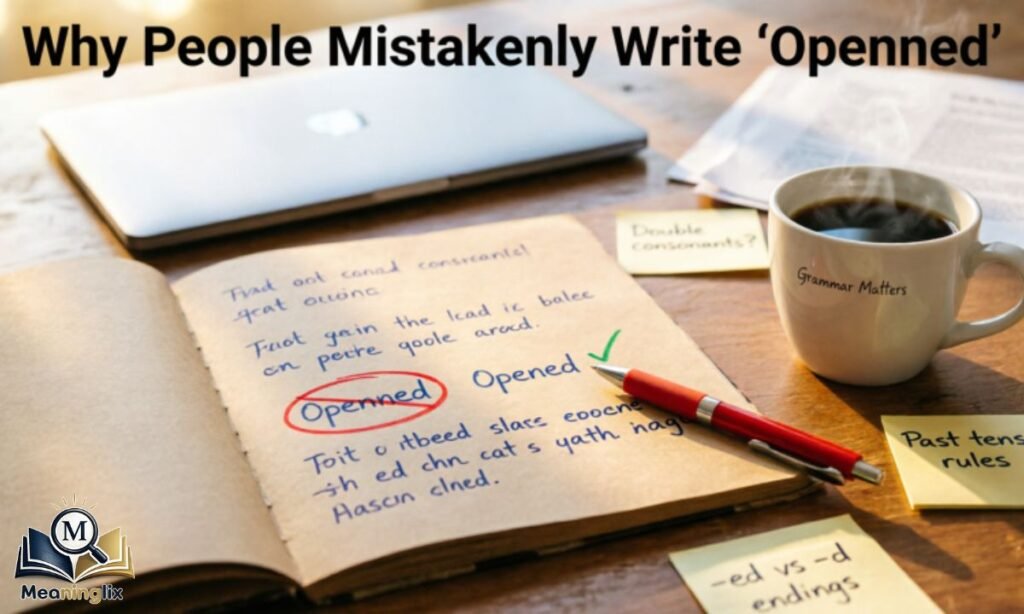
Understanding the root of this mistake helps prevent it permanently. Here are the main reasons people write “openned” instead of “opened”:
- Confusion with doubling rules – Many English verbs double their final consonant before adding “ed,” such as “stop” becoming “stopped” or “plan” becoming “planned.” Writers sometimes apply this rule incorrectly to “open.”
- Auditory spelling – When spoken aloud, “opened” can sound like it has a slightly stronger “n” sound, leading some writers to assume it should be doubled.
- Autocorrect and typing speed – Fast typing or muscle memory from words like “happened” or “planned” can cause accidental double letters.
- Non native English speakers – Learners studying English spelling patterns may overgeneralize the consonant doubling rule to unrelated words.
Recognizing these reasons makes it easier to catch the mistake before hitting publish or submit.
Simple Rule to Remember
Here is the easiest way to remember the correct spelling permanently:
The consonant doubling rule only applies when the final syllable of a word is stressed and ends in a single vowel plus a single consonant.
Since the stress in “open” falls on the first syllable (OH-pen), not the last, the final “n” is not doubled when adding “ed.” This is why we write:
- Open → Opened (correct)
- Open → Openned (incorrect)
Compare this to words like “occur” (stress on the last syllable), which becomes “occurred” with a doubled letter. “Open” simply does not follow that pattern.
Comparison Table: Openned vs Opened
| Feature | Opened | Openned |
| Correct spelling | Yes | No |
| Used in dictionaries | Yes | No |
| Grammatically valid | Yes | No |
| American English | Correct | Incorrect |
| British English | Correct | Incorrect |
| Common in professional writing | Yes | Never |
| Passes spell check | Yes | No |
This table makes it clear that in the Openned vs. Opened debate, there is no actual competition. Only one spelling is recognized as valid English.
Examples in Sentences
Seeing the word used correctly in different contexts makes it easier to remember. Below are examples across various writing styles.
Daily conversation
- She opened the window to let in some fresh air.
- He opened his eyes slowly after the alarm went off.
- We opened the gifts together on Christmas morning.
Professional writing
- The company opened three new branches this quarter.
- Management opened the meeting with a brief update on sales performance.
- The store opened earlier than usual due to high customer demand.
Academic writing
- The researcher opened the discussion by outlining the study’s objectives.
- The author opened the chapter with a historical overview of the topic.
- Data collection opened new questions that required further analysis.
Digital communication
- The app opened without any lag after the recent update.
- She opened the email and replied within minutes.
- The link opened a new tab showing the requested document.
Notice that in every single example, “opened” fits naturally, while “openned” would immediately look like an error to any reader familiar with proper English writing.
Common Mistakes to Avoid
When dealing with Openned vs. Opened, keep these common errors in mind:
- Writing “openned” because it “feels” correct phonetically
- Assuming doubling rules apply to every short verb
- Relying only on visual memory instead of checking a dictionary
- Ignoring spell check suggestions when typing quickly
- Copying spelling mistakes seen in informal online writing, such as social media captions
Avoiding these habits will help you maintain consistent and professional spelling accuracy.
American vs British English Differences

One relief for writers is that this particular word does not change between regions. Unlike words such as “color” versus “colour” or “organize” versus “organise,” opened is spelled exactly the same in American English and British English. There is no regional variation, no alternate accepted form, and no dialect where “openned” becomes valid. This makes it one of the more straightforward words in English spelling, despite the common confusion.
Related Forms of “Open”
Understanding the full verb conjugation helps reinforce correct spelling across different tenses.
| Form | Word |
| Base form | Open |
| Present tense (he/she/it) | Opens |
| Past tense | Opened |
| Past participle | Opened |
| Present participle | Opening |
| Adjective form | Open |
Notice that “opening” also does not double the “n,” following the same spelling logic as “opened.”
Synonyms for “Opened”
If you want to add variety to your writing, here are useful synonyms for “opened” depending on context:
- Unlocked
- Revealed
- Initiated
- Launched
- Unsealed
- Commenced
- Unveiled
- Started
Using these alternatives can also help you avoid repetitive spelling errors by shifting sentence structure entirely when needed.
Mini Spelling Test (Try Yourself)
Test your understanding with these quick questions. Choose the correct spelling for each sentence.
- She (opened / openned) the box carefully.
- The store (opened / openned) at nine this morning.
- He (opened / openned) his laptop and started working.
- The meeting (opened / openned) with a warm welcome.
Answer: All four should use “opened.” If you selected that in every case, you have fully mastered this rule.
Why Correct Spelling Matters
Spelling accuracy affects more than just grammar scores. In professional and academic settings, correct spelling reflects credibility, attention to detail, and communication competence. A single misspelled word like “openned” in a resume, email, or published article can distract readers and reduce trust in the content. In digital marketing and content writing, spelling accuracy also affects search engine visibility, since search engines prioritize well written, error free content when ranking pages.
FAQs
Which is correct, opened or openned?
“Opened” is the correct spelling. “Openned” is a common misspelling and is never considered correct in any English dictionary or writing standard.
Which is correct open or opened?
Both are correct, but they serve different grammatical purposes. “Open” is the base form or adjective, while “opened” is the past tense or past participle used to describe a completed action.
Why is open not opened?
“Open” is not automatically “opened” because “open” can function as a present tense verb, an adjective, or a command, while “opened” specifically indicates that an action has already occurred in the past.
What is the past tense of open?
The past tense of “open” is “opened.” It follows the regular verb pattern of simply adding “ed” without doubling the final consonant.
Summary
The debate between Openned vs. Opened has a clear and permanent answer. “Opened” is the only correct spelling, supported by standard English grammar rules, dictionary entries, and consistent usage across both American and British English. “Openned” is a spelling mistake that likely comes from confusing consonant doubling rules or mishearing how the word sounds.
By remembering that the stress in “open” falls on the first syllable, you can confidently avoid this mistake in every sentence you write. Whether you are writing a casual message, a professional email, or an academic paper, sticking with “opened” ensures your writing remains accurate, credible, and polished.

Alisha Lehmann is the founder and author of Meaninglix. She specializes in explaining word meanings, internet slang, abbreviations, grammar, and English expressions in simple, accurate language. Her goal is to help readers improve their vocabulary and communicate confidently through clear, well-researched, and easy-to-understand content.
1 thought on “Openned vs. Opened: Powerful Grammar Facts 2026”