If you’ve typed “toward” in one email and “towards” in the next, you’re not making a mistake, you’re just seeing two real spellings of the same word collide. The confusion happens because both forms show up constantly in books, articles, and everyday writing, with no obvious pattern.
Here’s the direct answer: both “Toward or Towards” are correct, and they mean exactly the same thing. The only real difference is regional. “Toward” is the standard American English spelling, while “towards” is the standard British English spelling.
Table of Contents
What Toward or Towards Actually Mean
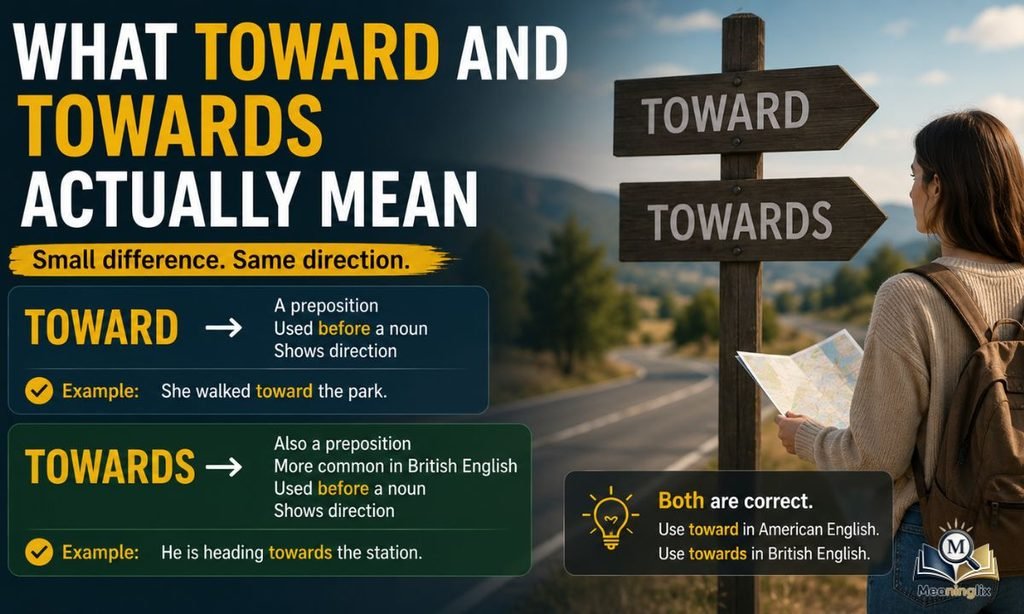
Both words are prepositions that describe movement or orientation in the direction of something. They can also describe an attitude, contribution, or relationship, as in “kind toward strangers” or “put money towards rent.”
A quick working definition: toward/towards = in the direction of, in relation to, or as a contribution to something.
Because the meaning never changes based on spelling, you don’t need to memorize separate definitions, just one meaning with two accepted spellings.
Is It Toward or Towards? The Short Rule
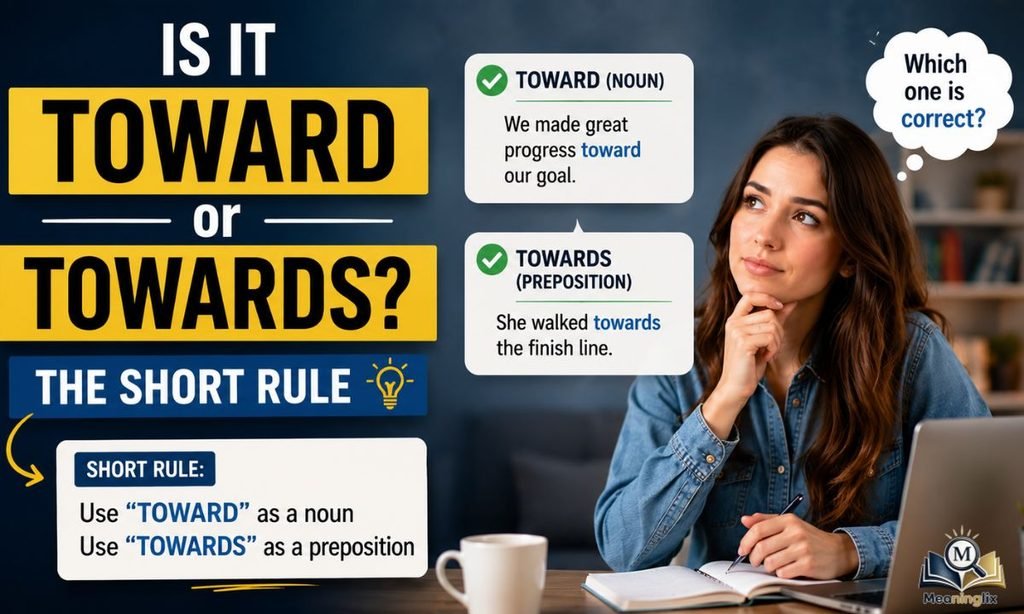
There’s no grammar rule that makes one spelling right and the other wrong. Instead, the choice comes down to which English variety you’re writing in:
- Use toward if you’re writing for a US or Canadian audience, or following American style guides.
- Use towards if you’re writing for a British, Australian, or other Commonwealth audience.
This is the same kind of split you see with color/colour or realize/realise a spelling variation tied to geography, not a rule about correctness.
Why the Confusion Happens “Toward or Towards”
Most spelling debates in English exist because one form eventually won out over time. “Toward” and “towards” never fully resolved that way. Both spellings trace back to the Old English word tōweard, and both versions have existed side by side for centuries rather than one replacing the other.
Add in the fact that American and British media mix freely online, in books, and on social platforms, and it’s easy to see both spellings so often that neither one looks “wrong.” That’s exactly why so many writers second-guess themselves here the eye gets used to both.
Toward or Towards: Quick Comparison Table
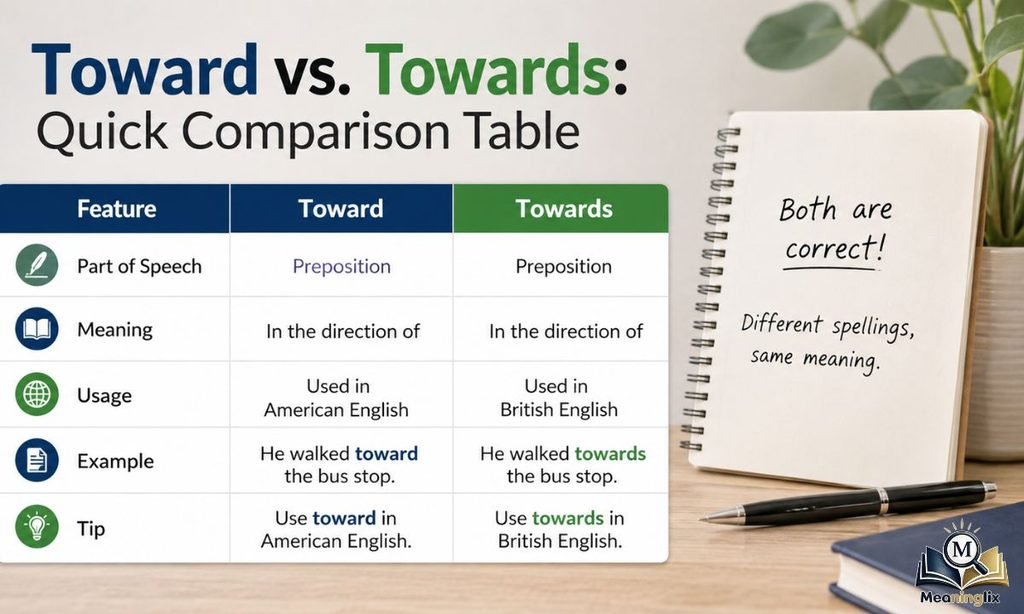
| Term | Correct? | Region | Typical Use | Example |
| Toward | Yes | American English (US, Canada) | Everyday and formal writing | “She walked toward the exit.” |
| Towards | Yes | British English (UK, Australia, most Commonwealth) | Everyday and formal writing | “She walked towards the exit.” |
Both entries in the table are fully grammatical. The table exists only to show where each spelling is expected, not to rank one as superior.
Toward or Towards in Real Sentences
Seeing both forms in a natural context makes the pattern easier to trust.
American English (toward):
- “The kids ran toward the playground.”
- “He’s always been generous toward new employees.”
- “We’re putting this bonus toward next year’s vacation fund.”
British English (towards):
- “The kids ran towards the playground.”
- “He’s always been generous towards new employees.”
- “We’re putting this bonus towards next year’s holiday fund.”
Notice the sentences are identical apart from the single letter and, in the last example, a small regional vocabulary swap (“vacation” vs. “holiday”). That’s the entire distinction in action.
Common Mistakes With Toward or Towards
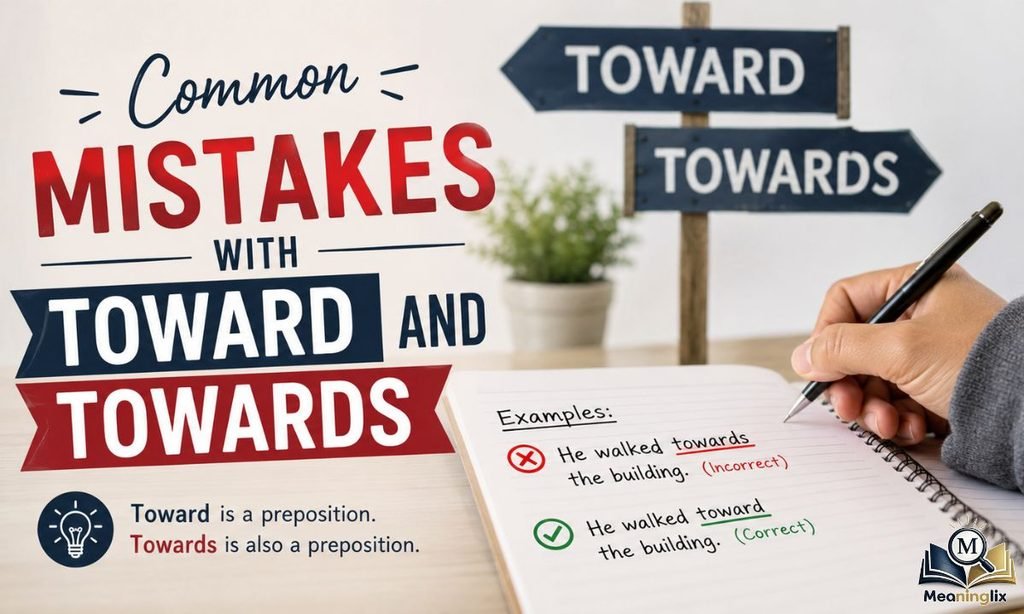
Most mistakes with this word pair aren’t really grammar errors, they’re consistency errors. Here’s what actually trips people up:
Mixing both spellings in the same document. Using “toward” in paragraph one and “towards” in paragraph three reads as sloppy, even though both spellings are individually correct. Pick one based on your audience and stick with it throughout.
Assuming one spelling is “more correct.” Neither Merriam-Webster nor the Oxford English Dictionary treats one form as an error. The idea that “towards” is somehow less formal or less proper in American English is a myth it’s simply less common there.
Ignoring the style guide you’re supposed to follow. If a company style guide, publication, or professor specifies American English (or a house style like AP or Chicago), “toward” is the expected choice, and using “towards” there isn’t wrong so much as off-brand for that document.
A simple way to remember the difference: American English tends to drop the extra letter, the same way it drops the “u” in “color” and “favorite.” If you write for US readers, leave off the “s.”
How to Choose the Right One for Your Writing “Toward or Towards”
Since grammar doesn’t force a choice here, let your audience and context decide:
- Identify your audience. Writing for US readers, a US employer, or US-based schoolwork? Use “toward.” Writing for a UK, Australian, or Commonwealth audience? Use “towards.”
- Check your style guide. AP Style and Chicago Manual of Style both American standards prefer “toward.” Publications following British conventions expect “towards.”
- Stay consistent. Whichever spelling you pick, use it every time in the same piece of writing. Consistency matters more here than the choice itself.
- When in doubt, default to “toward.” Because American usage dominates a large share of global online content, “toward” is a safe general default if you have no specific regional audience in mind.
This same audience-first logic applies to informal writing too texts, social media captions, and casual emails. No one will flag either spelling as wrong in casual contexts, so consistency within your own personal style is the only thing worth tracking.
Toward/Towards With Other “-ward” Words
This isn’t a one-word quirk. English has a whole family of direction words that follow the same American/British pattern, including forward/forwards, backward/backwards, upward/upwards, and onward/onwards. If you’ve settled on “toward” for American writing, apply the same no-“s” habit to this whole word family for consistency.
FAQs “Toward or Towards”
Is “towards” grammatically incorrect in American English?
No. “Towards” is grammatically correct everywhere; it’s simply less common in American writing. Using it in a US document won’t create a grammar error, but it may look inconsistent with American style conventions like AP or Chicago style.
What is the difference between “toward” and “towards” in meaning?
There is no difference in meaning. Both describe direction, contribution, or relationship for example, “walking toward the door” and “walking towards the door” describe the exact same action.
Which spelling should I use in academic writing?
Follow whatever style guide your school, journal, or instructor requires. If no guide is specified and you’re writing for a US institution, “toward” is the safer default; for a UK institution, use “towards.”
Does pronunciation change between the two spellings?
No. Both “toward” and “towards” are pronounced the same way, generally as two syllables (“TOH-erd” or “toh-WORD” depending on accent), regardless of whether the final “s” is written.
The Bottom Line “Toward or Towards”
There’s no rule to memorize and no winner to declare “Toward or Towards” are equally correct, equally grammatical, and equally clear. The only decision that matters is which regional spelling fits your audience: toward for American English, towards for British English.
Pick one, stay consistent within a document, and the “mistake” you were worried about disappears entirely.

Alisha Lehmann is the founder and author of Meaninglix. She specializes in explaining word meanings, internet slang, abbreviations, grammar, and English expressions in simple, accurate language. Her goal is to help readers improve their vocabulary and communicate confidently through clear, well-researched, and easy-to-understand content.
2 thoughts on “Toward or Towards? Discover the Clear Difference 2k26”