If you’ve ever paused mid-sentence wondering whether to write “assure,” “ensure,” or “insure,” you’re not alone. These three words all trace back to the same root idea of certainty, and they sound so similar that spell-checkers won’t catch the mix-up.
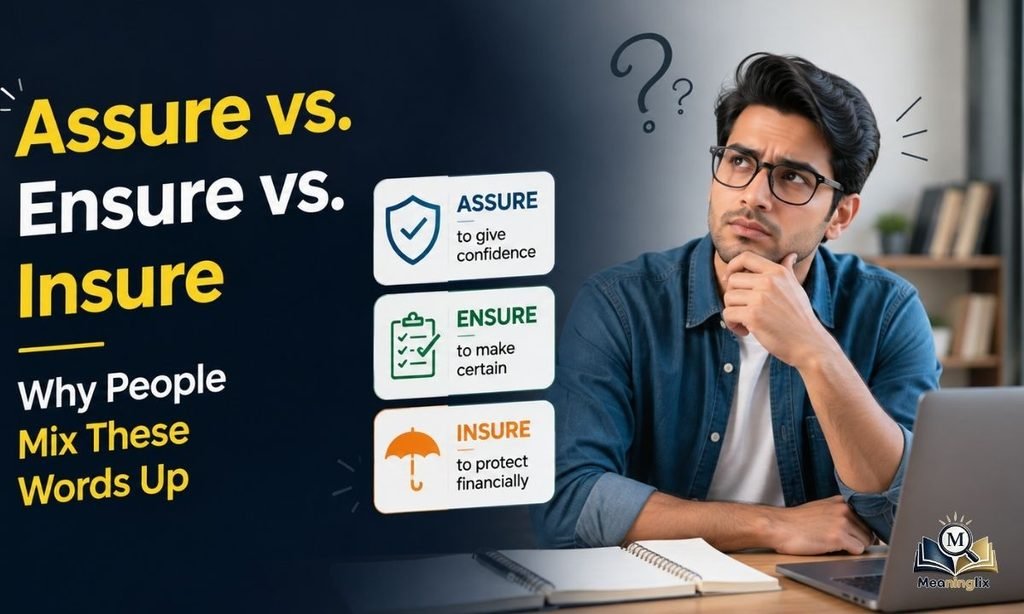
Here’s the quick answer: assure means to comfort a person, ensure means to guarantee an outcome, and insure means to financially protect against loss with an insurance policy. Once you separate them by “who or what” they act on, the confusion disappears.
Table of Contents
The Quick Answer (Direct Comparison)
Before digging into the details, here’s the core distinction in one place:
- Assure a person to remove their doubts. “I assure you the flight is on time.”
- Ensure an outcome to make it certain. “Double-check the locks to ensure the door is secure.”
- Insure a person or item with a financial policy. “We insured the house against fire damage.”
If your sentence involves reassuring someone, use assure. If it involves guaranteeing a result, use ensure. If it involves an insurance company or policy, use insure.
Why People Mix These Words Up
All three words come from the same Latin root, securus, meaning “safe” or “secure.” Centuries ago, English speakers actually used “ensure” and “insure” interchangeably as spelling variants of the same word. Only later did writers and editors start splitting them into separate meanings, with “insure” narrowing down to the financial sense we use today.
Because the words look alike, are pronounced almost identically, and share a common ancestor, the brain treats them as near-duplicates. Add in the fact that all three still carry a shared sense of “making something certain,” and it’s easy to see why even careful writers slip up.
What “Assure” Means
Assure is a verb that means to tell someone something with confidence in order to remove their doubt or worry. It’s about people, not tasks or objects. When you assure someone, you’re offering reassurance, not a guarantee of an actual result.
Correct: “The manager assured the team that layoffs weren’t planned.”
Incorrect: “The manager ensured the team that layoffs weren’t planned.”
The second sentence is wrong because “ensure” can’t take a person as its direct object in this way. You assure a person; you don’t ensure a person.
A simple trick: assure always pairs with a human being (or occasionally an animal) as the object of your reassurance. If you can rephrase the sentence as “I gave someone confidence about something,” assure is the word you want.
What “Ensure” Means
Ensure means to make certain that something will happen. It focuses on actions, processes, and outcomes rather than people’s feelings. When you ensure something, you’re taking steps to guarantee a result.
Correct: “Please review the report to ensure there are no errors before it goes out.”
Incorrect: “Please review the report to insure there are no errors before it goes out.”
Here, “insure” is wrong because there’s no financial or insurance context involved. The sentence is about guaranteeing accuracy, which is exactly what “ensure” is built for.
Ensure shows up constantly in workplace writing: ensuring compliance, ensuring quality, ensuring safety. If your sentence is really about confirming that a task, condition, or result happens the way it should, ensure is your word.
What “Insure” Means

Insure is specifically tied to insurance: the financial arrangement where a person or company pays money (a premium) in exchange for compensation if something is lost, damaged, or destroyed. This is the narrowest of the three meanings, and it’s the easiest to identify because it almost always involves a policy, a company, or a payout.
Correct: “They insured their car for accident and theft coverage.”
Incorrect: “They assured their car for accident and theft coverage.”
You can’t assure an object, and you don’t ensure a car in the financial sense, you insure it. If money, risk, coverage, or a policy is involved, insure is almost always the right choice.
One regional note worth knowing: in British and Commonwealth English, “assurance” is sometimes used for certain types of insurance, especially life assurance. In American English, this usage is rare, and “insurance” is the standard term across contexts.
Quick Comparison Table
| Term | Correct Use | Meaning | Typical Context | Example |
| Assure | People | To remove doubt or reassure someone | Conversations, promises, reassurance | “I assure you it’s handled.” |
| Ensure | Outcomes | To make certain something happens | Tasks, processes, guarantees | “Ensure the door is locked.” |
| Insure | Financial protection | To cover with an insurance policy | Insurance, finance, risk | “Insure your laptop against theft.” |
The Chicago Manual of Style Shortcut
If you want a memory trick that professional editors actually use, borrow this one: we assure people, we ensure events, and we insure things. Say the sentence out loud and ask which of those three categories your subject falls into. That single test resolves most mix-ups in seconds.
Real-Life Examples in Different Contexts
Everyday conversation: “Don’t worry, I assure you the pizza will arrive before the game starts.”
Workplace email: “Please ensure all invoices are submitted by Friday.”
Text message: “Can u insure the package for the full value when u ship it?”
Academic writing: “The researchers assured participants that their responses would remain anonymous, while the study protocol was designed to ensure consistent data collection.”
Formal business writing: “The company insures its fleet vehicles through a commercial auto policy and ensures driver compliance through mandatory training.”
Notice how a single paragraph can naturally use all three words correctly once you separate people (assure), outcomes (ensure), and financial coverage (insure).
Common Mistakes and How to Avoid Them
The most frequent error is swapping ensure and insure in everyday, non-financial writing. Because “insure” sounds almost identical and both words start the same way, writers often default to “insure” out of habit, even when no policy or financial protection is involved.
Incorrect: “We want to insure that customers are satisfied.” Correct: “We want to ensure that customers are satisfied.”
There’s no insurance policy here, so “insure” doesn’t fit. The sentence is about guaranteeing an outcome, which calls for “ensure.”
The second common mix-up is using assure when the sentence is really about an outcome rather than a person’s feelings.
Incorrect: “The new lock will assure the building stays secure.” Correct: “The new lock will ensure the building stays secure.”
A lock can’t reassure anyone’s doubts. It guarantees a result, so “ensure” is correct.
A simple way to remember the difference: assure ends in “sure” the way you make a person feel sure. Ensure starts with “en,” like “enable” an outcome. Insure starts with “in,” like the money you put into a policy.
Practical Usage Guidance
When you’re writing and unsure which word fits, ask yourself these three questions in order:
- Is the sentence about a person’s confidence or doubt? Use assure.
- Is the sentence about guaranteeing a task, process, or result? Use ensure.
- Is the sentence about a financial policy or coverage? Use insure.
If more than one seems to apply, go with the most specific meaning. Financial context always points to insure, even if the sentence also involves reassurance or certainty as a side effect.
Related Forms and Expressions
Each word has related noun and adjective forms worth knowing:
- Assure → assurance, assured, assuredly (“She spoke with assurance.”)
- Ensure → no common noun form; the related noun is usually “guarantee” or “certainty”
- Insure → insurance, insured, insurer (“The insured party filed a claim.”)
Interestingly, “assurance” and “insurance” can sometimes overlap in British English financial contexts, but in American English, stick to “insurance” for policies and “assurance” for reassurance or confidence.
Frequently Asked Questions
Is it “make sure” or “ensure”?
Both are correct, and they mean nearly the same thing in casual writing. “Make sure” is more conversational, while “ensure” sounds more formal and is common in business, academic, and technical writing. “Make sure the oven is off” and “Ensure the oven is off” convey the same idea.
Can “ensure” and “insure” ever be used interchangeably?
Historically, yes, they were spelling variants of the same word. In modern American English, though, they’ve split into distinct meanings: ensure means to guarantee an outcome, while insure means to provide financial coverage through an insurance policy. Using them interchangeably today is considered a usage error in formal writing.
What is the difference between assure and reassure?
“Assure” means to give someone confidence for the first time, while “reassure” means to comfort someone who already has doubts or has been worried before. “I assured her the plan would work” implies a first statement of confidence, while “I reassured her after she panicked” implies calming an existing worry.
Which word do I use for “I want to ___ my house against fire damage”?
Use “insure.” Since the sentence involves financial protection through an insurance policy, “insure” is the only correct choice among the three.
The Bottom Line
The fastest way to keep these words straight is to remember what each one acts on: assure comforts a person, ensure guarantees an outcome, and insure protects against financial loss through a policy.
Once you attach each verb to its proper object, the choice becomes automatic, and you’ll never second-guess a sentence involving assure, ensure, or insure again.

Alisha Lehmann is the founder and author of Meaninglix. She specializes in explaining word meanings, internet slang, abbreviations, grammar, and English expressions in simple, accurate language. Her goal is to help readers improve their vocabulary and communicate confidently through clear, well-researched, and easy-to-understand content.
After I originally commented I seem to have clicked
on the -Notify me when new comments are added- checkbox and now
each time a comment is added I receive four emails with the
exact same comment. There has to be a way you are able to remove me from that service?
Cheers!
Hi Dear, are you truly visiting this website on a regular basis, if
so then you will without doubt obtain fastidious knowledge.
I simply couldn’t depart your site prior to suggesting that
I really enjoyed the standard info an individual supply
for your guests? Is going to be again continuously in order to investigate cross-check new
posts
Hello there, just became alert to your blog through Google, and found that it is really informative.
I’m gonna watch out for brussels. I will be grateful if you continue this in future.
Many people will be benefited from your writing. Cheers!
Great site you’ve got here.. It’s difficult to find high quality writing like yours nowadays.
I really appreciate people like you! Take care!!