If you’ve ever paused mid-sentence wondering whether to write “alot” or “a lot,” you’re not alone. The short answer: “a lot” is correct. “Alot” is not a word.
This mix-up happens because “a lot” sounds like one word when we speak it out loud. Our brains often smash the sounds together, and our fingers follow along when we type.
Many other two-word phrases work the same way, which is why this error shows up so often in emails, essays, and text messages. Once you understand the pattern, you’ll never second-guess it again.
Table of Contents
Quick Answer
“A lot” (two words) is the only correct spelling. It means “a large amount” or “a great deal.” “Alot” is a common misspelling with no standing in standard English dictionaries. If you mean a piece of land or a way to distribute something, the correct single word is “allot” (with two L’s).
Which Is Correct: Alot or A Lot?
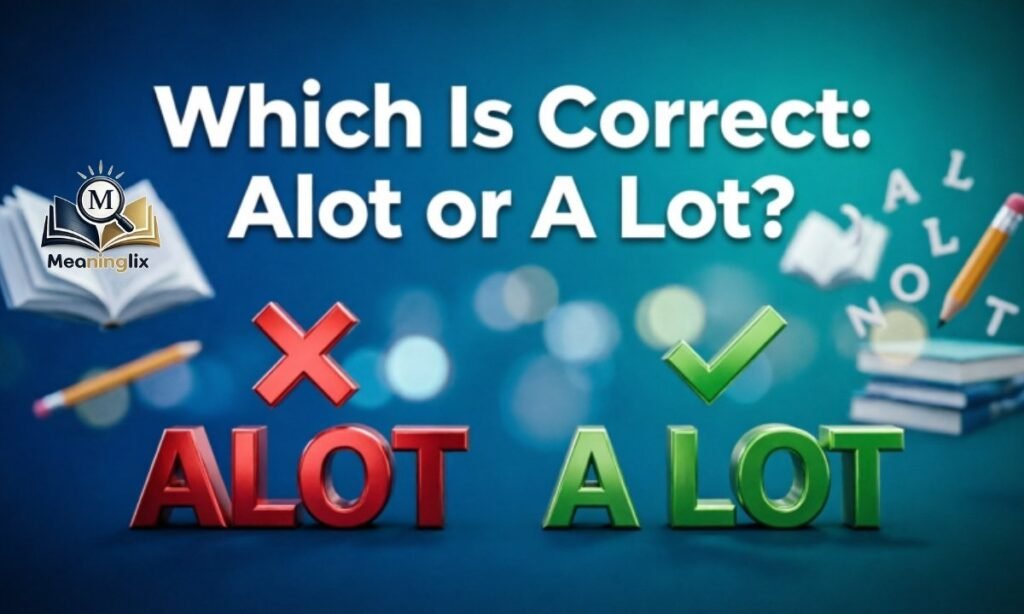
“A lot” is always written as two separate words. It functions as a noun phrase meaning a large quantity, or as an adverb meaning “very much.”
“Alot” is simply a spelling mistake. It has never been accepted into Merriam-Webster, the Oxford English Dictionary, or any major style guide. If you write it in a paper or a professional email, expect it to be marked wrong.
Difference Between Both Words
The confusion here isn’t really between two real words. It’s between a correct phrase and a misspelling that looks like it could be one. There’s also a third word, “allot,” that adds to the mix-up.
| Word | Meaning | Usage | Example | Correct Situation |
| A lot | A large amount or number | Noun phrase / adverb | She has a lot of books. | Standard writing, all contexts |
| Alot | Not a real word | Misspelling | ❌ “I like alot of pizza.” | Never correct |
| Allot | To give or assign a share | Verb | The teacher will allot time for questions. | Formal or business writing |
Definitions
A lot means “a large quantity” or “many.” It can describe amounts of things (a lot of money) or the extent of an action (I miss you a lot). It’s informal but grammatically accepted in nearly all writing styles.
Alot has no dictionary definition. It’s simply the incorrect merging of “a” and “lot” into a single word. Spell-checkers usually flag it in red for this exact reason.
Read Also Envolved or Involved
When to Use A Lot
Use “a lot” whenever you want to describe a large quantity, degree, or frequency. Here are five original examples:
- My grandmother has a lot of old photographs in her attic.
- We laughed a lot during the road trip.
- There’s a lot of traffic on this street every morning.
- He spent a lot of time fixing the old bicycle.
- I appreciate your help a lot more than you know.
When to Use Allot
Use “allot” when you mean to assign, distribute, or set aside a portion of something. Here are five original examples:
- The manager will allot each team a separate budget.
- Please allot ten minutes for questions at the end.
- Coaches allot playing time based on performance.
- The committee decided to allot extra funds to the library.
- We need to allot space for a new parking lot next year.
Side-by-Side Comparison
| Feature | A Lot | Alot | Allot |
| Word count | Two words | One word (incorrect) | One word |
| Part of speech | Noun phrase / adverb | None (not a word) | Verb |
| Meaning | Large amount | No meaning | To assign or give a share |
| Dictionary status | Accepted | Not accepted | Accepted |
| Example sentence | She reads a lot. | ❌ Invalid | They allot resources fairly. |
Common Mistakes
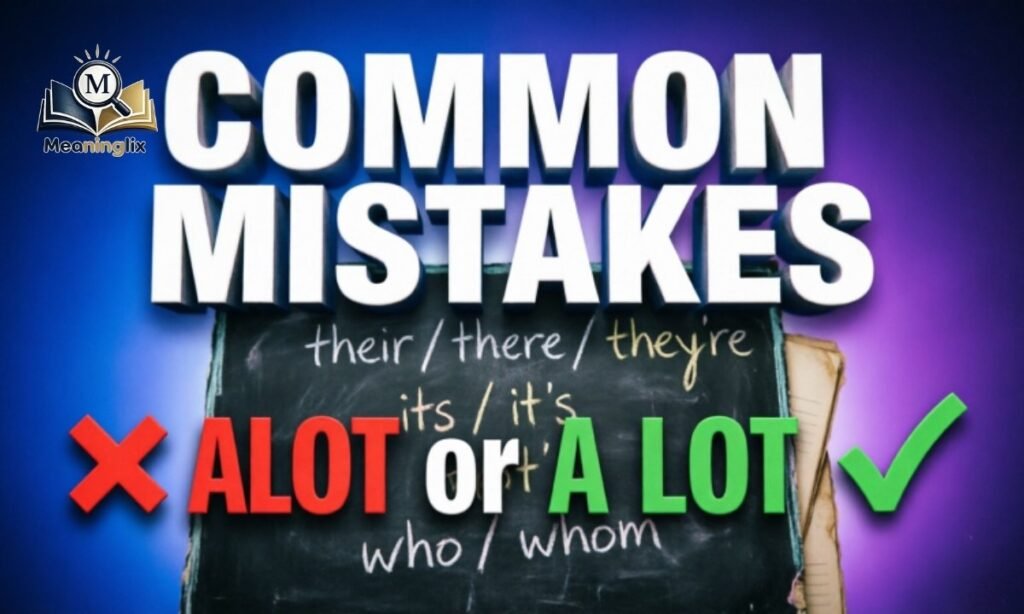
Learners often merge “a lot” into one word because they hear it spoken as a single sound in casual conversation. This habit carries over into writing without anyone noticing.
Another common slip is confusing “a lot” with “allot.” Since both look similar and sound close when spoken quickly, writers sometimes swap one for the other by accident.
A smaller mistake: some people also confuse “a lot” with “alot” when typing fast on phones, where autocorrect doesn’t always catch the error the way desktop software does.
Easy Trick to Remember
Think of “a lot” like “a house” or “a car.” You wouldn’t write “ahouse” or “acar,” so don’t write “alot” either. The word “a” is always separate from the noun that follows it.
If you’re tempted to write “alot,” picture the phrase “a little” instead. Since “little” is opposite in meaning but similar in structure, and nobody writes “alittle,” that same logic applies to “a lot.”
Real-Life Examples
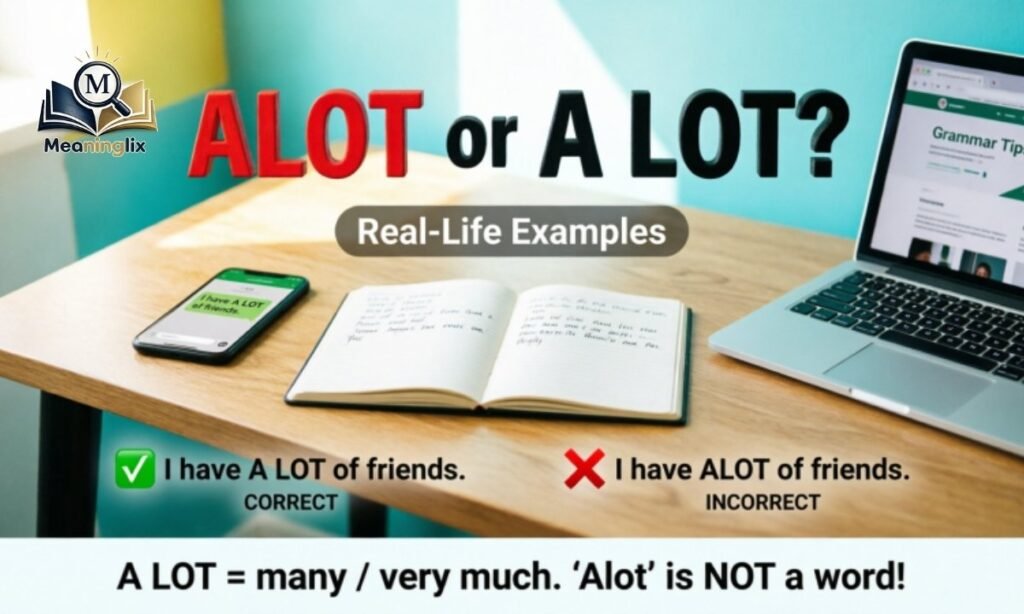
- I have a lot of homework tonight.
- She travels a lot for her job.
- Thank you a lot for your patience.
- There was a lot of noise outside last night.
- He knows a lot about ancient history.
- We need a lot more time to finish this project.
- The bakery sells a lot of bread on weekends.
- My dog sleeps a lot during the day.
- That movie made me think a lot about my choices.
- They saved a lot of money by planning ahead.
Click Here To Read Hola or Ola
Common Questions
Is “alot” correct? No. “Alot” is not recognized as a word in any standard English dictionary. Always write it as two separate words: “a lot.”
Can I use “alot” instead of “a lot”? No, you should not. Using “alot” in schoolwork, emails, or professional writing will likely be flagged as a spelling error.
Why do people confuse them? Because “a lot” is pronounced as one smooth sound in everyday speech, many writers assume it should also be spelled as one word, similar to words like “another” or “alone.”
Similar Grammar Confusions
- Allot vs. A Lot vs. Alot
- Everyday vs. Every Day
- A While vs. Awhile
- Alright vs. All Right
- Cannot vs. Can Not
Frequently Asked Questions
Is “a lot” one word or two?
“A lot” is always two words: “a” and “lot.” Writing it as a single word (“alot”) is a common but incorrect spelling that dictionaries and style guides do not recognize.
What does “a lot” mean in a sentence?
“A lot” means “a large amount” or “to a great extent.” For example, “She reads a lot” means she reads frequently or extensively, describing a high degree of the action.
Is “alot” a real word in any dictionary?
No. “Alot” does not appear in Merriam-Webster, Oxford, or Cambridge dictionaries. It’s classified strictly as a spelling error, not an informal variant or accepted alternative spelling.
What’s the difference between “a lot” and “allot”?
“A lot” describes a large quantity, while “allot” is a verb meaning to give or assign a share of something, such as time, money, or resources, to a person or group.
Can “a lot” be used in formal writing?
Yes, though it’s considered slightly informal. In academic or business writing, alternatives like “many,” “much,” or “a great deal” may sound more polished, but “a lot” is still grammatically correct.
How can I stop misspelling “alot”?
Practice separating “a” from “lot” the same way you would with “a house” or “a car.” Reading your writing aloud slowly also helps you catch the merged spelling before submitting.
Key Takeaways
- “A lot” is always two words and is the only correct spelling.
- “Alot” is a common misspelling with no dictionary recognition.
- “Allot” is a different word entirely, meaning to assign or distribute.
- “A lot” can act as a noun phrase or an adverb.
- A simple trick: if you wouldn’t merge “a” with another noun, don’t merge it with “lot.”
Conclusion
Getting “a lot” right comes down to remembering one simple rule: it’s always two words, never one. While “alot” might feel natural to type because of how we speak, it has no place in correct English writing.
Keep “allot” in mind too, since it’s a completely different word with its own meaning. With a little practice and the tricks above, this mistake becomes easy to catch and even easier to avoid for good.

Alisha Lehmann is the founder and author of Meaninglix. She specializes in explaining word meanings, internet slang, abbreviations, grammar, and English expressions in simple, accurate language. Her goal is to help readers improve their vocabulary and communicate confidently through clear, well-researched, and easy-to-understand content.
2 thoughts on “Alot or A Lot: Which One Is Actually Correct? 2026”