
Scrolling through a group chat and suddenly spotting “EVB” can stop you mid-scroll. It’s not as common as LOL or BRB, so when it shows up in a text, comment, or caption, it’s completely normal to pause and wonder what it means.
The good news is that EVB isn’t complicated once you understand it. In most everyday texting and social media use, EVB stands for “everybody.” It’s a quick, informal way to refer to a whole group of people without typing out the full word.
But that’s not the only place EVB shows up. Depending on the platform, the tone, or even the industry, EVB can carry a completely different meaning. This guide breaks down everything you need to know: the core definition, where it came from, how it’s used across WhatsApp, Instagram, TikTok, and Snapchat, common mix-ups, and exactly how to reply when someone sends it to you.
Table of Contents
What Does EVB Mean in Text & Chat?
In casual texting and chat apps, EVB is almost always shorthand for “everybody.” People use it the same way they’d use “everyone,” but shorter and faster to type.
You’ll typically see it used in three situations:
- Addressing a whole group chat at once (“EVB meet at 7”)
- Referring to a group of people in a casual sentence (“EVB was there last night”)
- Tagging or mentioning a wider audience in comments or captions
It’s informal by nature, which means it fits naturally into text messages, DMs, and comments, but it doesn’t belong in professional or academic writing. Think of it as sitting in the same slang family as “ppl” (people), “u” (you), and “thx” (thanks) all shortcuts built for speed rather than formality.
What Does EVB Mean in Text From a Girl
Context matters more than gender here, but this is one of the most searched versions of the question, so it’s worth answering directly.
When a girl uses “EVB” in a text, it almost always carries the same casual meaning as anywhere else: everybody. There’s no hidden romantic or flirtatious meaning behind it on its own it’s simply a fast way to refer to a group of people, whether that’s friends, classmates, or a wider circle.
Quick Definition
EVB = Everybody, used informally to refer to a group of people in a casual, conversational tone.
Example
Text: “EVB is coming to the party tonight, you in?”
Here, “EVB” simply replaces “everybody,” and the sender is asking if you’ll join the group.
Click Here To Read More Meaningful Article
Full Form, Stands For & Short Meaning of EVB
Because EVB isn’t an official dictionary term, it doesn’t have one single “correct” full form. Instead, its meaning shifts depending on where you see it. Here’s a breakdown of the most common interpretations:
| Full Form | Context Where It’s Used | Tone |
| Everybody | Texting, social media, group chats | Casual, inclusive |
| Extra Very Bad | Venting or exaggerating a bad situation | Negative, dramatic |
| Every Vibe Back | Reciprocating positive energy in a reply | Warm, playful |
| Electronic Verification Badge / Electric Vehicle Battery | Business, tech, or engineering settings | Neutral, technical |
Out of all of these, “everybody” is by far the most common meaning you’ll encounter in day-to-day chatting. The other definitions exist, but they’re far less frequent and usually depend heavily on the specific community or industry using them.
Origin, History & First Known Use of EVB
Like most texting abbreviations, EVB doesn’t trace back to one official inventor or a single dated moment. It grew naturally out of internet and SMS culture, where shortening words was less about slang and more about necessity.
Here’s how that evolution generally played out:
- Early SMS limitations Older phones had strict character limits per text, which pushed users to shorten common words.
- Chatroom and forum culture Early internet communities normalized abbreviations like “brb,” “afk,” and “lol,” creating space for newer shortcuts like EVB to catch on.
- Social media acceleration As platforms like Instagram, Twitter, and later TikTok grew, fast typing and caption-friendly language became the norm.
- Youth-driven adoption Younger users, especially Gen Z, embraced compressed language as part of everyday digital identity and speed of communication.
While EVB never became as universally recognized as “LOL” or “OMG,” it settled into a steady, niche use among younger, internet-native texting communities.
How People Use EVB in Daily Conversations
EVB shows up differently depending on the setting. Here’s how it typically plays out across daily communication.
In Text Messages
In one-on-one or group texts, EVB is usually used to refer to a group quickly:
- “EVB is meeting at the mall at 5.”
- “Tell EVB I said hi.”
- “EVB needs to see this.”
On Social Media
On platforms like Instagram or TikTok, EVB often appears in captions or comments, addressing a wider audience:
- “EVB needs to watch this show 😭”
- “EVB check the link in bio”
In Casual Situations
Beyond typed messages, EVB pops up in casual banter among friends who already understand internet shorthand often paired with emojis to add tone, since the letters alone can feel flat without context.
EVB Meaning Across WhatsApp, Instagram, TikTok & Snapchat
While the core meaning of EVB usually stays the same, the style of use can shift slightly depending on the platform.
On WhatsApp, EVB mostly appears in group chats among friends, family groups, or coworkers coordinating plans. It’s typically straightforward: “EVB, dinner’s at 8.”
On Instagram, EVB often shows up in captions and comments, sometimes exaggerated for effect: “EVB needs to see this outfit 🔥”
TikTok
TikTok comment sections use EVB in a trend-driven, relatable way, often reacting to a video: “EVB felt this 😂”
Snapchat
On Snapchat, EVB tends to appear in quick captions on stories or snaps, usually tagging a group of friends who’ll see the post.
Platform Comparison
| Platform | Common Use | Typical Tone |
| Group coordination, plans | Practical, friendly | |
| Captions, comments | Expressive, sometimes exaggerated | |
| TikTok | Video comments, trends | Relatable, humorous |
| Snapchat | Story captions | Quick, playful |
Different Meanings of EVB in Other Fields
Outside of texting, EVB can mean something entirely unrelated:
- Electronics/Engineering: EVB sometimes refers to an “Evaluation Board,” a hardware testing tool used by engineers.
- Automotive/Tech: In electric vehicle discussions, EVB may reference “Electric Vehicle Battery.”
- Business: Occasionally used for “Electronic Verification Badge” in workplace or security systems.
These meanings have nothing to do with texting slang, which is exactly why context always matters.
Common Confusions, Mistakes & Wrong Interpretations
Because EVB isn’t a fixed, dictionary-recognized term, misunderstandings happen often especially for people who aren’t deep into texting culture.
Common Mistakes
Thinking EVB Means “Everybody’s”
Some people assume EVB is short for the possessive “everybody’s” (as in “everybody’s here”). In reality, it almost always stands for the plain word “everybody,” not its possessive form.
Assuming It Has One Universal Meaning
Because EVB shows up in casual chats, tech forums, and even automotive discussions, assuming there’s only one correct meaning can lead to real confusion. Always read the surrounding context before deciding what it means.
Confusing EVB with EVP
EVB and EVP look similar at a glance, but they’re unrelated. EVP usually stands for “Electronic Voice Phenomenon” (often used in paranormal contexts) or “Executive Vice President” in business settings, nothing to do with “everybody” in texting.
Similar Terms, Alternatives & Related Slang
If you’re familiar with EVB, these related abbreviations will likely feel familiar too:
- EVO1 “Everyone,” used similarly to EVB
- PPL Short for “people”
- EVBD Occasionally used as a variation of “everybody”
- ALL A simpler, more universally understood alternative
- FR “For real,” often paired with EVB for emphasis (“EVB fr needs to see this”)
These terms all share the same DNA: speed, informality, and group-focused communication.
Examples of EVB in Real Chat Situations
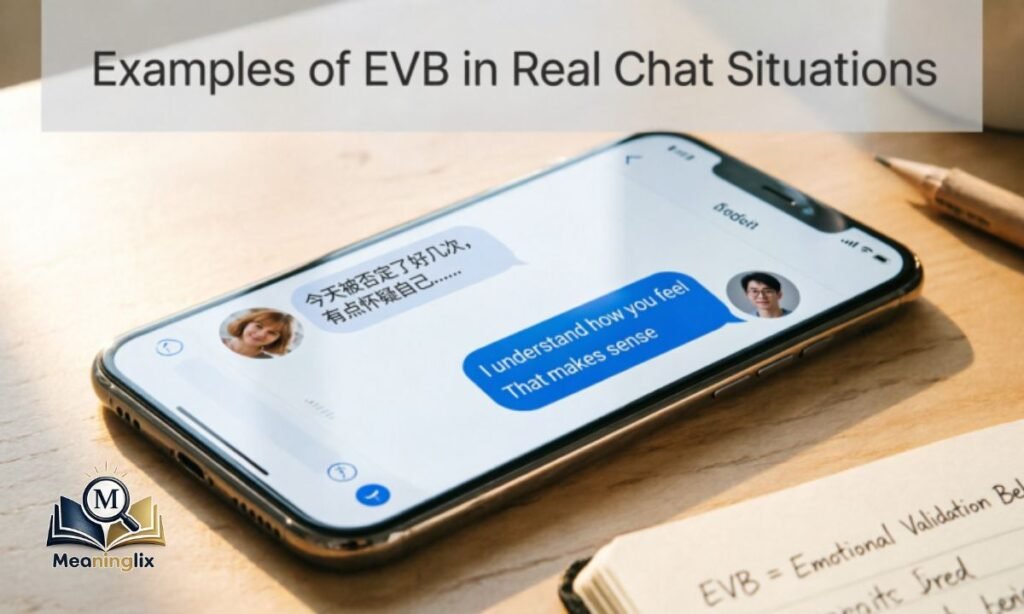
Seeing EVB in context makes the meaning click faster than any definition alone. Here are some realistic chat scenarios:
- Group Chat Announcement Friend: “EVB, movie night moved to Saturday!”
- Instagram Comment Comment: “EVB needs to hear this song on repeat 🎶”
- Casual Text Between Friends Text 1: “You coming tonight?” Text 2: “Yeah, EVB’s gonna be there.”
- TikTok Reaction Comment: “EVB felt this in their soul 😭”
- Workplace Group Chat (Casual Team) Message: “EVB please send updates before 4 pm.”
In every example, “EVB” slots in naturally wherever “everybody” or “everyone” would normally go.
How to Reply When Someone Says EVB
Once you understand what EVB means, replying becomes simple. Your response mostly depends on the tone of the conversation.
Casual Replies
- “Got it, I’ll be there.”
- “Sounds good, count me in.”
Friendly Replies
- “Aww, love that EVB’s coming together 🥹”
- “Yesss, can’t wait to see everyone!”
Funny Replies
- “EVB except me, I’m asleep 😴”
- “EVB better bring snacks 😂”
Formal Replies
If you’re replying in a more professional or unfamiliar setting, it’s best to mirror clearer language instead of slang:
- “Understood, I’ll make sure everyone is informed.”
- “Thanks, I’ll pass this along to the team.”
Is EVB Still Popular? Trends & Online Usage
EVB isn’t as widely recognized as staples like LOL, BRB, or OMG, but it still holds a steady, niche presence in digital conversations.
Current Popularity
EVB remains moderately popular, especially in casual group chats, comment sections, and youth-driven platforms like TikTok and Instagram.
Who Uses It Most?
- Gen Z and younger millennials most frequent users, comfortable with fast texting culture
- Casual online communities group chats, gaming communities, and social media commenters
- Older or less digitally active users least likely to recognize or use it
Usage Trend
| Age Group | Familiarity With EVB | Likelihood of Using It |
| Gen Z (Teens–20s) | High | High |
| Millennials | Moderate | Occasional |
| Gen X and Older | Low | Rare |
Slang like this tends to rise, dip, and sometimes resurface as trends shift, so its popularity may keep fluctuating rather than growing in a straight line.
Quick Facts
- EVB most commonly means “everybody” in texting and social media.
- It’s informal, only never appropriate for professional or academic writing.
- Meaning can shift in technical or engineering contexts.
- Popular mostly among younger, internet-savvy users.
- Often paired with emojis to clarify tone.
- Not as universally known as LOL, BRB, or OMG.
Frequently Asked Questions
What is the meaning of EVB?
EVB most commonly means “everybody” in texting, social media, and casual online chats.
What is EVB short for?
It’s typically short for “everybody,” though it can also mean “extra very bad” or refer to technical terms depending on context.
Does EVB mean everybody?
Yes, in the vast majority of texting and social media contexts, EVB means “everybody.”
What does ytb mean in chat?
YTB commonly stands for “YouTube” or, less often, “yeah that’s true,” depending on the conversation.
Is EVB rude?
No, EVB is neutral and casual. It’s not considered rude in any common usage.
What does EVB mean from a girl?
The same as anywhere else it typically means “everybody,” with no hidden meaning tied to gender.
What does EVB mean from a guy?
Just like with any sender, EVB from a guy usually means “everybody” in a casual, informal message.
Is EVB an official acronym?
No, EVB isn’t an official dictionary term. It’s internet slang that gained meaning through casual usage rather than formal definition.
Conclusion
EVB might look confusing the first time you spot it, but once you know it typically stands for “everybody,” the mystery disappears fast. It’s a small, casual shortcut built for speed perfect for group chats, captions, and quick replies, but not something you’d use in a formal email or report.
Keep in mind that context is everything. While “everybody” covers most everyday texting situations, EVB can occasionally mean something different in technical or professional settings. The next time you see it pop up in a chat, you’ll know exactly what’s being said and you might even find yourself using it too.

Alisha Lehmann is the founder and author of Meaninglix. She specializes in explaining word meanings, internet slang, abbreviations, grammar, and English expressions in simple, accurate language. Her goal is to help readers improve their vocabulary and communicate confidently through clear, well-researched, and easy-to-understand content.