You’re typing a sentence, you reach for that word right before a noun about ownership, and suddenly your fingers freeze. Is it “Who’s vs. Whose “? Here’s the short answer: whose shows possession (“Whose phone is this?”), while who’s is a contraction meaning “who is” or “who has” (“Who’s calling?”). The confusion happens because the apostrophe in “who’s” looks possessive, but it isn’t standing in for missing letters, not ownership.
Once you separate those two ideas, the mix-up mostly disappears. Let’s break down exactly why these two words get swapped so often, and how to stop doing it for good.
Table of Contents
What “Whose” Means
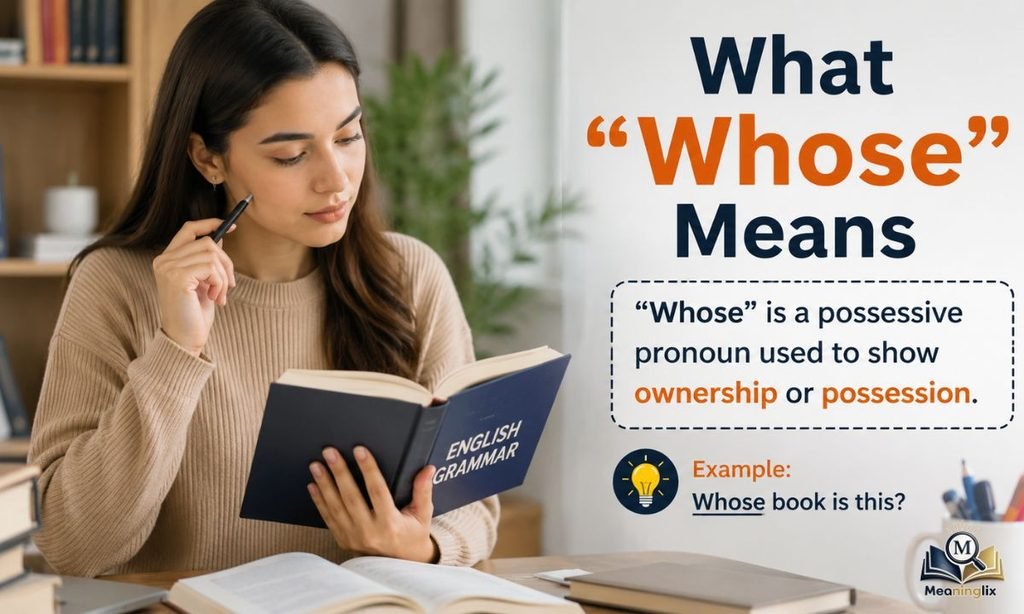
Whose is a possessive pronoun. It asks or tells who owns, controls, or is connected to something. It always works alongside a noun, because that noun is the thing being possessed.
- “Whose car is parked outside?”
- “I don’t know whose idea this was.”
- “The author, whose latest novel just launched, is on tour this month.”
Notice that “whose” is followed (directly or a bit later) by a noun: car, idea, novel. That pattern is one of the biggest clues to whether you need “whose.”
What “Who’s” Means
Who’s is a contraction. It’s simply “who is” or “who has” squeezed into one word, with the apostrophe replacing the missing letters.
- “Who’s coming to dinner tonight?” (Who is coming?)
- “Who’s already finished the report?” (Who has already finished?)
- “Do you know who’s in charge here?” (who is in charge)
Because “who’s” is built from a verb (“is” or “has”), it’s describing an action, state, or identity not ownership.
Why This Mix-Up Happens So Often “Who’s vs. Whose”
In English, an apostrophe followed by “s” almost always signals possession with regular nouns: the dog’s leash, Maria’s car, the team’s schedule. So your brain naturally assumes an apostrophe plus “s” means “belongs to.”
The catch: possessive pronouns never use an apostrophe. Think of his, hers, its, theirs, and whose none of them take an apostrophe, even though they all show possession. The apostrophe in “who’s” is doing contraction duty, not possession duty. That single exception is the entire source of the confusion.
The Simple Substitution Test “Who’s vs. Whose”
Here’s the fastest way to check yourself before hitting send or submit:
- Take the word you’re unsure about and mentally replace it with “who is” or “who has.”
- If the sentence still makes sense, use who’s.
- If it sounds wrong or awkward, use whose.
Try it:
- “___ bag is this?” → “Who is this bag is this?” (doesn’t make sense) → use whose
- “___ ready to go?” → “Who is ready to go?” (makes sense) → use who’s
This test works almost every time because it forces you to check what the word is actually doing in the sentence showing ownership, or standing in for “who is/has.”
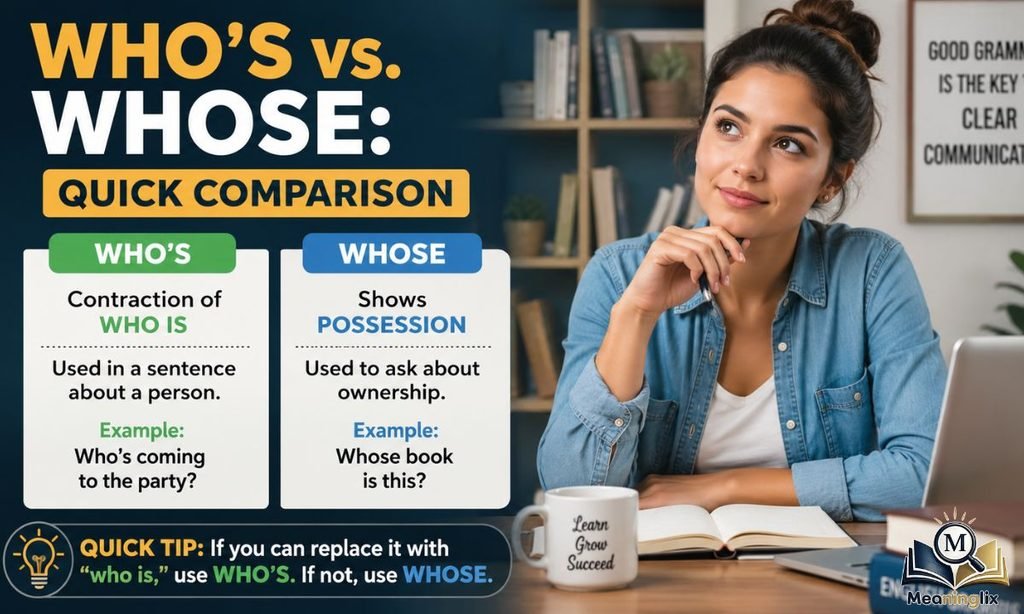
Who’s vs. Whose: Quick Comparison
| Term | Correct? | Meaning | Typical Use | Example |
| Whose | Yes | Possessive form of “who” | Before a noun, to show ownership | “Whose keys are these?” |
| Who’s | Yes | Contraction of “who is” / “who has” | Before a verb, describing action or identity | “Who’s driving tonight?” |
| Who’s (as possessive) | No | Common mistake | Incorrectly used to show ownership | ~~”Who’s book is this?”~~ |
Real-Life Examples in Context “Who’s vs. Whose”
Everyday conversation “Who’s vs. Whose“
- Correct: “Whose turn is it to pick the restaurant?”
- Correct: “Who’s picking the restaurant tonight?”
Text messages “Who’s vs. Whose“
- Correct: “Who’s free later? Also, whose charger is this mine’s missing.”
Workplace communication “Who’s vs. Whose“
- Correct: “Whose approval do we need before this goes out?”
- Correct: “Who’s approving the budget this quarter?”
Academic or formal writing “Who’s vs. Whose“
- Correct: “The committee, whose decision is final, will announce results Friday.”
- Incorrect: “The committee, who’s decision is final, will announce results Friday.” This is wrong because “who’s decision” would literally read “who is decision,” which makes no sense. The sentence needs the possessive whose.
Social media “Who’s vs. Whose “
- Correct: “Who’s watching the game tonight?”
- Incorrect: “Whose watching the game tonight?” Here, the writer needs the contraction (“who is watching”), not the possessive.
See Also : Who vs. Whom
Common Mistakes and How to Avoid Them
The two mix-ups below cover almost every real-world error people make with these words.
Mistake 1: Using “who’s” to show possession. “Who’s laptop is this?” is incorrect because you’re asking about ownership, not identity or action. It should be “Whose laptop is this?”
Mistake 2: Using “whose” instead of the contraction. “Whose going to the meeting?” is incorrect because the sentence means “Who is going,” which calls for the contraction. It should be “Who’s going to the meeting?”
Why people slip up: the apostrophe trick tricks even careful writers, since it visually mimics possessive nouns like Sam’s or the dog’s. A quick way to remember the difference: whose rhymes with whom and hose think of it as a solid, single word doing one job (possession). Who’s, on the other hand, has that apostrophe gap because two words got squeezed together.
Whose vs. Who’s in Formal Writing

In academic papers, business reports, and other formal contexts, contractions like “who’s” are generally best avoided altogether spell out “who is” or “who has” instead. Whose is fully acceptable in formal writing at any time, since it functions as a standard possessive pronoun rather than a shortened phrase. This is a useful shortcut on its own: if you’re writing something formal and you’re not sure which word you need, spelling out “who is” or “who has” instantly tells you whether a contraction was even necessary.
Related Forms Worth Knowing
- Who vs. whom: “who” is a subject pronoun (the one doing the action), while “whom” is an object pronoun (the one receiving the action). “Who called you?” vs. “To whom did you send it?”
- Its vs. it’s: this follows the exact same logic as whose vs. who’s. “Its” shows possession (“The cat licked its paw”), while “it’s” is a contraction for “it is” or “it has” (“It’s raining”).
- Whose can refer to things, not just people, in modern usage: “the company whose stock rose” is standard and accepted, even though “whose” technically comes from “who.”
Frequently Asked Questions
Is “whose” only used for people?
No. While “whose” originates from “who,” it’s widely accepted for objects, organizations, and ideas too, as in “a house whose roof needs repair.” This usage has been standard in English for centuries and is not considered incorrect.
What is the difference between “who’s” and “whose”?
“Who’s” is a contraction meaning “who is” or “who has,” used to describe an action, state, or identity. “Whose” is a possessive pronoun used to show ownership or connection, and it’s always followed by a noun. For example: “Who’s bringing the cake?” versus “Whose cake is this?”
Can “who’s” ever be possessive?
No. Despite the apostrophe, “who’s” is never possessive; it’s strictly a contraction. The possessive form of “who” is always whose, with no apostrophe, matching other possessive pronouns like his, hers, and its.
Is it OK to use “who’s” in formal writing?
It’s generally better to avoid it. Because “who’s” is a contraction, style guides for academic and business writing usually recommend spelling out “who is” or “who has” instead. “Whose,” being a standard pronoun rather than a contraction, is fine in any register.
The Bottom Line
Every time you hesitate between these two, run the quick substitution test: swap in “who is” or “who has.” If it works, you want who’s. If it doesn’t, especially if a noun follows right after you want whose.
Keep that one check in your back pocket, and this classic mix-up won’t trip you up again.

Alisha Lehmann is the founder and author of Meaninglix. She specializes in explaining word meanings, internet slang, abbreviations, grammar, and English expressions in simple, accurate language. Her goal is to help readers improve their vocabulary and communicate confidently through clear, well-researched, and easy-to-understand content.
2 thoughts on “Who’s vs. Whose: The 10-Second Trick to Get It Right Every Time”