You send an email, pause before the last line, and freeze. Is it “please contact John or myself” or “please contact John or me”? Most people mix up these three words because they all point to the same person, yet English asks you to pick a different one depending on the job that word is doing in the sentence.
Here is the short answer: use I when you are the one doing the action, use me when you are the one receiving the action, and use myself only when “I” already appears earlier in the same sentence.
Table of Contents
The Quick Answer “Me vs. Myself vs. I”
I is a subject pronoun. It performs the action. Me is an object pronoun. It receives the action. Myself is a reflexive or emphatic pronoun. It refers back to a subject that is already “I.”
Once you separate these three jobs, the confusion mostly disappears. The rest of this guide walks through why people mix them up, how to test any sentence in seconds, and where even careful writers still trip.
What Each Word Actually Means “Me vs. Myself vs. I”
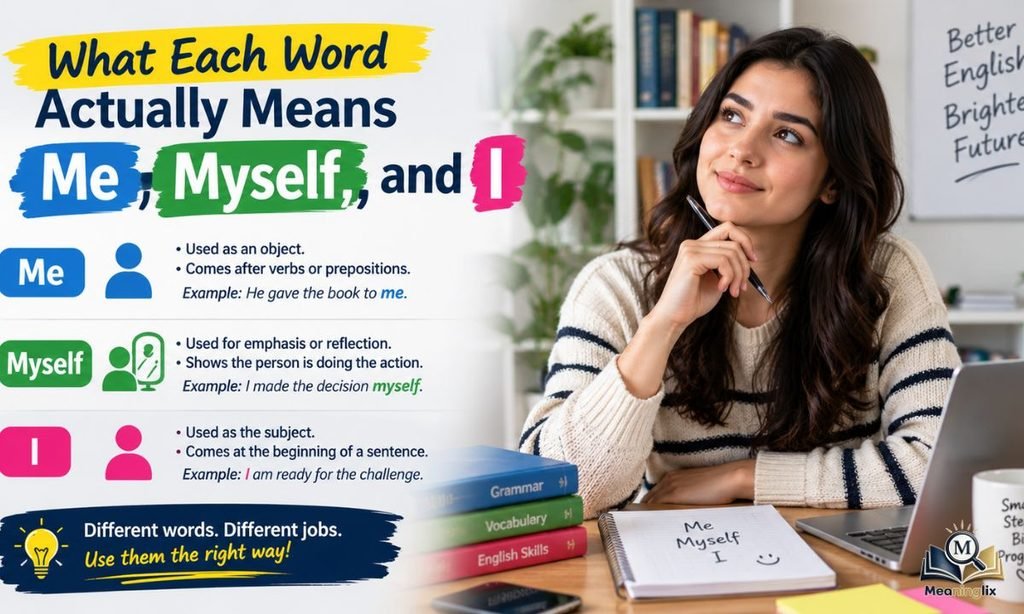
I stands in for yourself when you are the subject, meaning the person carrying out the verb. Example: I finished the report early.
Me stands in for yourself when you are the object, meaning the person the action happens to. Example: She sent the report to me.
Myself is a reflexive pronoun. It shows up when the subject and the object are the same person, or when you want to add emphasis to that subject. Example: I proofread the report myself.
Notice that myself never appears without an earlier “I” doing the main action. That single fact solves most mistakes involving this word.
Why People Mix These Up “Me vs. Myself vs. I”
The confusion usually starts with politeness. Many of us were corrected as children for saying “me and Sam went to the store,” so we learned that “me” sounds wrong in a sentence’s opening spot. Some writers overcorrect from there and start swapping in “I” or “myself” anywhere a pronoun feels risky, even in places where “me” is actually correct.
A second cause is length. When a sentence has extra names or clauses between the pronoun and the verb, it becomes harder to hear whether the pronoun is a subject or an object. “The manager thanked Priya, David, and I for staying late” sounds fine out loud, but it is wrong, because the pronoun is receiving the thanks, not doing the thanking.
The Difference Between Me vs. Myself vs. I
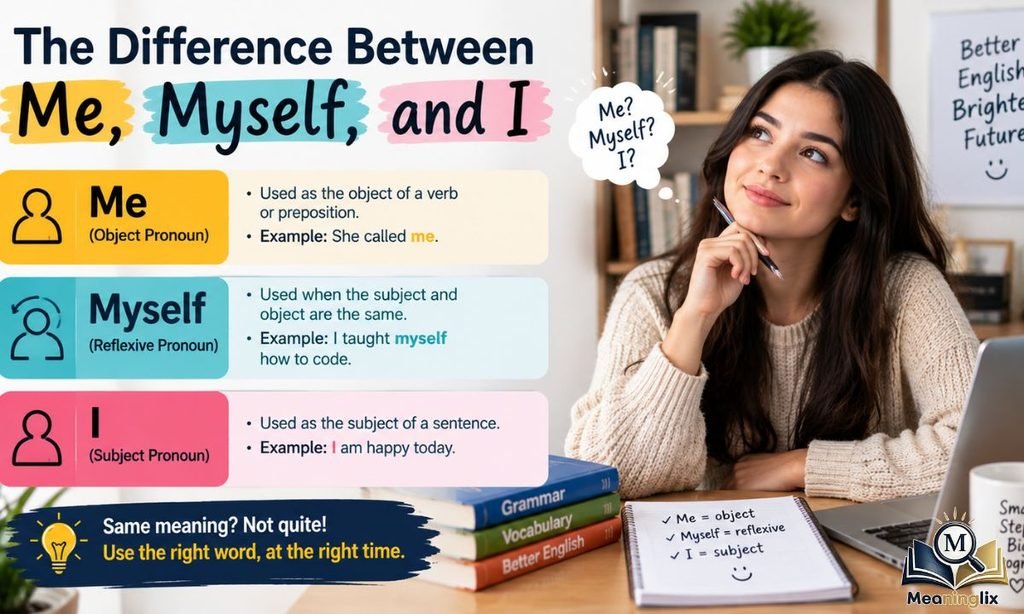
The core difference comes down to grammatical role, not formality or politeness. None of the three words is more polite or more correct in general. Each one is correct in its own specific role.
| Term | Correct? | Grammatical Role | Typical Use | Example |
| I | Yes, as a subject | Subject pronoun | Performing the action | I called the client. |
| Me | Yes, as an object | Object pronoun | Receiving the action | The client called me. |
| Myself | Yes, in limited cases | Reflexive or emphatic pronoun | Referring back to a subject that is “I” | I called the client myself. |
The Fast Test for I vs Me
Whenever a sentence has extra names before or after the pronoun, remove those names and read the sentence alone. Your ear will usually catch the error right away.
Correct: “Please send the invoice to Marcus and me.” Test sentence: “Please send the invoice to me.” That sounds natural, so “me” is correct.
Incorrect: “Please send the invoice to Marcus and I.” Test sentence: “Please send the invoice to I.” That sounds wrong immediately, which confirms the mistake.
The same trick works for the subject side.
Correct: “Marcus and I finished the project.” Test sentence: “I finished the project.” That works, so “I” is correct.
Incorrect: “Marcus and me finished the project.” Test sentence: “Me finished the project.” That fails the test, so “me” is wrong here.
When Myself Is Actually Correct

Myself has two legitimate jobs, and only two.
Reflexive use: the subject and the object are the same person. Correct: “I cut myself while chopping onions.” Incorrect: “The recipe surprised myself.” There is no earlier “I” performing the action, so myself has nothing to reflect back to.
Emphatic use: you want to stress that the subject, and no one else, did something. Correct: “I wrote the entire proposal myself.” Incorrect: “Please forward the file to Sarah or myself.” Here myself is standing in for “me,” which is not one of its two real jobs.
A simple way to remember this: myself always needs an “I” partner somewhere in the sentence. If there is no “I,” there is no valid reason for myself to appear.
Real Life Examples in Context “Me vs. Myself vs. I”
Everyday conversation Correct: “I am heading to the gym after work.” Correct: “Can you drive me to the gym?”
Text messages Correct: “I’ll grab it myself on the way home.” Incorrect: “Text John or myself when you land.” Should be “John or me.”
Workplace email Correct: “I reviewed the contract and sent it to legal.” Correct: “Legal sent the revised contract to me.” Correct: “I signed off on the final version myself.”
School or academic writing Correct: “I analyzed the data using three separate models.” Incorrect: “The professor assigned the project to Maya and I.” Should be “Maya and me.”
Social media Correct: “I baked this cake myself, no mix involved.”
Common Mistakes and How to Avoid Them “Me vs. Myself vs. I”
Mistake one: using I as an object. Incorrect: “The award went to Daniela and I.” Correct: “The award went to Daniela and me.” Why it happens: writers assume that pairing a name with a pronoun always calls for “I,” since that is the form used more often at the start of a sentence.
Mistake two: using myself as a polite substitute for me. Incorrect: “Feel free to reach out to myself with questions.” Correct: “Feel free to reach out to me with questions.” Why it happens: myself can sound more formal or careful, so people reach for it in professional writing, even though it breaks the reflexive rule.
Mistake three: using me as a subject. Incorrect: “Me and my brother are visiting our parents.” Correct: “My brother and I are visiting our parents.” Why it happens: in casual speech, this pattern is common and rarely corrected, so it feels natural even in writing where it is not standard.
A quick memory trick: picture “myself” as needing a matching “I” earlier in the same sentence, almost like a set of bookends. No opening “I,” no closing “myself.”
Formal Writing vs Everyday Speech “Me vs. Myself vs. I”
In relaxed spoken English, “me and my friend went” shows up constantly and rarely causes real communication problems. In formal writing, resumes, business email, and academic papers, the subject and object rules above are expected, and errors stand out more. When you are unsure which register a piece of writing calls for, default to the grammatically correct form, since it works in both casual and formal contexts, while the casual pattern only works in relaxed speech.
Related Forms Worth Knowing “Me vs. Myself vs. I
The same subject, object, and reflexive pattern applies to other pronouns, which is why understanding “me, myself, and I” makes the rest of English pronouns easier.
- You (subject) versus you (object), with yourself as the reflexive form.
- He (subject) versus him (object), with himself as the reflexive form.
- She (subject) versus her (object), with herself as the reflexive form.
- They (subject) versus them (object), with themselves as the reflexive form.
Once the subject, object, and reflexive pattern clicks for “I,” “me,” and “myself,” you can apply the exact same logic to every other pronoun pair in English.
Frequently Asked Questions
Is “you and I” or “you and me” correct?
It depends on the role in the sentence. Use “you and I” when both people are performing the action, as in “You and I should talk.” Use “you and me” when both people are receiving the action, as in “This decision affects you and me.”
Is it ever correct to say “for you and I”?
No. After a preposition like “for,” “to,” “with,” or “between,” you need the object form, so the correct phrase is “for you and me.” Prepositions never take a subject pronoun.
What is the difference between me and myself?
Me is a plain object pronoun used any time you receive an action from someone or something else. Myself only applies when you are both the doer and the receiver of that same action, or when you want to emphasize that you personally did something.
Can myself start a sentence?
Not as a subject. Myself cannot replace I at the start of a sentence, so “Myself and my team finished the audit” is incorrect. The correct version is “My team and I finished the audit.”
The Bottom Line
Match the pronoun to its job. Choose I when you act, choose me when you receive the action, and save myself for moments when an earlier “I” needs a matching reflexive or emphatic partner.
Run the quick removal test whenever a sentence feels long or crowded with names, and these three small words will stop causing big hesitation.

Alisha Lehmann is the founder and author of Meaninglix. She specializes in explaining word meanings, internet slang, abbreviations, grammar, and English expressions in simple, accurate language. Her goal is to help readers improve their vocabulary and communicate confidently through clear, well-researched, and easy-to-understand content.
1 thought on “Me vs. Myself vs. I: The Ultimate Grammar Guide”