OP stands for “overpowered” in gaming, and it describes a character, weapon, strategy, or item that is too strong compared to everything else in the game. When someone calls a gun OP in a shooter or a champion OP in a MOBA, they mean it wins fights it probably shouldn’t, and the game feels unbalanced because of it.
That’s the short version. But the term carries more nuance than most quick definitions let on, and where you see it used changes what it actually implies.
Table of Contents
Quick Answer
- OP = Overpowered
- Used when something gives a player an unfair advantage
- Common in gaming chat, Discord, Reddit, and patch note discussions
- Can be a compliment (“that build is so OP”) or a complaint (“nerf this OP weapon”)
- Sometimes shortened further to just “broken” or paired with “meta”
Don’t Miss : Compose vs. Comprise
Where the Term Actually Comes From
OP didn’t start as gaming slang exclusively. It has roots in general internet forums from the early 2000s, back when tabletop and early online multiplayer communities needed shorthand for “this thing breaks the balance of the game.”
Strategy games and early MMORPGs picked it up fast because balance patches were a constant topic. If you played anything with regular updates, like early World of Warcraft or Counter-Strike, you were already living in a world where certain items or classes dominated until a developer stepped in.
There’s no single game credited with inventing the term, and any article claiming otherwise is guessing. What’s more accurate is that OP grew alongside competitive online gaming as a whole, once players had communities and forums to actually argue about balance in real time.
OP Meaning in Different Gaming Contexts
The word doesn’t shift meaning much between games, but the flavor of what counts as OP changes a lot depending on genre.
In Shooters (FPS games)
Here, OP usually refers to a weapon, attachment, or piece of gear that outperforms everything else with almost no downside. Think of a gun with no recoil, huge damage, and a fast fire rate all at once. Players will say something like “they need to nerf this rifle, it’s actually OP right now.”
In MOBAs (League of Legends, Dota 2)
OP often refers to a champion or hero whose kit is too strong for the current patch. A character can go from mid-tier to OP overnight after a single balance update buffs one ability too much.
In RPGs and Loot-Based Games
Here it’s less about a single item and more about a build. Players combine gear, skills, and stats in a way that trivializes content the developers intended to be difficult. This is sometimes called being “OP as a build” rather than one specific piece being OP on its own.
In Card Games and Tabletop-Style Games
OP describes a card or combo that wins games on its own with little counterplay. Hearthstone, Magic, and similar games see this constantly, especially right after a new expansion drops.
See Also : Seaver Meaning
OP as a Compliment vs. OP as a Complaint
This is the part a lot of definitions skip, and it actually matters for understanding how the word gets used day to day.
When a player says “my build is OP,” they’re usually bragging. It means they found something strong and they’re enjoying it while it lasts.
When a player says “this is so OP, please nerf it,” they’re frustrated. It usually means they’re losing to it repeatedly and think it’s unfair rather than just strong.
The exact same word covers both feelings. Context, tone, and who’s saying it tell you which one you’re dealing with. A streamer showing off a new discovery is bragging. A comment section under patch notes complaining about a weapon is venting.
Read Now : Synonym for Ecosystem
A Nuance Most Articles Miss: OP vs. Meta vs. Broken
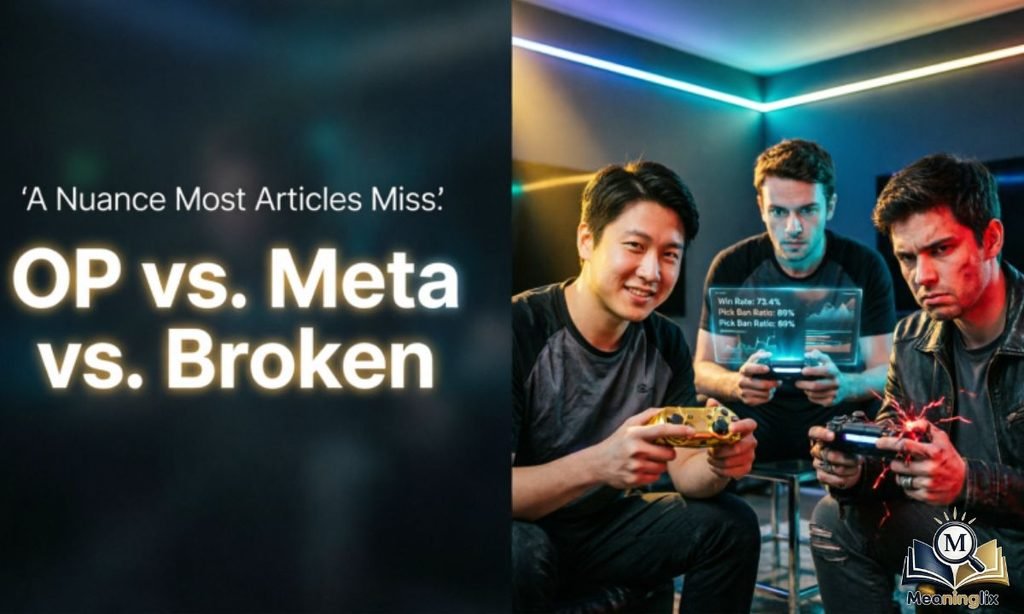
People throw around OP, meta, and broken like they’re interchangeable, but experienced players draw a line between them.
Meta just means “what’s currently strong and commonly used.” Something can be meta without being OP if it’s simply a solid, balanced choice that beats other solid choices.
OP means it’s noticeably stronger than it should be relative to everything else. It might not even be the most-used pick yet, but once players catch on, it usually becomes meta fast.
Broken is a step further than OP. It usually implies the thing barely has a counter, or exploits a bug or interaction the developers didn’t intend at all. A broken combo often gets hotfixed outside the normal patch cycle, while something merely OP might wait until the next scheduled update.
Knowing this difference actually helps you read patch notes and community discussion more accurately, instead of assuming every complaint means the same thing.
Real Examples of How It’s Used
In a Discord voice chat during a match: “Bro just headshot me through a wall with that thing, it’s so OP right now.”
In a Reddit comment on patch notes: “They buffed the wrong stat again. This is going to be OP for at least two weeks before they fix it.”
In a game review or YouTube video: “The new class is genuinely OP compared to the others, especially in the early levels where nobody has counters yet.”
Between two friends after a ranked loss: “That’s not skill, that character is just OP right now, everyone’s playing it.”
Notice how none of these use it as an insult toward the player using the OP thing. It’s aimed at game balance, not at people.
When to Use It OP (and When You’re Using It Wrong)
Use OP when you’re specifically talking about balance, something outperforming its peers in a way that feels unfair or unintended.
Avoid using it just to mean “good” or “skilled.” If a player wins a fight through smart positioning and good aim with a totally average weapon, that’s not OP, that’s just good play. Mixing these up is a common mistake newer players make, and it waters down the term’s meaning in a conversation.
It’s also a mistake to call something OP just because you personally lost to it once. One bad match doesn’t make a weapon or character overpowered. Repeated, consistent dominance across many matches and many skill levels is what actually earns the label from the wider community.
Common Mistakes and Recent Shifts
A mistake worth flagging: some newer players confuse OP with “sweaty” or “tryhard,” which describe player behavior, not game balance. A tryhard player can use a perfectly balanced weapon and still seem unbeatable because of skill, not because the weapon is OP.
Another shift worth noting is that live-service games now patch so fast that something can be OP for a matter of days rather than weeks. Games like Fortnite or Apex Legends have pushed hotfixes within 24 to 48 hours of a weapon becoming an obvious problem, which is a change from a decade ago when balance patches came monthly at best.
Related and Similar Terms
- Nerf – when developers weaken something that was too strong
- Buff – the opposite, making something stronger
- Meta – the current dominant strategies or picks
- Broken – stronger than OP, often implies a bug or unintended interaction
- Cracked – slang for a player being extremely skilled, not about the game itself
- S-tier – ranking terminology for the strongest options in a tier list
- Cheese – a strategy that wins through an exploit or unfair tactic rather than skill
- Counterplay – the tools or strategies available to fight back against something strong
Frequently Asked Questions
What does OP mean in gaming slang?
OP means overpowered. It describes anything in a game, a weapon, character, ability, or item, that performs significantly better than its alternatives, usually to the point where it feels unfair or unbalanced.
Is OP a compliment or an insult?
It depends on context. Players use it as a compliment when bragging about a strong find, and as a complaint when frustrated about losing to something repeatedly. The word itself is neutral.
What’s the difference between OP and meta?
Meta describes what’s currently popular or effective. OP describes something that’s stronger than it should be. Something meta isn’t always OP, but something OP almost always becomes meta once players notice it.
Does OP mean the same thing outside of gaming?
Yes, OP is also used online to mean “original poster” on forums like Reddit. In gaming chat specifically, it almost always means overpowered, but context matters if you’re reading a mixed thread.
Why do developers keep creating OP things by accident?
Balancing a game with dozens of characters, weapons, or abilities is genuinely hard, since small numerical changes can interact in ways that aren’t obvious until millions of players start experimenting with them in live matches.
How long does something usually stay OP before it gets fixed?
It varies a lot by game. Competitive live-service titles sometimes hotfix within days, while slower-updating games might leave something OP for a full season before addressing it in a major patch.
Wrapping It Up
OP is one of those gaming terms that seems simple on the surface but actually carries a lot of context depending on who’s saying it and why. At its core, it always comes back to balance, something performing better than it reasonably should against everything else in the game.
Once you start noticing the difference between OP, meta, and broken, patch notes and community arguments make a lot more sense. And next time your friend calls something OP after losing a match, you’ll know exactly which version of the word they mean.
Alisha Lehmann is the founder and author of Meaninglix. She specializes in explaining word meanings, internet slang, abbreviations, grammar, and English expressions in simple, accurate language. Her goal is to help readers improve their vocabulary and communicate confidently through clear, well-researched, and easy-to-understand content.
3 thoughts on “OP Meaning in Gaming: The Powerful Truth Explained 2026”