If you’ve typed this word and then stared at it wondering whether you added one too many L’s, you’re not alone. Both labelled and labeled show up constantly online, which makes the word look misspelled no matter which version you pick. Here’s the short answer: both spellings are correct; the one you should use depends entirely on which English you’re writing in.
Table of Contents
The Quick Answer
Labeled (one L) is the standard spelling in American English. Labelled (two L’s) is the standard spelling in British, Canadian, and Australian English. Neither spelling is “wrong” in an absolute sense; they’re regional variants of the same word, similar to color versus colour or canceled versus cancelled.
If you’re writing for a US audience, use labeled. If your audience is in the UK, Canada, Ireland, Australia, or most other English-speaking countries, use labelled.
What “Labeled” and “Labelled” Actually Mean
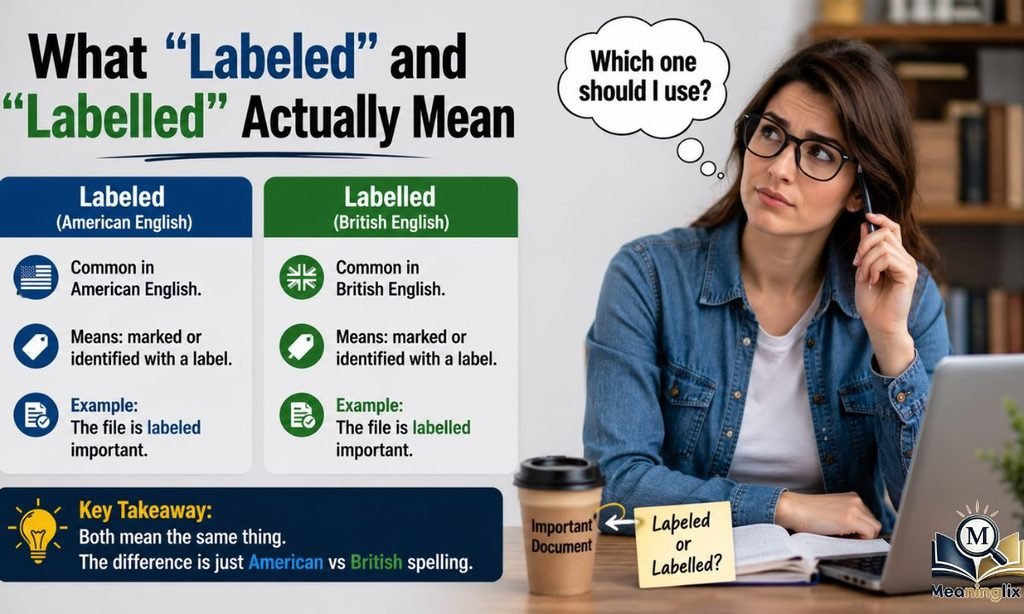
Both spellings are past-tense and past-participle forms of the verb label, which means to attach a tag, name, or description to something, or to categorize someone or something in a particular way.
- The boxes were labeled with the shipping address. (attaching a physical tag)
- Critics have labelled the film a masterpiece. (assigning a description or category)
The meaning doesn’t change based on spelling. A jar that’s been “labeled” and a jar that’s been “labelled” have had exactly the same thing done to them.
Why the Spelling Splits Between US and UK English
The difference comes down to a consonant-doubling rule that American and British English handle differently.
In British English, when a word ends in a single vowel followed by a single consonant (like the “el” in label), that final consonant usually doubles before you add an ending like -ed or -ing regardless of which syllable is stressed. That’s why British English gives you labelled, labelling, travelled, and cancelled.
American English follows a stricter version of the doubling rule: the final consonant only doubles if the last syllable is stressed. Since the label is stressed on the first syllable (LA-bel, not la-BEL), American English doesn’t double the L. That gives you labeled, labeling, traveled, and canceled.
This isn’t a random quirk specific to “label.” It’s a consistent pattern across dozens of two-syllable verbs, which is why you’ll notice the same US/UK split with words like modeled/modelled and fueled/fuelled.
Labeled vs. Labelled: Quick Comparison
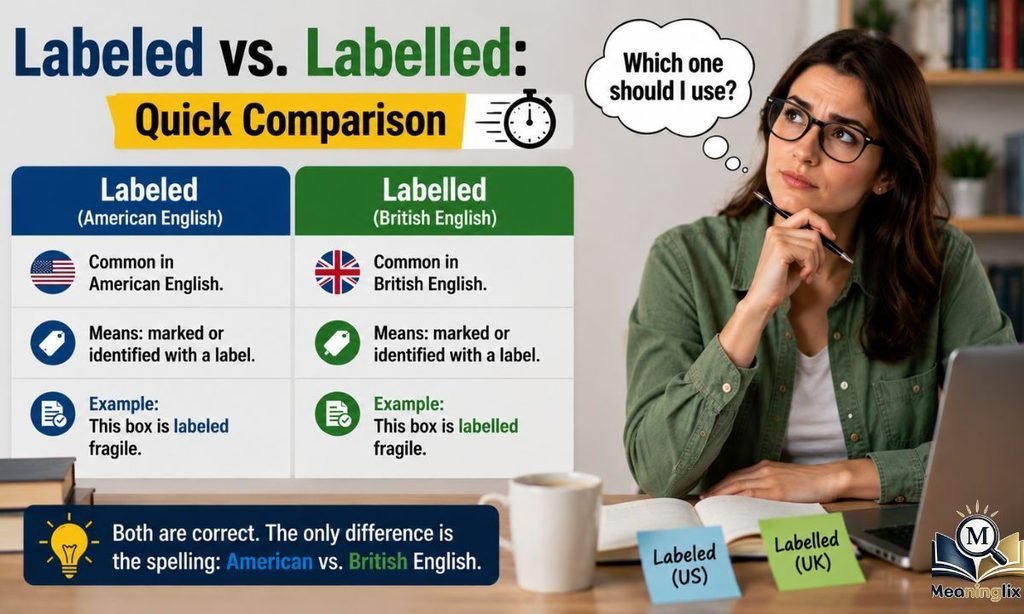
| Form | Correct? | English Variant | Typical Use | Example |
| Labeled | Yes | American English | US writing, US audiences | The samples were labeled by hand. |
| Labelled | Yes | British/Canadian/Australian English | UK, Canadian, and Australian writing | The samples were labelled by hand. |
Both belong in the same table because neither one is incorrect; the table exists to show where each spelling fits, not to declare a winner.
Labeling vs. Labelling: The Same Rule Applies
The present-participle form follows the identical pattern. Americans write labeling (one L); British, Canadian, and Australian writers use labelling (two L’s).
- US: She is labeling the samples before lunch.
- UK: She is labelling the samples before lunch.
The same goes for the related nouns labeler/labeller, which refer to a person or device that labels things. If you’re consistent with the verb spelling, the related forms will naturally follow the same pattern.
Correct and Incorrect Examples
Because both spellings are legitimate, “incorrect” here mostly means inconsistent with your audience or with the rest of your document not grammatically wrong.
Correct (American English): “The nutrition facts were labeled clearly on the back of the box.”
Correct (British English): “The nutrition facts were labelled clearly on the back of the box.”
Inconsistent: “The files were labeled by department, but the folders were labelled by date.”
That last example is the real mistake: mixing both spellings in a single piece of writing. Readers may not consciously notice which spelling you used, but inconsistency reads as unpolished, especially in professional or academic documents.
Where You’ll See Each Spelling in Real Life
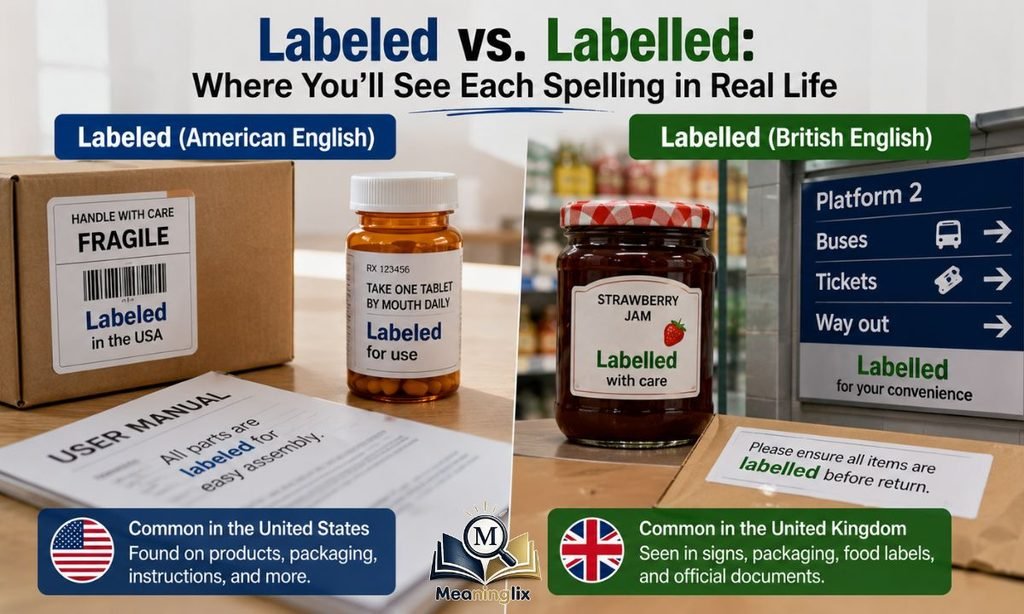
- Everyday conversation: Both spellings sound identical when spoken, so this only matters in writing.
- School and academic writing: Follow your institution’s style guide. US schools expect labeled; UK, Canadian, and Australian schools expect labelled.
- Workplace communication: Match the spelling convention your company or client uses, especially in official documents, packaging, and reports.
- Text messages and social media: Either spelling is fine informally, though people often default to whichever version their phone’s autocorrect suggests.
- Formal writing: Pick one spelling based on your audience and use it consistently throughout the entire document.
Common Mistakes People Make
Mixing spellings in one document. This is by far the most frequent issue. Writers start with labeled, then switch to labelled later in the same article, email, or report. Pick a variant of English before you start writing and stick with it.
Assuming one spelling is simply wrong. Some writers think labelled is a typo because spell-checkers set to American English will flag it. The spell-checker isn’t identifying an error it’s just enforcing one regional standard.
Guessing based on how it sounds. Since labeled and labelled are pronounced exactly the same way, sound gives you no clue about which spelling to use. The choice comes entirely from written convention, not pronunciation.
Not checking the style guide. Publications, companies, and universities often specify American or British English in their style guides. When one exists, it overrides personal preference.
A Simple Way to Remember the Difference
Here’s a memory trick that sticks: American English tends to simplify spelling by dropping extra letters, so think “American English, one less letter” labeled with a single L. British English tends to preserve older, more traditional spelling patterns, which is where the extra L in labelled comes from.
If you already know you write color instead of colour, or canceled instead of cancelled, you’re already using American English conventions so labeled will match your existing habits.
Practical Guidance for Choosing the Right Spelling
- Identify your audience first. If you’re writing for a US-based company, publication, or reader, use labeled. For UK, Canadian, Australian, or other Commonwealth audiences, use labelled.
- Check for a style guide. Many organizations specify a preferred English variant. When one exists, follow it even if it differs from your personal habit.
- Stay consistent. Once you choose a spelling, use it for every related form labeled/labeling or labelled/labelling throughout the same piece of writing.
- Let your spell-checker match your audience. Set your word processor’s language setting to “English (US)” or “English (UK)” so it flags the spelling that doesn’t match your intended audience.
- When in doubt, default to American English for a general or international audience, since it’s the more commonly taught variant online and in global business writing unless you know your readers are specifically British, Canadian, or Australian.
Related Forms Worth Knowing
- Label (noun): a tag or marker attached to something, spelled the same in both American and British English.
- Label (verb, present tense): also spelled the same in both I label the jars every week.
- Mislabeled/mislabelled: follows the same US/UK spelling split as the base word.
- Relabeled/relabelled: same pattern applies here too.
FAQ
Is “labelled” grammatically correct?
Yes. “Labelled” is grammatically correct and is the standard spelling in British, Canadian, and Australian English. It’s only “incorrect” if you’re writing specifically for an American audience or following an American English style guide, where “labeled” is expected instead.
What is the difference between “labeled” and “labelled”?
There’s no difference in meaning, pronunciation, or grammar, only spelling. “Labeled” is the American English form, while “labelled” is the British English form. For example, an American writer would say “The shelves were labeled,” while a British writer would say “The shelves were labelled.”
Which spelling should I use for a global audience?
If you don’t know your audience’s location, American English (“labeled”) is generally the safer default for international business and online content, since it’s widely recognized. That said, always match your organization’s existing style guide if one is in place.
Do “labeling” and “labelling” follow the same rule?
Yes. The present-participle forms follow the identical US/UK split: “labeling” (one L) in American English and “labelling” (two L’s) in British, Canadian, and Australian English.
The Bottom Line
There’s no wrong answer between labeled and labelled only a regional one. Choose labeled for American English audiences and labelled for British, Canadian, or Australian audiences, and keep your choice consistent throughout your writing.
Once you match the spelling to your reader, the confusion disappears for good.

Alisha Lehmann is the founder and author of Meaninglix. She specializes in explaining word meanings, internet slang, abbreviations, grammar, and English expressions in simple, accurate language. Her goal is to help readers improve their vocabulary and communicate confidently through clear, well-researched, and easy-to-understand content.
1 thought on “Labelled or Labeled? The Simple Rule You Need 2k26”