
You’ve typed the word, stared at it, and suddenly it looks wrong no matter which way you spell it. That’s the classic practice vs. practise moment, and it trips up even confident writers. Here’s the short answer: if you’re writing American English, always use practice, whether it’s a noun or a verb.
If you’re writing British English, use practice for the noun and practise for the verb. That single distinction explains almost every case of confusion you’ll ever run into.
Table of Contents
The Quick Answer
In American English, there is only one spelling: practice. It works as both a noun (“I have soccer practice”) and a verb (“I need to practice more”). The spelling “practise” is not used in American English at all.
In British English (and in Canadian, Australian, and most Commonwealth English), the two spellings split by job:
- Practice = the noun
- Practise = the verb
So a British writer would say, “It is good practice to practise the piano every day,” using both spellings correctly in the same sentence.
Why This Word Confuses So Many People
The confusion exists because English has two major spelling systems living side by side, and they don’t agree on this word. American English tends to simplify pairs like this into one spelling for convenience. British English keeps a noun/verb distinction that also shows up in similar word pairs, like advice (noun) and advise (verb), or licence (noun) and license (verb).
Because so much content online mixes American and British sources, readers often see both spellings used correctly, just in different systems, and assume one of them must be a typo. Neither is wrong. They belong to different regional standards.
Practice vs. Practise: Quick Comparison Table
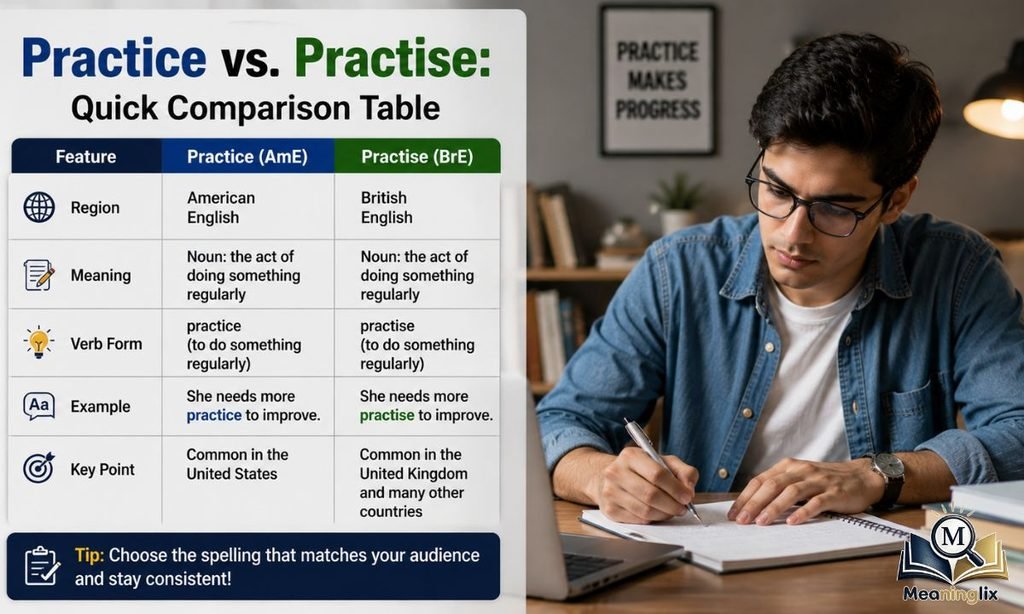
| Term | Correct In | Part of Speech | Meaning | Example |
| Practice | American English | Noun and verb | To do something repeatedly, or a repeated activity/custom | “I need more practice.” / “I practice guitar daily.” |
| Practice | British English | Noun only | A repeated activity, custom, or business (like a doctor’s practice) | “The clinic is a busy medical practice.” |
| Practise | British English | Verb only | To perform an activity to improve at it | “She practises yoga every morning.” |
| Practise | American English | Not used | N/A | Not correct in American English |
The Noun Form: Practice
Across both American and British English, practice (spelled with a “c”) is always the noun. It never changes, regardless of which version of English you’re using. As a noun, it can mean:
- A repeated activity done to improve a skill “Piano practice helped her master the sonata.”
- A habit or custom “It’s common practice to tip servers in the United States.”
- A professional business, especially in law or medicine “He has run a small dental practice for fifteen years.”
Since the noun spelling never varies by region, you can memorize this part with confidence: practice with a “c” is always the noun.
The Verb Form: Where American and British English Split

This is where the two systems disagree.
American English: The verb is also spelled practice.
- “I practice Spanish for twenty minutes every night.”
- “She has practiced medicine for over a decade.”
British English: The verb is spelled practise.
- “I practise Spanish for twenty minutes every night.”
- “She has practised medicine for over a decade.”
Notice the sentences are identical except for one letter. That single letter is the whole rule.
A Simple Trick to Remember the Difference
If you write in British English and want a fast way to check yourself, try substituting the words advice and advise into the sentence. These words follow the exact same noun/verb pattern, but their pronunciation makes the distinction obvious.
- If “advice” (the noun) fits, use practice.
- If “advise” (the verb) fits, use practise.
Example: “I need more ___ before the exam.” You’d naturally say “advice,” a noun, so the correct word is practice.
Another example: “I want to ___ my French.” You’d naturally say “advise,” a verb, so the correct word is practise in British English.
American writers don’t need this trick at all, since “practice” covers both jobs.
Real-Life Examples in Context
Everyday conversation (American English): Correct: “I practice my speech before every presentation.” Incorrect: “I practise my speech before every presentation.” (wrong in American English)
Academic writing (British English): Correct: “Students are expected to practise conversational French twice a week.” Incorrect: “Students are expected to practice conversational French twice a week.” (wrong in British academic style, since “practice” should be reserved for the noun)
Workplace communication (American English): Correct: “Our law practice handles small business contracts.” Incorrect: “Our law practise handles small business contracts.” (the noun is never spelled with an “s”)
Text messages (either region): Correct: “Gotta practice/practise before the game tonight, can’t talk long.”
Social media caption: Correct: “Three hours of practice and it finally clicked. 🎸” (noun, correct in both regions)
Common Mistakes People Make
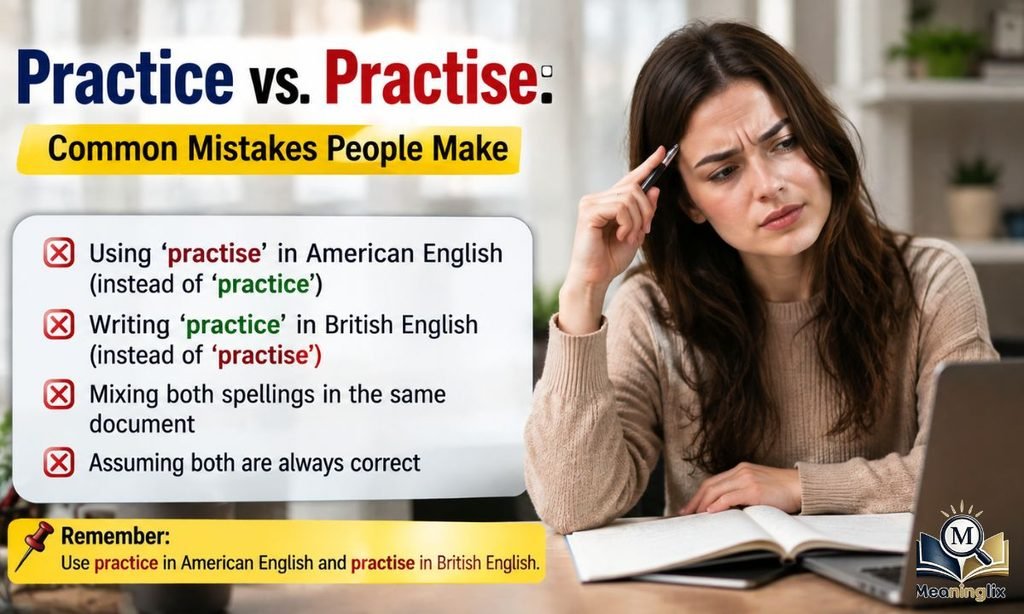
Mistake 1: Using “practise” in American English. Many Americans see “practise” in books, articles, or software with British spell-check settings and start using it by accident. In American English, this is always incorrect. Stick with practice for everything.
Mistake 2: Using “practice” as a British verb. British writers sometimes default to “practice” out of habit, especially since American content is so common online. In formal British writing, especially academic or professional documents, this counts as an error. The verb needs the “s.”
Mistake 3: Overcorrecting the noun. Some writers, once they learn about the noun/verb split, mistakenly start spelling the noun as “practise” too. Remember: the noun is always “practice,” in both American and British English. Only the verb changes.
Read Also : Quiet vs. Quite
Practicing vs. Practising (and Other Word Forms)

The same regional split carries into related word forms:
- American English: practicing, practiced, practices (verb forms), practitioner
- British English: practising, practised, practises (verb forms), practitioner
Note that practitioner keeps the “c” spelling in both regions, since it isn’t directly tied to the noun/verb pattern the same way.
Which One Should You Use?
The real answer depends on your audience, not personal preference.
- Writing for a US-based company, publication, or app? Use practice for everything.
- Writing for a UK, Australian, Canadian, or other Commonwealth audience? Split the spelling: practice for the noun, practise for the verb.
- Writing for an international or mixed audience? Pick one standard and apply it consistently throughout the document. Mixing both within the same piece looks like an error even when each individual sentence is technically correct somewhere in the world.
Most grammar checkers and style guides recommend choosing a single regional standard at the start of a project and sticking with it from the first sentence to the last.
Frequently Asked Questions
Is “practise” grammatically correct?
Yes, but only in British English, and only as a verb. In American English, “practise” is considered a misspelling in every context, so American writers should always use “practice” instead.
What is the difference between practice and practise?
Practice is always the noun in both American and British English. Practise exists only in British English, where it serves as the verb. American English uses practice for both the noun and the verb, so British-style “practise” never appears in standard American writing.
Is “practice” a noun or a verb?
In American English, “practice” is both a noun and a verb. In British English, “practice” is only the noun; the verb form is spelled “practise.”
Why does American English only use one spelling?
American English generally simplified several noun/verb spelling pairs that British English kept separate, following broader 19th and 20th century spelling reforms. “Practice/practise” is one of several pairs affected, alongside words like “license/licence.”
The Bottom Line
If you remember nothing else, remember this: American English uses practice for everything, while British English splits it into practice (noun) and practise (verb).
Once you know which style guide you’re following, the choice becomes automatic rather than something you have to second-guess every time you type it.

Alisha Lehmann is the founder and author of Meaninglix. She specializes in explaining word meanings, internet slang, abbreviations, grammar, and English expressions in simple, accurate language. Her goal is to help readers improve their vocabulary and communicate confidently through clear, well-researched, and easy-to-understand content.
1 thought on “Practice or Practise? The Ultimate Guide to Get It Right 2k26”