If you’ve ever paused mid-sentence wondering whether to write “license” or “licence,” you’re not alone. The confusion happens because both spellings are technically correct, just not in the same place or for the same purpose.
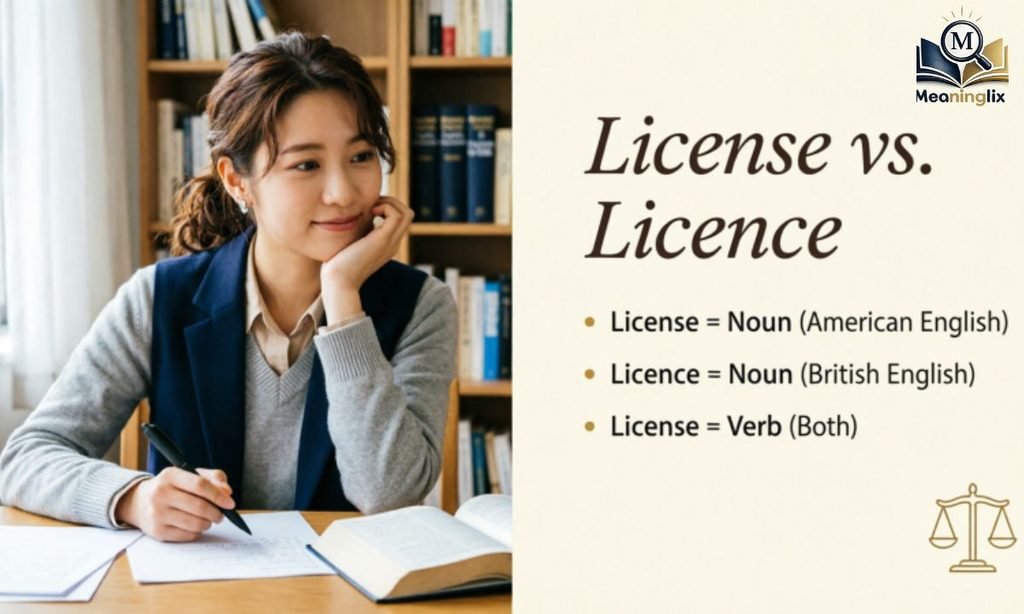
Here’s the short version: in American English, “license” is always correct, whether you’re using it as a noun or a verb. In British English, “licence” is the noun and “license” is the verb.
Table of Contents
The Quick Answer “License or Licence”
If you’re writing for a US audience, use a license for everything. You license a driver, you apply for a license, you renew your license. One spelling, no exceptions.
If you’re writing for a UK, Australian, Canadian, or other Commonwealth audience, the spelling depends on the word’s job in the sentence:
- Licence (with a c) = noun the document or permission itself
- License (with an s) = verb the act of granting permission
That single rule solves almost every case of confusion with this word.
Why “License or Licence ” Trips People Up
Most spelling mix-ups happen because two words sound completely different. This one is different, “license” and “licence” are pronounced exactly the same way. Nothing in speech tells you which spelling to use, so the confusion only shows up once you start writing.
On top of that, American English simplified the rule while British English kept a distinction that used to apply to several noun/verb word pairs (think “practice” and “practise,” or “advice” and “advise”). Since most people encounter American and British writing side by side online, it’s easy to see one spelling in a headline and a different one in a comment thread and assume someone made a typo. Usually, no one did.
License or Licence: What Each Word Means
Both words point to the same underlying idea: official permission to do, own, or use something. A license (or licence) can refer to:
- A driver’s license
- A business license
- A software license
- A license to practice medicine, law, or another regulated profession
- Broadcasting or liquor licenses
As a verb, “to license” means to officially authorize someone or something. A state licenses drivers. A company licenses its software to customers. A city licenses restaurants to serve alcohol.
Read Meaning Slang : Crash Out Meaning
The Rule for American English “License or Licence”
This is the easiest version of the rule, and it’s the one most readers searching this term actually need.
In American English, “license” is the correct spelling in every noun and verb.
- Noun: “I forgot to renew my driver’s license.”
- Verb: “The state will license new contractors starting next month.”
“Licence” is not standard American spelling. If you’re writing for a US company, publication, or audience, avoid it entirely, even if spell-check doesn’t flag it (some checkers allow both spellings).
The Rule for British English “License or Licence”
British English along with Australian, Canadian (with some regional variation), and most other Commonwealth English keeps the noun and verb spellings separate.
- Noun (licence): “You need a licence to drive in the UK.”
- Verb (license): “The council will license the new pub next week.”
A helpful memory trick: licence has a c, just like advice and practice, which are also nouns. License, advise, and practise are the matching verbs, spelled with an s. If you can remember one pair, you can remember all three.
Quick Comparison Table License or Licence
| Term | Correct In | Part of Speech | Example |
| License | American English | Noun and verb | “She has a valid license.” / “They license drivers here.” |
| Licence | British/Commonwealth English | Noun only | “She has a valid licence.” |
| License | British/Commonwealth English | Verb only | “They license drivers here.” |
| Licencing | Not standard anywhere | — | Always spelled licensing |
| Licenced | Not standard anywhere | — | Always spelled licensed |
That last row trips up a lot of writers, so it’s worth its own section.
The One Spelling Everyone Shares: -ing and -ed Forms
No matter which dialect you’re writing in, the words licensing and licensed are always spelled with an s. There is no British variant with a c here. So even a UK writer who correctly uses “licence” as a noun still writes:
- “The restaurant is fully licensed.” (not licenced)
- “Licensing laws vary by state.” (not licencing)
This is because these forms come from the verb “to license,” and the verb never takes the c spelling in either dialect.
Real-World Examples “License or Licence”
American English (always “license”):
- “You’ll need to show your license at the checkpoint.”
- “Our company licenses this software to over 200 businesses.”
- “Her medical license was renewed in March.”
British English (noun vs. verb):
- “He lost his licence after the accident.” (noun)
- “The council licenses taxi drivers every two years.” (verb)
- “Do you have a TV licence?” (noun)
Informal or text-based writing:
- US: “lol forgot my license at home again”
- UK: “just renewed my licence, cost a fortune”
Common Mistakes to Avoid License or Licence
Mistake 1: Using “licence” in American writing. Incorrect: “You need a licence to drive here.” Correct (US): “You need a license to drive here.” This happens most often when writers read a mix of American and British sources and absorb both spellings without noticing the difference.
Mistake 2: Using “license” for the noun in British writing. Incorrect (UK): “I need to renew my license.” Correct (UK): “I need to renew my licence.” Since American spelling dominates online content, British writers sometimes default to it without realizing their own dialect has a separate noun form.
Mistake 3: Writing “licenced” or “licencing.” Incorrect: “The bar is fully licenced.” Correct: “The bar is fully licensed.” These -ing and -ed forms are always spelled with an s, even in British English, so this mistake is worth memorizing on its own.
Practical Usage Guidance “License or Licence”
If you’re not sure which audience you’re writing for, default to license. It’s correct in American English for every use, and it’s still understood everywhere, even if it’s not the traditional British noun spelling.
When precision matters legal documents, UK-based business writing, or formal correspondence with a British or Australian audience apply the noun/verb split and double-check with the advice/advise or practice/practise trick.
For US-based writing, you can stop thinking about this entirely. One spelling. Every context.
Related Terms Worth Knowing “License or Licence”
- Licensee: the person or business that receives a license.
- Licensor: the person or entity that grants a license.
- Unlicensed: lacking a required license (same spelling in both dialects).
- License plate (US) vs. number plate (UK): a related but separate vocabulary difference, not a spelling variant.
FAQ “License or Licence”
Is “licence” grammatically correct?
Yes, but only in British and Commonwealth English, and only as a noun. In American English, “licence” is not considered correct; “license” is used for both the noun and the verb.
What is the difference between “license” and “licence”?
In American English, there’s no difference “license” covers both the noun and the verb. In British English, “licence” is the noun (the document or permission) and “license” is the verb (the act of authorizing). For example: “She has a licence” (noun) but “They license drivers” (verb).
Is “licensed” ever spelled “licenced”?
No. Regardless of dialect, the past tense and adjective form is always licensed, never licenced. The same goes for licensing, which is never spelled licencing.
Which spelling should I use if I’m not sure of my audience?
Use a license. It’s correct in every context in American English and is widely recognized even in British English, since it’s the required spelling for the verb form there too.
The Bottom Line “License or Licence”
For American writers, this is simple: always use license, for both the noun and the verb. For British and Commonwealth writers, remember the c/s split licence is the noun, license is the verb and note that the -ing and -ed forms are always spelled with an s, no matter where you’re writing from.
Once that distinction clicks, you won’t second-guess this word again.

Alisha Lehmann is the founder and author of Meaninglix. She specializes in explaining word meanings, internet slang, abbreviations, grammar, and English expressions in simple, accurate language. Her goal is to help readers improve their vocabulary and communicate confidently through clear, well-researched, and easy-to-understand content.
4 thoughts on “License or Licence: The Perfect Spelling Guide 2k26”