Have you ever typed “what happen” in a text message and then paused, unsure if you just made a grammar mistake? You’re not alone. This tiny phrase trips up native speakers and English learners alike, and autocorrect doesn’t always save you.
The good news is that the rule behind it is simple once someone actually explains it clearly. That’s what we’re doing here. No jargon, no confusing grammar charts that make things worse. Just a straight answer, followed by everything else you might want to know.
Table of Contents
Quick Answer: Is It “What Happen” or “What Happened”?
“What happened” is correct. It’s the standard, grammatically accurate way to ask about something that occurred in the past.
“What happen” is grammatically incomplete. It’s missing the past tense ending “-ed,” which is required when you’re asking about an event that already took place. You’ll sometimes see “what happen” in casual speech, song lyrics, or informal texting, but it does not follow standard English grammar rules.
So if you’re writing an email, a message to your boss, or a school essay, always go with “what happened.”
What Does “Happened” Actually Mean?
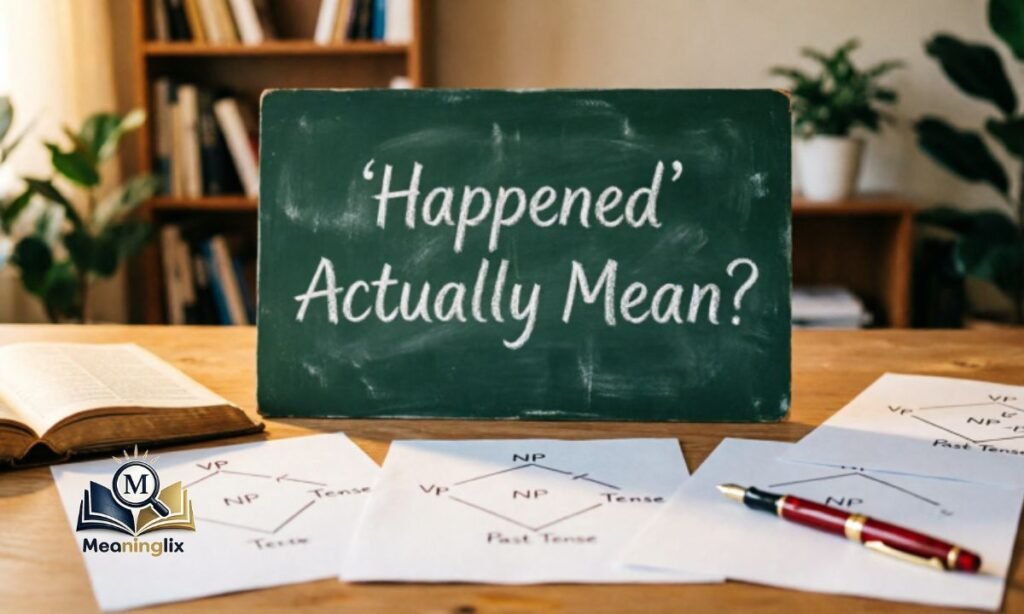
“Happened” is the past tense form of the verb “happen.” The base verb “happen” means for something to occur or take place. Add “-ed,” and you get the version that describes something that already occurred.
Here’s a simple way to picture it:
- Happen = present tense, describes something occurring now or generally
- Happened = past tense, describes something that already occurred
When someone asks “What happened?”, they’re asking about an event that’s already over. Maybe a car accident, a breakup, a plot twist in a movie, or why the office printer is on fire again. The event is finished, so the question needs the past tense.
Click Here To Read People Do vs. People Does
Why Do People Write “What Happen” Instead?
There are a few honest reasons this mistake shows up so often.
- Spoken English blends sounds. In fast, casual speech, the “-ed” at the end of “happened” can sound almost silent, especially before a word starting with a consonant. Your ear hears “whut-HAP-en” instead of “whut-HAP-end.”
- Autocorrect and typing habits. People type quickly on phones and drop the ending without noticing.
- Influence from other languages. In many languages, verb tense isn’t marked the same way English marks it, so non-native speakers sometimes carry that pattern over.
- Song lyrics and slang. Some music and internet slang deliberately drop grammar rules for rhythm or style, and that casual style bleeds into everyday writing.
None of these reasons make “what happen” grammatically correct. They just explain why it’s a common slip.
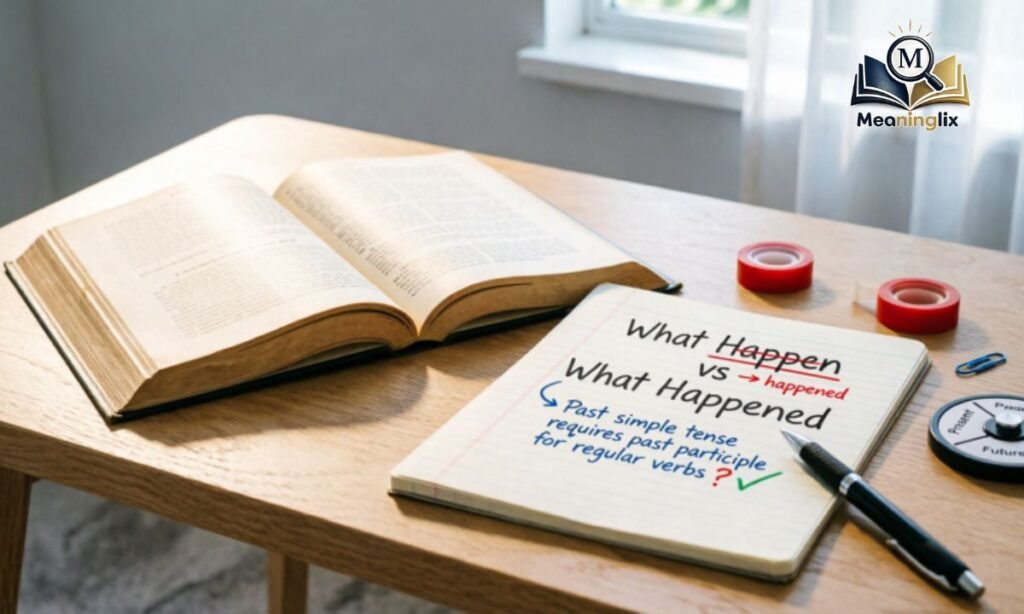
What Happen vs What Happened: Quick Comparison
| Phrase | Grammatically Correct? | Meaning | Best Used In | Example Sentence |
| What happened | Yes | Asks about a past event that already occurred | Formal and informal writing, speech, questions about the past | “What happened at the meeting this morning?” |
| What happen | No (standard grammar) | Attempted past-tense question, missing “-ed” | Casual speech, song lyrics, texting, non-standard dialects | “What happen to your car?” (should be “happened”) |
| What happens | Yes (different meaning) | Present tense, asks about something occurring regularly or generally | Describing routines, hypotheticals, general truths | “What happens when you mix baking soda and vinegar?” |
That last row matters. A lot of confusion around “what happen” actually comes from mixing it up with “what happens,” which is a completely valid present-tense question. More on that below.
Where Did This Confusion Come From?
English verb tenses weren’t always this rigid. Older forms of English, along with many regional dialects, handled verb endings more loosely than the standardized grammar taught in schools today.
Some regional and dialectal forms of English, including certain varieties of African American Vernacular English (AAVE) and Caribbean English creoles, use “happen” without the “-ed” ending as a natural, consistent grammatical pattern rather than a mistake. In these dialects, tense can be signaled through context, other words in the sentence, or different grammatical markers entirely. Linguists recognize these as legitimate rule-governed language systems, not broken English.
That said, standard American and British English, the kind used in schools, business writing, news articles, and most formal contexts, requires “happened” for past events. If you’re writing for a general audience, a resume, a report, or a customer email, “what happened” is the expected and correct form.
How to Use “What Happened” Correctly
Using “what happened” correctly comes down to one question: did the event already occur?
If yes, use “happened.”
Here’s the pattern in action:
- “What happened last night?” (The event is over.)
- “What happened to your phone screen?” (The damage already occurred.)
- “What happened after you left the party?” (Past event, already finished.)
You can also use “happened” in statements, not just questions:
- “I don’t know what happened.”
- “Tell me what happened at work today.”
- “Nobody explained what happened to the missing files.”
Notice that “happened” doesn’t change form based on who’s speaking. Whether it’s I, you, he, she, or they, the past tense stays the same. That’s actually one of the easier parts of English grammar. No need to memorize different endings for different subjects.
Real-World Examples Across Different Situations
Seeing the phrase in different contexts makes the rule stick better than any explanation alone.
Workplace example: “Can you walk me through what happened during the client call yesterday?”
Legal example: “The witness was asked to describe exactly what happened on the night of the incident.”
Everyday conversation example: “I heard you got a new haircut. What happened, did you get tired of the long hair?”
Academic writing example: “Historians still debate what happened in the final days before the treaty was signed.”
In every one of these, the event already occurred, so “happened” is the only correct choice.
Don’t Confuse It With “What Happens”
This is where a lot of writers second-guess themselves. “What happens” is not a mistake. It’s a different tense with a different job.
- Use “what happened” for something that already occurred.
- Use “what happens” for something ongoing, habitual, or hypothetical.
Examples of correct “what happens” usage:
- “What happens if I forget my password?”
- “What happens during a solar eclipse?”
- “I never know what happens next in this show.”
If you can swap in the phrase “will/does” and it still makes sense, you probably want “happens.” If the event is clearly finished, you want “happened.”
Common Mistakes People Make
Even careful writers slip up sometimes. Here are the most frequent errors:
- Dropping the “-ed” in writing: “What happen to the report?” should be “What happened to the report?”
- Mixing past and present in the same sentence: “What happened is that nothing happen.” Pick one tense and stay consistent.
- Using “happen” after “did”: Saying “What did happen?” is grammatically fine, but it’s more natural to just say “What happened?” unless you’re adding emphasis.
- Overcorrecting dialect speech: If you’re quoting someone who speaks a dialect where “what happen” is standard, don’t assume it’s automatically wrong in that context. Standard grammar rules and dialect grammar rules are both valid, just different.
Which Phrase Should You Use?
For nearly all writing and speaking situations, especially anything formal, professional, or academic, use “what happened.” It’s the version that matches standard English grammar, and it’s what teachers, employers, and editors expect to see.
Save “what happen” for song lyrics, casual slang, or situations where you’re intentionally reflecting a specific dialect or speech pattern. Outside of those cases, stick with “happened.”
Frequently Asked Questions
Is “what happen” ever grammatically correct?
In standard English, no. “Happen” needs the “-ed” ending to properly describe a past event. However, in certain English dialects, “what happen” follows its own consistent grammar rules and is considered correct within that dialect.
What’s the difference between “what happened” and “what’s happening”?
“What happened” asks about something that already occurred and is finished. “What’s happening” (a contraction of “what is happening”) asks about something occurring right now, in the present moment.
Why does “what happen” sound normal in songs and social media?
Music and casual online writing often prioritize rhythm, style, or brevity over strict grammar. That’s a stylistic choice, not a grammar rule you should apply to formal writing.
Final Takeaway
When in doubt, remember this: if the event is over, add the “-ed.” “What happened” is the grammatically correct choice for describing anything in the past, whether you’re asking a coworker about a missed deadline or wondering what happened to the last slice of pizza.
Keep “what happen” for casual, dialectal, or musical contexts where the rules work a little differently. Once you’ve got that distinction down, you’ll never second-guess this phrase again.

Alisha Lehmann is the founder and author of Meaninglix. She specializes in explaining word meanings, internet slang, abbreviations, grammar, and English expressions in simple, accurate language. Her goal is to help readers improve their vocabulary and communicate confidently through clear, well-researched, and easy-to-understand content.