You type a quick message. “Does anyone have a pen?” sounds right. Then you write a report and pause: “Anyone has completed the form” or “anyone has completed the form”?
That tiny hesitation happens to native speakers and learners alike, because anyone looks like it should mean “many people,” so it feels natural. It isn’t. This guide settles the confusion for good, in anyone has vs anyone have, using clear rules and real examples.
Table of Contents
Quick Answer (Anyone Has vs Anyone Have)
“Anyone has” is correct in statements, because anyone is a singular indefinite pronoun and always pairs with a singular verb. “Anyone have” is only correct in questions or after the helping verb does, such as “Does anyone have a charger?”
In casual speech, people sometimes drop “does” and say “Does anyone have a charger?” but this is informal, not standard grammar. For essays, emails, and formal writing, stick with “anyone has” or “does anyone have.”
Quick Comparison Table: Anyone Has vs Anyone Have

| Feature | Anyone Has | Anyone Have |
| Grammatical Role | Subject + singular verb (statement) | Subject + base verb (question form) |
| Key Meaning | States a fact or condition about one unspecified person | Asks about possession or availability |
| Best Used For | Declarative sentences, formal writing, reports | Questions, casual speech, after “does” |
| Quick Example | Anyone has the right to ask questions. | Does anyone have a spare charger? |
Click Here To Read Another Topic
Why “Anyone” Is Always Singular
Anyone is an indefinite pronoun. It refers to one unspecified person out of a group, not to the whole group at once. That single detail decides everything about anyone has vs anyone have.
English grammar treats indefinite pronouns like anyone, someone, everyone, and nobody as third-person singular subjects. This is true even when the sentence implies a large crowd of possible people.
A simple test helps here. Replace anyone with he or she:
- “He or she has the right to vote.” (Correct)
- “He or she have the right to vote.” (Incorrect)
If “he or she” fits with “has,” then “anyone” needs “has” too. This test works every time and removes the guesswork instantly.
Deep Dive: When to Use “Anyone Has”

“Anyone has” follows the standard rule of subject-verb agreement. Since anyone is singular, it takes the singular verb form has, the same way he, she, or it would.
Use “anyone has” in:
- Declarative sentences that state a fact
- Formal writing, including essays, reports, and emails
- Negative statements like “I don’t think anyone has…”
- Embedded clauses inside longer sentences
Here are real-world examples:
- Anyone has the right to express their opinion in a meeting.
- If anyone has a question, please raise your hand.
- I don’t think anyone has finished the assignment yet.
- Anyone has access to the shared folder once they log in.
- The policy states that anyone has authority to escalate an issue.
- She asked whether anyone has experience with this software.
- Anyone has the ability to improve with consistent practice.
Notice that “anyone has” stays correct even inside a longer or more complex sentence. The verb always agrees with anyone, not with any other word nearby.
Deep Dive: When to Use “Anyone Have”
“Anyone have” only works correctly as part of a question, right after the helping verb does. In that structure, does carries the singular agreement, so the main verb drops back to its base form, have.
Use “anyone have” in:
- Direct questions with “does” (“Does anyone have a minute?”)
- Casual spoken English, where “does” is often dropped
- Elliptical questions, a shortened form common in speech (“Anyone have a pen?”)
Examples:
- Does anyone have a charger I can borrow?
- Does anyone have experience with this tool?
- Anyone have a moment to help me out? (informal, spoken)
- Does anyone have the report from yesterday’s meeting?
Without “does,” saying “anyone have” as a plain statement breaks the subject-verb agreement rule. It only sounds acceptable in casual speech because listeners mentally fill in the missing “does.”
Key Differences & Golden Rule to Remember (Anyone Has vs Anyone Have)
Here is the simplest way to lock in anyone has vs anyone have for good:
- Statement = Has. If you are telling someone something, use “anyone has.”
- Question = Have. If you are asking something (with “does”), use “does anyone have.”
Memory trick
Say the full question out loud. If “does” fits naturally before the phrase, use “have.” If it doesn’t, use “has.” This one shortcut solves almost every case of anyone has vs anyone have you will ever face.
Real-World Context and Usage Examples (Anyone Has vs Anyone Have)
Professional and Email Etiquette
In workplace writing, correct grammar signals professionalism. Use “anyone has” for statements and “does anyone have” for polite questions.
- “Anyone has the option to request remote work under the new policy.”
- “Does anyone have the updated budget file?”
Casual Conversation
In spoken English, shortened forms are common and widely accepted, even without strict grammar.
- “Anyone have a lighter?”
- “Anyone have plans this weekend?”
Formal and Academic Writing
Academic and formal contexts require full grammatical accuracy. Avoid dropped auxiliary verbs entirely.
- “Anyone has the right to submit a peer review.”
- “The survey asks whether anyone has encountered this issue before.”
Common Mistakes to Avoid ( Anyone Has vs Anyone Have)
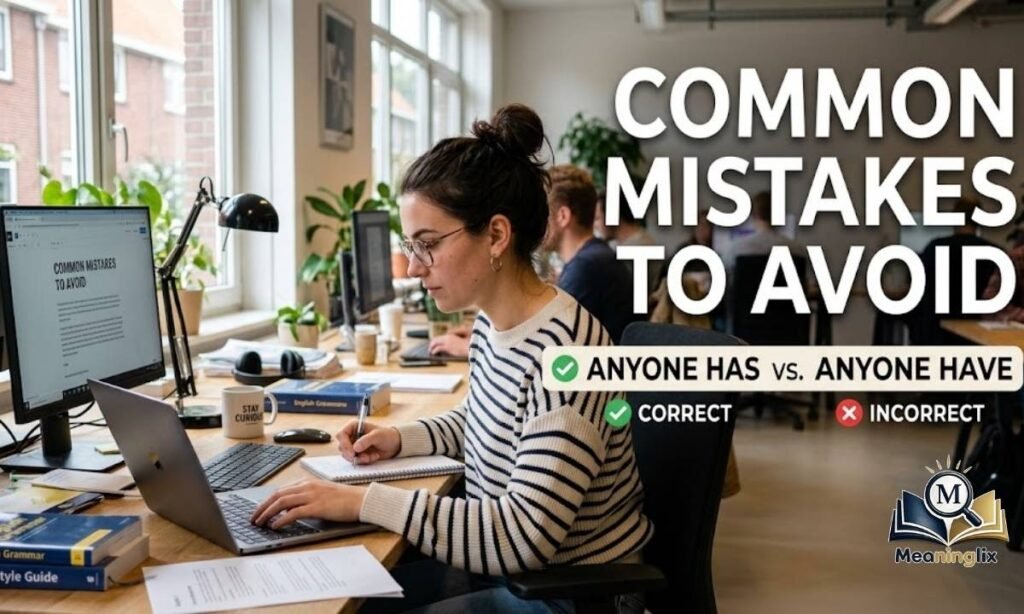
- Using “anyone have” in a statement. Wrong: “Anyone have the answer.” Correct: “Anyone has the answer.”
- Dropping “does” in formal writing. Wrong (in an email): “Anyone have the file?” Correct: “Does anyone have the file?”
- Matching the verb to an implied plural meaning. Remember, anyone always means one person, never a group.
- Confusing “anyone” with “any.” “Any of them have” is different because “them” is plural.
- Forgetting the rule inside long sentences. The verb still agrees with anyone, even many words later in the sentence.
- Assuming “anybody” follows different rules. It doesn’t. “Anybody has” and “anybody have” follow the exact same pattern.
- Overcorrecting in casual speech. “Anyone have” is fine in relaxed conversation; it just isn’t standard for writing.
Frequently Asked Questions (FAQs)
Is it “anyone has” or “anyone have” in a question?
In a question, use “does anyone have,” as in “Does anyone have a pen?” The word does already shows agreement with the singular subject, so the main verb stays in its base form, have.
Why is “anyone” treated as singular if it can mean many people?
Grammar rules focus on the pronoun’s form, not its implied range of people. Anyone refers to one unspecified individual at a time, so English grammar always pairs it with singular verbs like has, is, or does.
Is “anyone have a question” grammatically correct?
Not in formal writing. The full correct form is “Does anyone have a question?” Dropping “does” is common in relaxed spoken English, but it is not standard for essays, reports, or professional messages.
Does “anybody” follow the same rule as “anyone”?
Yes. “Anybody” is also a singular indefinite pronoun, so it follows the exact same pattern as “anyone.” Use “anybody has” in statements and “does anybody have” in questions.
Conclusion
Choosing correctly between anyone has vs anyone have comes down to one simple habit: use “has” when you are stating something, and use “have” only after “does” in a question. This one rule keeps your writing accurate whether you are drafting a formal email, an academic paper, or a casual text.
Keep the “he or she” substitution test in your back pocket whenever you feel unsure. With a little practice, choosing between anyone has vs anyone have will become automatic, and your writing will sound clear, confident, and correct every time.

Alisha Lehmann is the founder and author of Meaninglix. She specializes in explaining word meanings, internet slang, abbreviations, grammar, and English expressions in simple, accurate language. Her goal is to help readers improve their vocabulary and communicate confidently through clear, well-researched, and easy-to-understand content.
3 thoughts on “Anyone Has vs Anyone Have: The Ultimate Grammar Guide 2026”