Breath vs Breathe: If you’ve ever paused mid-sentence wondering whether to write “breath” or “breathe,” you’re not alone. Breath is a noun the air you take into your lungs. Breathe is a verb the action of moving air in and out of your body. One word names a thing. The other names an action.
Table of Contents
👉 Curious what “GTS” means in a text? Find out here.
This mix-up trips up even confident writers because the two words look almost identical and sound similar when spoken quickly. The good news is that once you learn one simple trick, you’ll never confuse them again. This guide breaks down the meaning, origin, common mistakes, and real examples so you can use both words correctly every time.
Quick Answer Box ( Breath vs Breathe )
Breath (noun) = the air you breathe in and out. Example: “Take a deep breath.” Breathe (verb) = the act of inhaling and exhaling. Example: “Remember to breathe.” Memory trick: Breathe has an extra “e” think “e for exercise” or action. Breath is short, like a single puff of air.
Key Takeaways Box
- Breath = noun (a thing)
- Breathe = verb (an action)
- Breath rhymes with “death”
- Breathe rhymes with “seethe”
- Both words come from the same Old English root
- Common secondary keywords: breath vs breathe pronunciation, breath breathe grammar, breathe meaning, breath meaning, how to use breathe in a sentence, breath noun or verb, breathe verb form, deep breath meaning, breathe easy meaning, out of breath meaning
What Does Breath vs Breathe Mean?
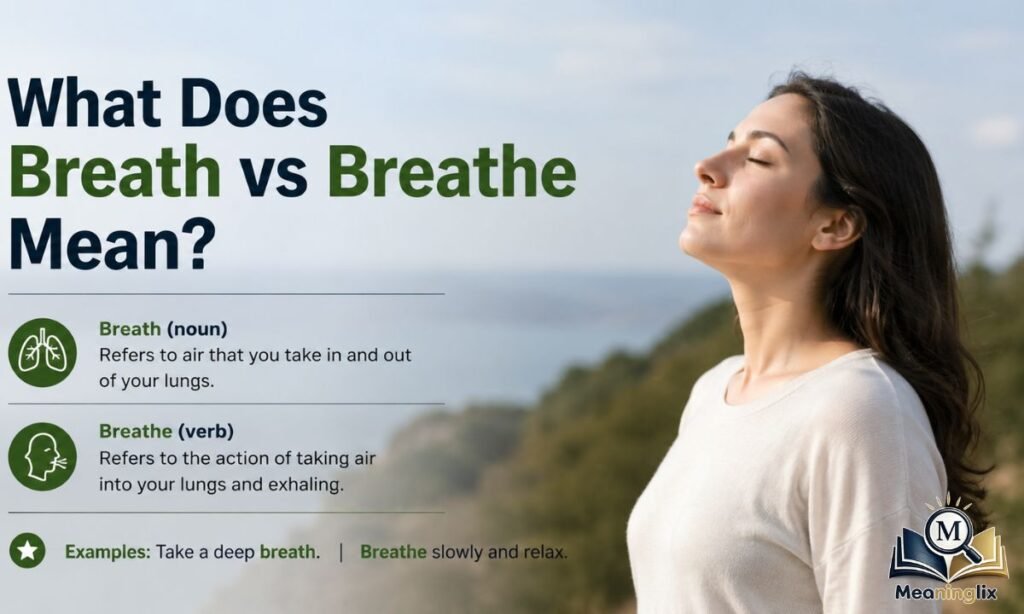
Breath is a noun that refers to the air moving into and out of your lungs. Breathe is a verb that describes the physical act of taking air in and letting it out. The core difference is grammar: one is a person, place, or thing; the other is an action word.
Meaning Explained ( Breath vs Breathe )
English has many word pairs that share a root but split into a noun and a verb. Breath and breathe are a classic example of this pattern.
Breath (noun) describes a single instance of air entering or leaving your body. You can have “a breath,” “your breath,” or “bad breath.” It’s something you can count, hold, or lose.
Breathe (verb) describes the ongoing action. You breathe every second of your life without thinking about it. It’s what your lungs do, not a thing they produce.
Here’s a simple test: if you can put “a” or “your” in front of the word, it’s “breath.” If you need “to” in front of it, or it follows a subject like “I,” “you,” or “she,” it’s “breathe.”
| Feature | Breath | Breathe |
| Part of speech | Noun | Verb |
| Pronunciation | Rhymes with “death” (short e) | Rhymes with “seethe” (long e) |
| Example | “Catch your breath.” | “Breathe slowly.” |
| Can be plural? | Yes (“breaths”) | No (verbs conjugate, not pluralize) |
| Common phrases | Bad breath, deep breath, last breath | Breathe easy, breathe in, breathe out |
Origin of the Term ( Breath vs Breathe )
Both words trace back to the Old English word “bræth,” meaning “odor” or “exhalation.” Over centuries, English speakers split the noun and verb forms, adding the silent “e” to the verb to mark the different pronunciation and grammatical function. This noun-verb pattern with a silent “e” appears in other English pairs too, such as “bath” and “bathe” or “cloth” and “clothe.” The spelling difference isn’t random it reflects a real shift in sound that happened as the language evolved.
Breath vs Breathe in Texting and Everyday Writing
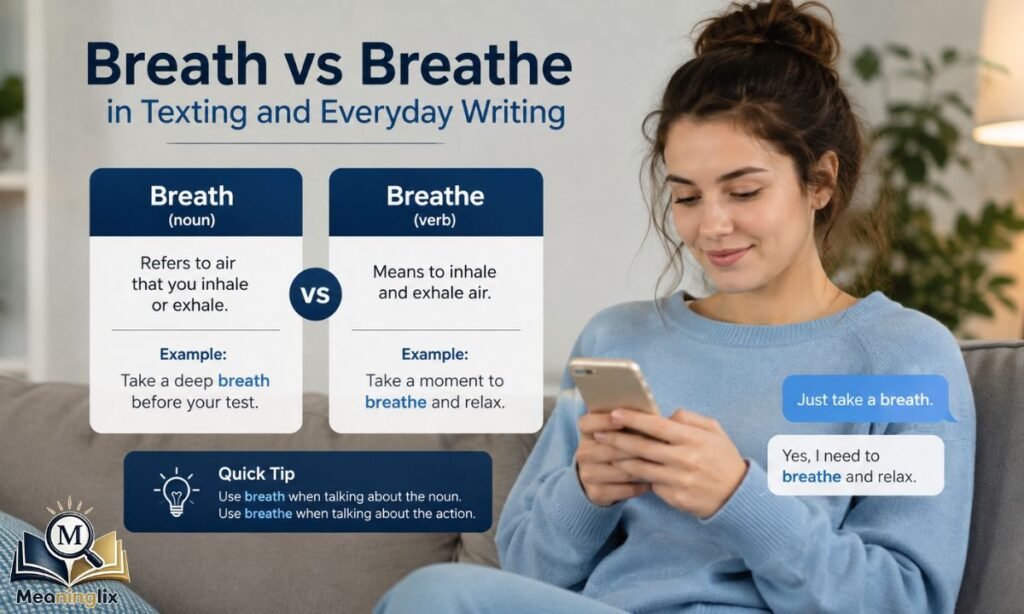
Unlike slang terms, “breath” and “breathe” don’t carry hidden or platform-specific meanings on TikTok, Instagram, or Snapchat. They’re standard English words used the same way everywhere people write casually, including in texts, captions, and comments.
That said, both words show up often in informal writing, usually in a few common patterns:
- “Just breathe” — a caption or comment meant to calm someone down during a stressful moment.
- “Take a breath” — used in texts when someone needs to pause before reacting.
- “Can’t even breathe rn” — a dramatic way to say something is shocking, funny, or overwhelming.
- “Out of breath” — used literally after exercise or figuratively when someone is overwhelmed with tasks.
Because autocorrect sometimes swaps these words, double-checking which one you meant before hitting send is always a good habit.
Real Chat Examples ( Breath vs Breathe )
1 Maya: “I’m so stressed about finals.” Jordan: “Just breathe. You’ve got this.”
2 Sam: “Ugh, that hill run wrecked me.” Priya: “Yeah, I could barely catch my breath after.”
3 Alex: “Wait, did you see her last text??” Emma: “I literally can’t breathe, that’s wild 😂”
4 Noah: “Public speaking makes me so nervous.” Liam: “Take a deep breath before you start talking.”
5 Chloe: “Meditation app keeps telling me to breathe.” Zoe: “Honestly not bad advice.”
6 Ryan: “Gym was brutal today.” Ben: “Same, I was out of breath the whole time.”
7 Ava: “He forgot our anniversary again.” Mia: “Take a breath before you text him back lol.”
8 Ethan: “This exam is going to kill me.” Grace: “Breathe. You studied all week, you’ll be fine.”
9 Isabella: “I just ran up five flights of stairs.” Lucas: “Lol did you lose your breath?”
10 Sophia: “My presentation is in ten minutes and I’m panicking.” Daniel: “Close your eyes, breathe, and just start talking slowly.”
Example Sentences ( Breath vs Breathe )
- She took a deep breath before diving into the pool.
- Doctors advise patients to breathe slowly during a panic attack.
- His breath smelled like coffee and mint.
- Remember to breathe between each set at the gym.
- The cold air made every breath visible in the winter morning.
- Yoga instructors often remind students to breathe deeply.
- He held his breath as the results were announced.
- Try to breathe through your nose while running.
- Her last breath came peacefully, surrounded by family.
- Singers learn to breathe correctly to hit long notes.
When Should You Use “Breath”?
- When naming the air itself, not the action
- After words like “a,” “your,” “his,” or “her”
- When describing a smell (bad breath, fresh breath)
- When talking about a countable instance (“three breaths”)
- In fixed phrases like “out of breath” or “last breath”
When Should You Use “Breathe”?
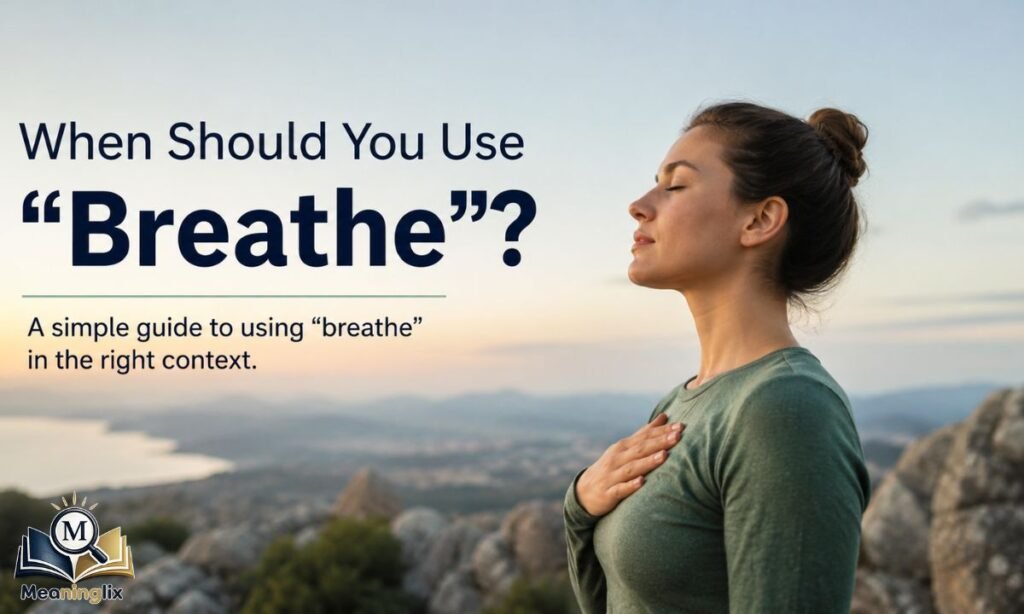
- When describing the physical action of inhaling or exhaling
- After a subject and before “in,” “out,” “deeply,” or “slowly”
- In commands or instructions (“Breathe now”)
- When giving relaxation or exercise guidance
- In present, past, or future verb forms (“breathed,” “will breathe”)
When Should You Avoid Using It? ( Breath vs Breathe )
- Don’t use “breath” where an action is required “I need to breath” is incorrect; it should be “I need to breathe.”
- Don’t use “breathe” as a noun “Take a breathe” is incorrect; it should be “Take a breath.”
- Avoid mixing tenses incorrectly, such as writing “breathed” when you mean the noun form.
Common Mistakes ( Breath vs Breathe )
- Writing “breath” instead of “breathe” in instructions, such as “breath deeply” instead of “breathe deeply.”
- Writing “breathe” as a noun, such as “catch your breathe” instead of “catch your breath.”
- Mispronouncing “breathe” with a short e sound instead of the correct long e sound.
- Forgetting that “breathe” conjugates like a normal verb: breathe, breathes, breathed, breathing.
Similar Words
| Word Pair | Noun | Verb |
| Bath / Bathe | A bath (the water) | To bathe (the action) |
| Cloth / Clothe | A cloth (the fabric) | To clothe (the action) |
| Teeth / Teethe | Teeth (body part) | To teethe (a baby’s process) |
| Life / Live | A life (existence) | To live (the action) |
Frequently Asked Questions ( Breath vs Breathe )
1. Is “breath” a noun or a verb?
“Breath” is always a noun. It refers to the air you take in or let out, such as in “take a breath” or “hold your breath.” It never functions as an action word in standard English grammar.
2. Is “breathe” a noun or a verb?
“Breathe” is always a verb. It describes the act of inhaling and exhaling, as in “breathe slowly” or “remember to breathe.” It changes form based on tense, like “breathed” or “breathing.”
3. How do you pronounce breath vs breathe?
“Breath” has a short e sound and rhymes with “death.” “Breathe” has a long e sound and rhymes with “seethe.” The added silent “e” at the end signals the different pronunciation.
4. Can “breath” ever be used as a verb?
No. “Breath” is strictly a noun in modern English. If you need a verb, “breathe” is the correct choice, as in “I need to breathe” rather than “I need to breath.”
5. What is a simple trick to remember the difference?
Think of the extra “e” in “breathe” as standing for “extra effort” or “exercise,” since it’s the action word. “Breath” is shorter, just like a single puff of air.
6. Are breath and breathe related to other word pairs?
Yes. English has several noun-verb pairs with the same pattern, including bath/bathe and cloth/clothe. These pairs share a root word but split based on grammatical function.
7. Does autocorrect often confuse breath and breathe?
Yes, because the words look similar, autocorrect and quick typing sometimes swap them. It helps to proofread sentences, especially in texts or emails, before sending.
8. Is “out of breath” using the noun or verb form?
“Out of breath” uses the noun form. It describes the state of having little air left after physical activity, such as running or climbing stairs.
Conclusion
Breath and breathe may look almost identical, but their roles in a sentence are completely different. Breath is the noun that names the air you take in, while breathe is the verb that describes the action of doing so. Once you remember that the extra “e” signals action, the confusion tends to disappear for good.
Whether you’re writing a text, an essay, or a work email, getting this pair right adds polish to your writing. Keep the simple tricks from this guide in mind the pronunciation difference, the noun-verb test, and the common phrases and you’ll use breath and breathe correctly every time.

Alisha Lehmann is the founder and author of Meaninglix. She specializes in explaining word meanings, internet slang, abbreviations, grammar, and English expressions in simple, accurate language. Her goal is to help readers improve their vocabulary and communicate confidently through clear, well-researched, and easy-to-understand content.
2 thoughts on “Breath vs Breathe: Learn the Difference Now Master It in Seconds”