If you’ve ever paused mid-sentence wondering whether to say “John and I” or “John and me,” you’re not alone. The short answer: use “I” when the pronoun is doing the action (the subject), and use “me” when the pronoun is receiving the action (the object).
The confusion usually creeps in once a second person joins the sentence, because that’s when our ear starts playing tricks on us. Once you know the trick to test it, you’ll never second-guess yourself again.
Table of Contents
What “Me vs. I” Actually Mean

“I” and “me” both refer to the speaker, but they belong to two different pronoun categories, and that’s the whole reason this mix-up exists.
I is a subject pronoun. It shows up when the speaker is the one performing the action in the sentence.
Me is an object pronoun. It shows up when the speaker is on the receiving end of the action, or when it follows a preposition like to, with, for, or between.
Think of it this way: “I” acts, “me” gets acted upon.
The Core Rule: Subject vs. Object
Every sentence has a job to hand out, and pronouns take that job seriously. If a pronoun is the one carrying out the verb, it needs the subject form. If a pronoun is on the receiving end of the verb, or sitting after a preposition, it needs the object form.
- Correct: “I finished the report early.”
- Incorrect: “Me finished the report early.”
- Correct: “The manager emailed me the schedule.”
- Incorrect: “The manager emailed I the schedule.”
That part rarely trips anyone up. The trouble starts when a name or another pronoun joins the sentence.
Why the Confusion Happens “Me vs. I”
Most people get “I” and “me” right when they’re alone in a sentence. The problem is compound subjects and objects, phrases like “John and I” or “me and my sister.” Once two pronouns (or a name and a pronoun) are grouped together, the ear stops trusting itself, and many speakers overcorrect by using “I” everywhere, assuming it always sounds more polished.
That overcorrection is actually its own common mistake. “I” isn’t the fancier option; it’s only correct when it’s the subject.
A Simple Test: Remove the Extra Name “Me vs. I”
Here’s the trick that grammar teachers rely on for a reason: it works. Whenever a pronoun is grouped with a name or another pronoun, mentally delete the other name and read the sentence again.
Example: “Sarah and (I/me) are going to the concert.”
Remove “Sarah and”: “Me are going to the concert” sounds wrong immediately. “I am going to the concert” sounds right.
Correct: “Sarah and I are going to the concert.”
Example 2: “The coach picked (John and I / John and me) for the team.”
Remove “John and”: “The coach picked I” sounds wrong. “The coach picked me” sounds right.
Correct: “The coach picked John and me for the team.”
This single-step test resolves nearly every “me vs. I” question you’ll ever run into.
Quick Comparison Table “Me vs. I”
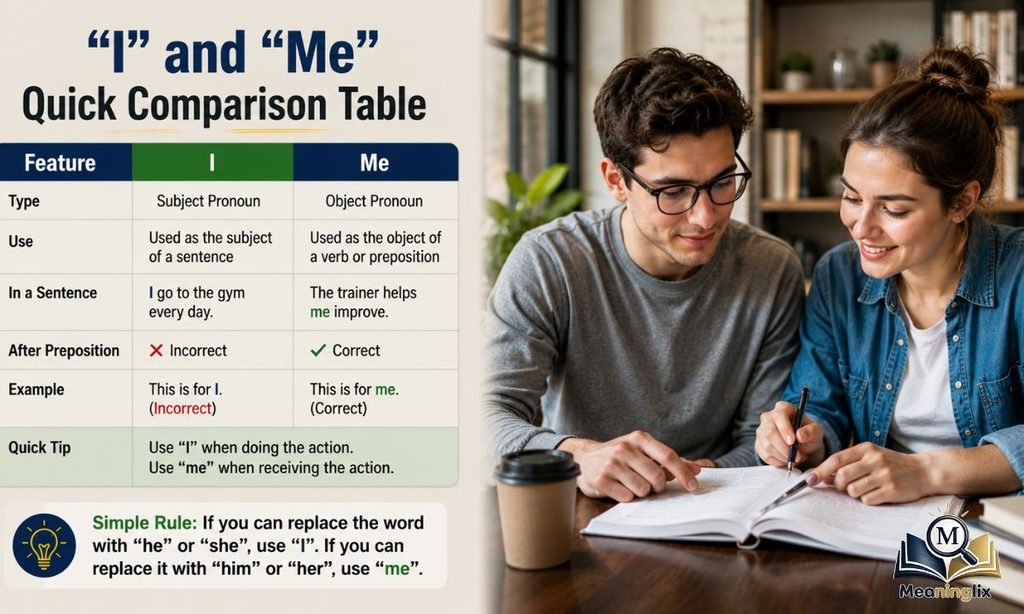
| Term | Grammatical Role | When to Use | Example |
| I | Subject pronoun | When the pronoun performs the action | “I called the client this morning.” |
| Me | Object pronoun | When the pronoun receives the action or follows a preposition | “The client called me this morning.” |
Read Also : License or Licence
Real-Life Examples in Different Contexts “Me vs. I”
Everyday conversation “Me vs. I“:
- Correct: “My roommate and I are cooking dinner.”
- Incorrect: “Me and my roommate are cooking dinner.”
Workplace email “Me vs. I“:
- Correct: “Please loop in Sarah and me on the next update.”
- Incorrect: “Please loop in Sarah and I on the next update.”
Text message “Me vs. I“:
- Correct: “Can you call me later?”
- Incorrect: “Can you call I later?”
Academic writing “Me vs. I“:
- Correct: “The professor and I discussed the thesis outline.”
- Incorrect: “The professor and me discussed the thesis outline.”
Social media caption “Me vs. I“:
- Correct: “Me and the dog, taking on Monday.” (informal contexts allow this loosely, but “The dog and I” is the grammatically precise version.)
Common Mistakes People Make “Me vs. I”
Mistake 1: Using “I” after a preposition. Incorrect: “This is just between you and I.” Correct: “This is just between you and me.” Why it happens: Prepositions like “between,” “with,” and “for” always take the object form, but many people assume “I” sounds more correct in formal settings.
Mistake 2: Starting a sentence with “me” in a compound subject. Incorrect: “Me and Tom are heading out.” Correct: “Tom and I are heading out.” Why it happens: This is often a habit carried over from casual speech patterns, where word order gets prioritized over grammatical role.
Mistake 3: Overcorrecting in every compound phrase. Incorrect: “The teacher gave the assignment to Maria and I.” Correct: “The teacher gave the assignment to Maria and me.” Why it happens: After being corrected once for “me and Maria,” some speakers swing too far and assume “I” is always the safer, more formal choice.
A simple way to remember it: subjects act, objects get acted on. If you’re ever unsure, drop the other name and trust your ear on the shorter sentence.
Formal vs. Informal Usage “Me vs. I”
In formal writing, academic papers, business communication, and professional emails, the subject/object rule should be followed precisely. In casual speech and informal texting, native speakers occasionally bend the rule (“Me and my friends went to the game”), and it rarely causes real confusion. Still, if you want your writing to read as polished and grammatically sound, especially in a resume, cover letter, or report, stick to the correct form every time.
“Me vs. I” in Comparisons
Comparisons with than or as are another spot where this pair causes hesitation.
- “She is taller than I.” (implies “than I am”)
- “She is taller than me.” (informal, but widely accepted in casual speech)
Formally, “than I” is preferred because it completes an implied clause (“than I am tall”). In relaxed conversation, “than me” is common and generally understood without any issue.
Frequently Asked Questions
Is “me and my friend” grammatically correct?
No. “Me and my friend” places the object pronoun in the subject position. The correct form is “My friend and I,” since the pronoun is performing the action. Also, in polite English, the other person’s name typically comes before “I” or “me.”
What is the difference between “I” and “me”?
“I” is a subject pronoun used when the speaker performs the action, while “me” is an object pronoun used when the speaker receives the action or follows a preposition. For example: “I called her” versus “She called me.”
Is it “between you and I” or “between you and me”?
It’s “between you and me.” Prepositions like “between” always require the object form of a pronoun, so “me” is correct here, even though “between you and I” is a frequent overcorrection.
How do I know which one to use in a long sentence?
Temporarily remove the other name or pronoun from the sentence and read it back. Whichever form sounds natural on its own, “I” or “me”, is the one you need for the full sentence.
The Takeaway
The choice between “me” and “I” comes down to one question: is the pronoun performing the action, or receiving it? Use “I” for the subject, “me” for the object, and lean on the simple removal test whenever a sentence gets crowded with names and pronouns.
Once that habit sticks, you’ll say and write it correctly without even needing to pause.

Alisha Lehmann is the founder and author of Meaninglix. She specializes in explaining word meanings, internet slang, abbreviations, grammar, and English expressions in simple, accurate language. Her goal is to help readers improve their vocabulary and communicate confidently through clear, well-researched, and easy-to-understand content.
1 thought on “Me vs. I: The Ultimate Grammar Guide 2k26”