You’re typing a sentence, you pause, and suddenly two nearly identical words are staring back at you. This mix-up happens because than and then look alike, sound almost alike, and differ by a single letter.
Here’s the quick fix: use “than” to compare two things, and use “then” to talk about time or what happens next. Once that distinction clicks, you’ll stop second-guessing yourself every time you type one of these words.
Table of Contents
The Quick Answer: Than vs. Then in One Sentence
If you’re comparing two people, things, or ideas, the word you want is than. If you’re talking about time, sequence, or a consequence, the word you want is then.
That’s the entire rule in its simplest form, and nearly every example below traces back to this one distinction.
What “Than” Means and When to Use It

Than is a conjunction (and sometimes a preposition) used to introduce the second part of a comparison. It shows up right after comparative words like more, less, better, faster, smaller, and any adjective ending in -er.
- Correct: “This winter feels colder than last year.”
- Correct: “She finished the marathon faster than everyone expected.”
Notice that “than” never stands alone. It only makes sense when it’s connecting two things being weighed against each other.
What “Then” Means and When to Use It
Then is mainly an adverb, though it can also work as a noun or adjective. It relates to time, order, or the result of a condition. Think of it as a word that answers “when” or “what happens next.”
- Correct: “We ate dinner, and then we watched a movie.” (sequence)
- Correct: “If it rains, then we’ll move the party indoors.” (consequence)
- Correct: “Back then, gas cost half of what it does now.” (a point in the past)
Why People Mix These Two Words Up “Than vs. Then”
The confusion isn’t really about grammar rules it’s about the letters themselves. “Than” and “then” differ by only one vowel, and in fast, casual speech, most Americans pronounce them almost identically.
Your eyes and ears expect the words to behave the same way because they look and sound so close, but their jobs in a sentence couldn’t be more different.
Than vs. Then: A Simple Comparison Table
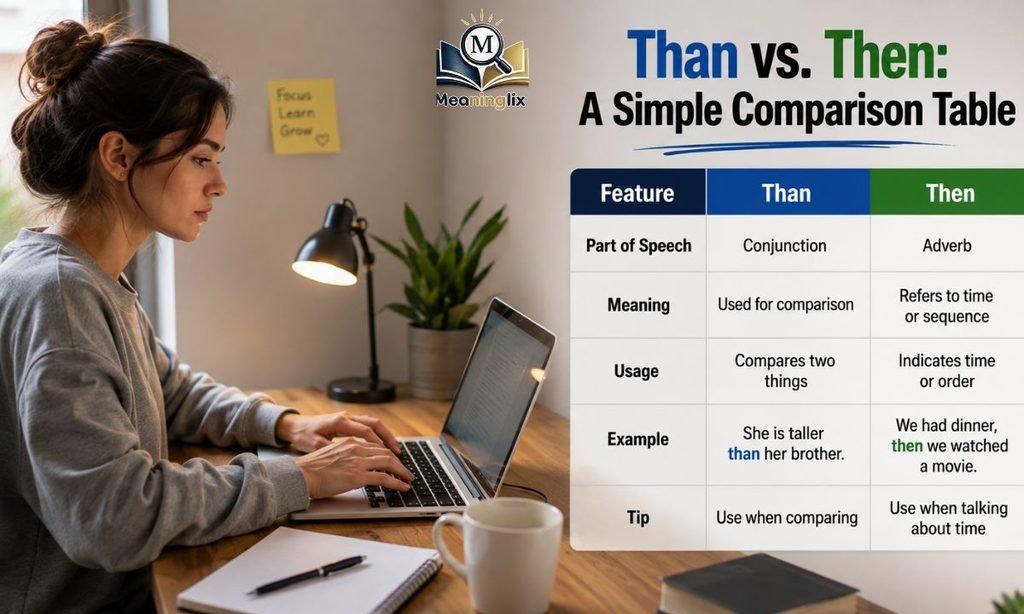
| Word | Part of Speech | Meaning | Typical Use | Example |
| Than | Conjunction / preposition | Introduces a comparison | After comparative adjectives (more, less, better) | “He’s taller than his brother.” |
| Then | Adverb / noun / adjective | Refers to time, sequence, or result | Describing order of events or consequences | “Finish your homework, then you can play.” |
A Memory Trick That Actually Works “Than vs. Then”
If you need a fast way to remember which word to use, try this: “than” has an A, and so does “compArison.”
Meanwhile, “then” has an E, and so does “whEn.” Since “then” is all about time and “when” is a time-related word the matching vowels give your brain a shortcut you can use in seconds.
Read Slang : Touch Grass Meaning
Common Mistakes with Than vs. Then
Mistake 1: Writing “then” in a comparison.
- Incorrect: “My coffee is stronger then yours.”
- Correct: “My coffee is stronger than yours.”
- Why it happens: The writer’s brain autocorrects to the more visually familiar word, or the sentence is typed too quickly to catch the swap.
Mistake 2: Writing “than” when describing a sequence.
- Incorrect: “I got dressed than left for work.”
- Correct: “I got dressed, then left for work.”
- Why it happens: Because both words often get pronounced the same way in casual speech, the ear doesn’t register a difference.
Mistake 3: Confusing “rather than” with “rather then.”
- Incorrect: “I’d rather stay home then go out.”
- Correct: “I’d rather stay home than go out.”
- This one is tricky because “rather” often appears near time-related sentences, but “rather ___” is always a comparison, so “than” is the only correct choice.
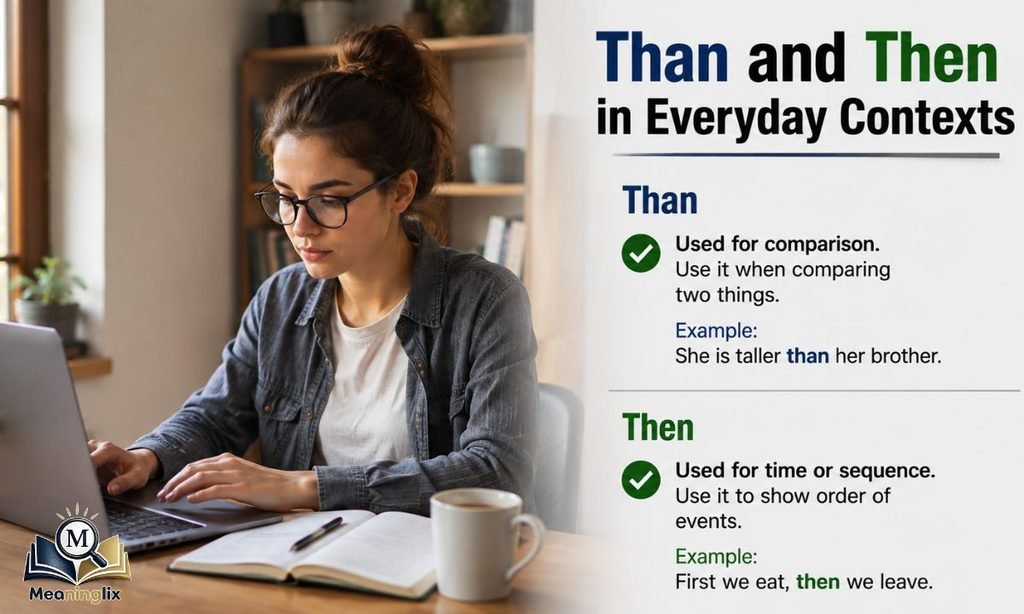
Than vs. Then in Everyday Contexts
Text message: “omw, be there in 10 then we can grab food” (sequence)
Workplace email: “Our Q3 numbers were stronger than Q2’s.” (comparison)
Academic writing: “The results were more significant than the researchers initially predicted.” (comparison)
Casual conversation: “I used to live downtown; back then, rent was way cheaper.” (time reference)
Across all these contexts, the underlying rule never changes: comparison calls for “than,” and time or sequence calls for “then.”
Common Expressions That Use “Than vs. Then”
Certain phrases almost always trip people up because they sound so natural that writers stop thinking about which word belongs there.
- Rather than always “than,” because it’s a comparison (“I’d rather walk than drive”).
- More than / less than always “than,” since these are comparative phrases.
- Other than always “than,” meaning “except for” (“Other than the rain, the trip was great”).
- Now and then always “then,” referring to occasional timing.
- Then again always “then,” meaning “however” or “on the other hand.”
- Back then always “then,” referring to a past time.
Than vs. Then: A Quick Self-Check

Before you hit send, ask yourself one question: Am I comparing two things, or am I talking about time?
If the sentence is weighing one thing against another, “than” is correct. If the sentence is about when something happened or what came next, “then” is correct. This single question resolves almost every case you’ll run into.
FAQs “Than vs. Then”
Is “then” ever used in a comparison?
No. Standard American English never uses “then” to introduce a comparison. If your sentence compares two things, “than” is the only grammatically correct choice, even though “then” might sound similar when spoken aloud.
What’s the difference between “rather than” and “rather then”?
Only “rather than” is correct. “Rather” is a comparative word, so it must be followed by “than,” as in “I’d rather read than watch TV.” “Rather then” is a common typo, not an accepted phrase.
Can “than” ever relate to time?
Rarely, and only in a specific structure: “no sooner ___ than ___,” as in “No sooner had I sat down than the phone rang.” Even here, “than” is still technically forming a comparison between two events happening in quick succession.
Is it “different than” or “different then”?
It’s “different than” (or “different from,” depending on your style preference). Since “different” implies a comparison between two things, “than” is the grammatically correct partner, and “different then” is always incorrect.
The Bottom Line “Than vs. Then”
“Than” belongs in comparisons, and “then” belongs with time, sequence, and consequence. Whenever you’re unsure which one fits, pause and ask whether you’re comparing two things or describing when something happens.
That one habit is enough to keep this classic mix-up out of your writing for good.

Alisha Lehmann is the founder and author of Meaninglix. She specializes in explaining word meanings, internet slang, abbreviations, grammar, and English expressions in simple, accurate language. Her goal is to help readers improve their vocabulary and communicate confidently through clear, well-researched, and easy-to-understand content.
2 thoughts on “Than vs. Then: The Ultimate Guide to Get It Right 2k26”