If you’ve ever paused mid-sentence wondering whether to write “Compliment vs Complement,” you’re not alone. The two words sound identical, share nearly the same spelling, and even come from the same Latin root which is exactly why so many writers swap them by accident. Here’s the short answer: compliment (with an “i”) means a kind or flattering remark, while complement (with an “e”) means something that completes or goes well with something else.
Once you separate the two meanings, the spelling stops feeling like a coin flip. Let’s break down exactly when to use each one, why the confusion happens, and how to stop second-guessing yourself for good.
Table of Contents
What Does Compliment Mean?
A compliment is a polite remark that expresses praise, admiration, or approval. It’s what you give someone when you like their work, their outfit, or their cooking.
Compliment can work as either a noun or a verb:
- Noun: “Thank you for the compliment on my presentation.”
- Verb: “She complimented him on his quick thinking.”
If the sentence involves someone saying something nice, “compliment” is almost always the word you want.
What Does Complement Mean?
A complement is something that completes, enhances, or pairs perfectly with something else. It doesn’t involve praise at all; it’s about balance, completeness, or a good match.
Complement also functions as a noun or a verb:
- Noun: “The scarf is a nice complement to the coat.”
- Verb: “The wine complements the grilled salmon.”
You’ll also see “complement” in more technical settings, such as grammar (a sentence complement) or staffing (“a full complement of employees”), where it refers to the parts needed to make something whole.
Why People Mix Up Compliment vs Complement

Compliment and complement are homophones, meaning they sound exactly the same when spoken aloud. Add to that a one-letter spelling difference “i” versus “e” sitting in the least noticeable part of the word, and it’s easy to see why spellcheck alone won’t save you.
Both words also trace back to the same Latin verb, complere, meaning “to complete.” Over time, English split that single root into two separate meanings: one about finishing or matching (complement), and one about flattering praise (compliment). The shared history explains the confusion, but the modern meanings are distinct enough that mixing them can genuinely change what your sentence says.
Compliment vs Complement: Quick Comparison
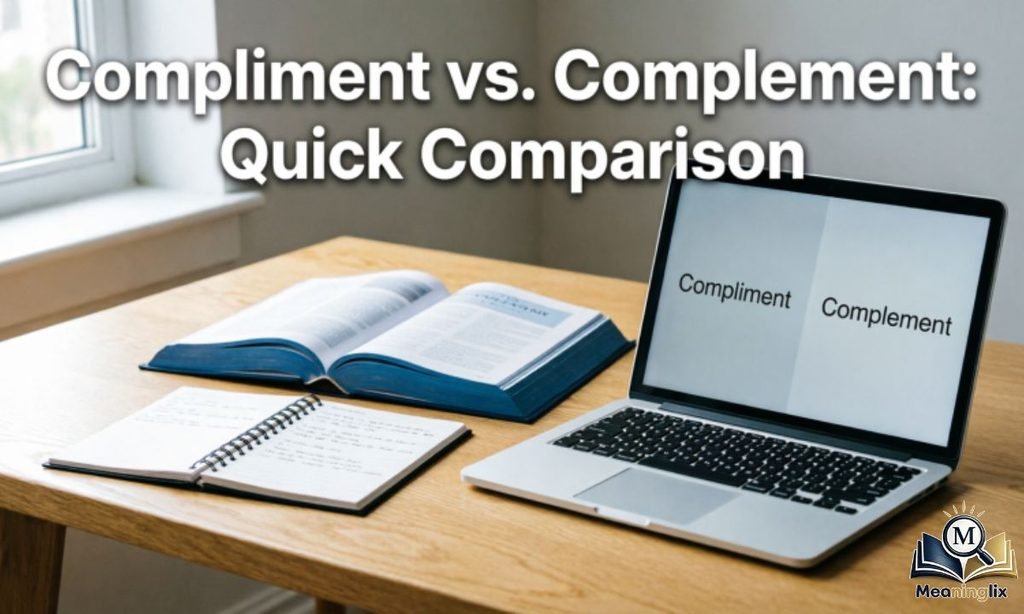
| Term | Part of Speech | Meaning | Typical Use | Example |
| Compliment | Noun / Verb | A flattering or admiring remark | Praising someone or something | “He paid her a compliment on her speech.” |
| Complement | Noun / Verb | Something that completes or pairs well | Describing balance, completeness, or a good match | “The tie complements the suit perfectly.” |
If your sentence is about admiration or flattery, reach for compliment. If it’s about two things fitting or working well together, reach for complement.
Read Also : Stationary vs Stationery
How to Remember the Difference Compliment vs Complement
A simple memory trick can save you from ever second-guessing this pair again:
- “I” like compliments. Both the word “I” and “compliment” contain an “i,” and compliments are things people generally like to receive.
- Complement completes. Both words start with “comple-” and share the idea of making something whole think of “complete” as your anchor word for “complement.”
If you can connect “complement” to “complete” in your mind, the spelling will click into place almost automatically.
Compliment vs Complement in Real Sentences
Seeing the words used across different everyday situations makes the distinction easier to lock in.
Everyday conversation Compliment vs Complement
- Correct: “That’s such a nice compliment, thank you!”
- Incorrect: “That’s such a nice complement, thank you!” This is wrong because the sentence is about praise, not completeness.
Workplace communication Compliment vs Complement
- Correct: “Her analytical skills complement his creative approach.”
- Incorrect: “Her analytical skills compliment his creative approach.” The idea here is that the two skill sets balance each other, not that one is flattering the other.
Text messages or social media Compliment vs Complement
- Correct: “Just got the sweetest compliment from a stranger today 🥹”
- Incorrect: “Just got the sweetest complement from a stranger today 🥹” A stranger can’t “complete” you in this casual context; they gave praise, so “compliment” is correct.
Academic or formal writing Compliment vs Complement
- Correct: “The appendix complements the main argument by providing supporting data.”
- Incorrect: “The appendix compliments the main argument by providing supporting data.” An appendix doesn’t flatter an argument; it completes or supports it.
Common Mistakes and How to Avoid Them Compliment vs Complement
The most frequent error is using “compliment” when the sentence is actually describing something that completes or pairs with something else, or vice versa. This usually happens because writers are focused on how the word sounds rather than what it means.
A few patterns worth watching for:
- Confusing “complementary” with “complimentary.” Complementary describes things that go well together (complementary colors). Complimentary describes something given for free or as praise (a complimentary drink, a complimentary review).
- Autocorrect assumptions. Many phone keyboards will not flag either spelling as wrong, since both are real words so autocorrect can’t save you here.
- Rushing past the meaning. If you slow down and ask, “Am I praising something, or describing something that completes or matches something else?” the correct word usually becomes obvious.
Complementary vs Complimentary
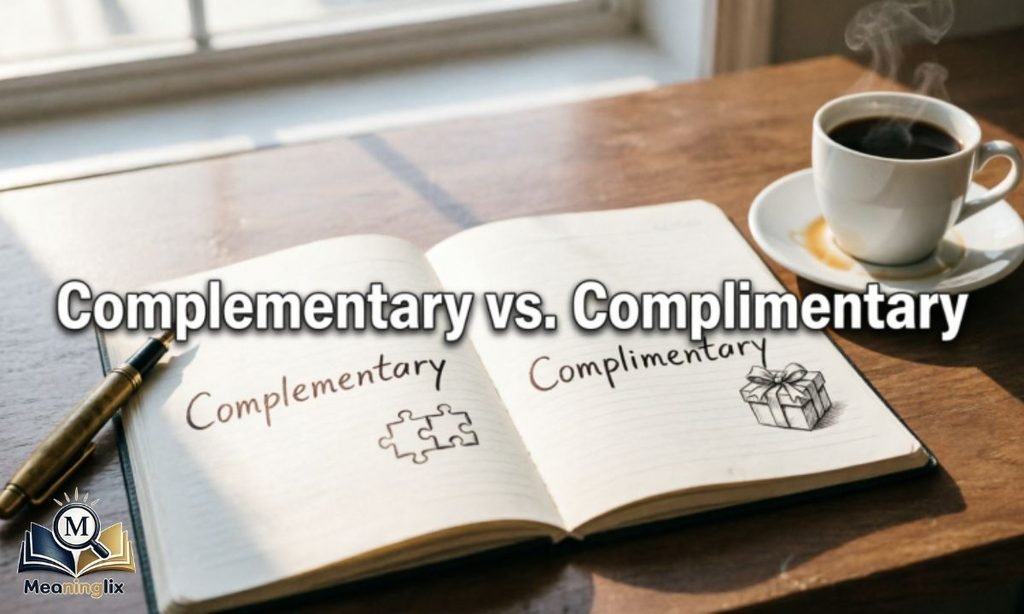
Since these adjective forms trip people up just as often as the base words, it helps to separate them clearly:
- Complementary (with an “e”) means two things that go well together, like complementary colors on a color wheel or complementary skill sets on a team.
- Complimentary (with an “i”) means either given as praise or given for free, such as a complimentary compliment on your presentation or a complimentary breakfast at a hotel.
The same “i for admiration, e for completion” logic applies to both pairs.
Is There a British vs. American English Difference?
No. Both American and British English use the same spellings and meanings for compliment and complement. The confusion isn’t regional; it comes from the words’ identical pronunciation and shared Latin origin, not from a difference between English varieties.
Practical Tips for Choosing the Right Word Compliment vs Complement
Before you hit send or submit, run through this quick mental checklist:
- Ask yourself if the sentence involves praise or admiration. If yes, use compliment.
- Ask yourself if the sentence involves completing, balancing, or pairing well. If yes, use complement.
- If you’re still unsure, try substituting the word “complete.” If the sentence still makes sense, you likely need complement.
- Double-check adjective forms separately, since complementary and complimentary follow the same rule but are easy to swap in formal writing.
FAQs Compliment vs Complement
Is “compliment” or “complement” correct in a sentence about matching outfits?
“Complement” is correct when you’re describing how two things look good together, such as “The shoes complement the dress.” Use “compliment” only if someone is actually praising the outfit out loud.
Can compliment and complement both be verbs?
Yes. “Compliment” as a verb means to praise someone (“She complimented his cooking”), while “complement” as a verb means to complete or enhance something (“The sauce complements the pasta”). The meaning of the sentence tells you which verb fits.
What is the easiest way to remember the spelling difference?
Link “complement” to “complete,” since both start with “comple-” and share the idea of wholeness. For “compliment,” remember that people generally like receiving one, just as “compliment” and “I” both contain the letter “i.”
Is “complementary” the same as “free”?
No, that word is “complimentary.” Complementary (with an “e”) means two things pair well together, while complimentary (with an “i”) means either praise or something offered free of charge, like a complimentary upgrade.
Final Takeaway Compliment vs Complement
The difference between compliment and complement comes down to one question: are you praising something, or describing something that completes or pairs well with something else? Compliment, with an “i,” is about admiration.
Complement, with an “e,” is about completion. Keep that distinction in mind, lean on the “complete equals complement” trick when you’re unsure, and you’ll never let a single letter undercut your writing again.

Alisha Lehmann is the founder and author of Meaninglix. She specializes in explaining word meanings, internet slang, abbreviations, grammar, and English expressions in simple, accurate language. Her goal is to help readers improve their vocabulary and communicate confidently through clear, well-researched, and easy-to-understand content.
1 thought on “Compliment vs Complement: Master the Difference Fast!”