
Drove vs Driven :
If you’ve ever paused mid-sentence wondering whether to write “I drove there” or “I have driven there,” you’re not alone. These two words trip up native speakers and English learners alike because they both come from the same root verb but play completely different grammatical roles.
By the end of this guide, you’ll know exactly which one to pick, every single time, without having to guess.
Table of Contents
Have you ever drove vs driven
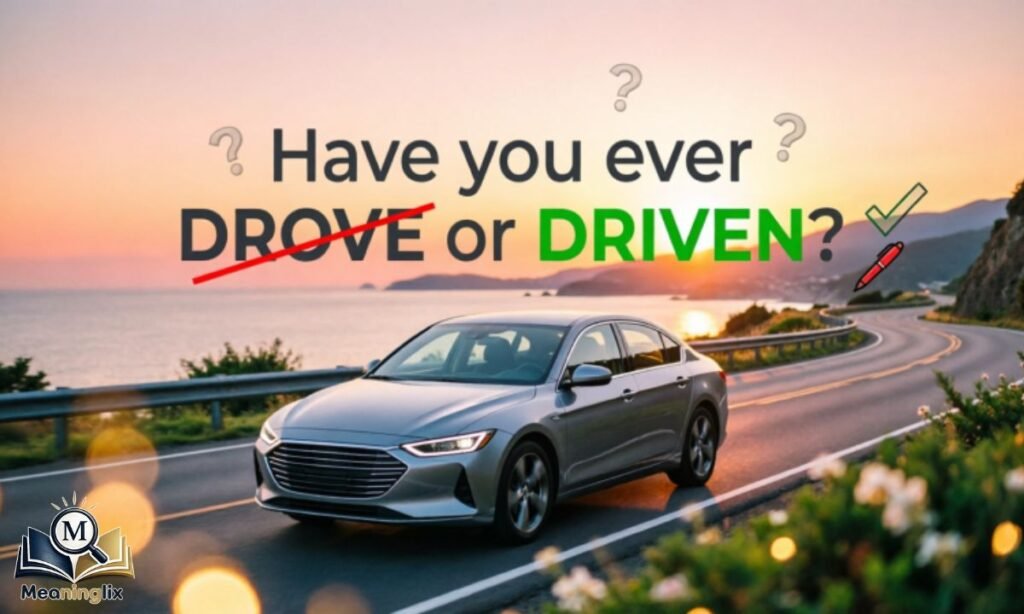
Let’s start by clearing up the confusion right away: the sentence “Have you ever drove” is actually incorrect. The correct version is “Have you ever driven?”
Why? Because “have” is a helping verb, and helping verbs always pair with the past participle form of a verb, not the simple past form. This one example captures the entire drove vs. driven debate in a nutshell. Once you understand this single rule, almost every mistake involving these two words disappears.
Throughout this article, we’ll break down exactly when to use each form, why the rule exists, and how to avoid the mistakes that even confident writers make.
Click Here To Read More Grammar
Understanding the Verb “Drive”
“Drive” is an irregular verb, which means it doesn’t follow the standard pattern of simply adding “-ed” to form its past tenses. Regular verbs like “walk” become “walked” in both the simple past and the past participle. Irregular verbs like “drive” change their spelling entirely and use two separate forms:
- Base form: drive
- Simple past: drove
- Past participle: driven
This pattern is shared by many other common irregular verbs, such as “write/wrote/written,” “ride/rode/ridden,” and “eat/ate/eaten.” If you’re comfortable with those, you already have a mental template for how “drive” behaves.
The verb “drive” itself refers to operating and controlling a vehicle, but it also extends to figurative meanings being “driven” by ambition, for instance, or a “driving” rainstorm. The grammar rules we’re discussing apply regardless of which meaning is intended.
Forms of “Drive” at a Glance
Here’s a simple table summarizing every major form of the verb “drive” so you can reference it quickly:
| Form | Word | Example |
| Base form | drive | I drive to work every day. |
| Simple past | drove | I drove to work yesterday. |
| Past participle | driven | I have driven to work many times. |
| Present participle | driving | I am driving to work right now. |
| Third-person singular | drives | She drives to work daily. |
Keep this table in mind: nearly every question about “drove vs. driven” can be answered by simply checking which row applies to your sentence.
What Is the Simple Past? (Drove)
“Drove” is the simple past tense of “drive.” It’s used to describe an action that started and finished at a specific point in the past. The key feature of the simple past is that it works independently it does not need any helping verb to function correctly.
Example:
- “We drove to the beach last weekend.”
Here, “drove” stands entirely on its own. There’s no “have,” “has,” or “had” attached to it, and none is needed. The sentence is grammatically complete exactly as it is.
Simple past tense is typically used with time markers like:
- Yesterday
- Last night
- Last week
- In 2020
- A few hours ago
These time references reinforce that the action is fully finished, with no ongoing connection to the present moment.
What Is the Past Participle? (Driven)
“Driven” is the past participle form of “drive.” Unlike “drove,” it cannot stand alone in a standard sentence. It must always be paired with an auxiliary (helping) verb such as has, have, had, is, was, were, or been.
Example:
- “She has driven across the country twice.”
Notice that “driven” here is supported by “has.” Remove the helping verb, and the sentence becomes grammatically broken: “She driven across the country twice” simply doesn’t work in standard English.
Past participles like “driven” are the building blocks for two major grammatical structures:
- Perfect tenses (present perfect, past perfect, future perfect)
- Passive voice constructions
We’ll explore both in detail shortly.
Drove vs Driven: What’s the Real Difference?

At its core, the difference between these two words isn’t about meaning; both refer to the act of driving in the past. The real difference is structural. One works alone; the other needs support.
| Feature | Drove | Driven |
| Grammatical role | Simple past tense | Past participle |
| Need a helping verb? | No | Yes |
| Common tenses used in | Simple past | Present perfect, past perfect, future perfect, passive voice |
| Stands alone in a sentence? | Yes | No |
| Example | He drove to the store. | He has driven to the store. |
Think of “drove” as a complete, independent action like a finished chapter in a story. “Driven,” on the other hand, always needs a companion word to make grammatical sense, much like a puzzle piece that only fits when connected to another.
How to Use “Drove” Correctly
When to Use “Drove”
Use “drove” whenever you’re describing a single, completed action that happened at a specific, identifiable point in the past and when there’s no helping verb in the sentence.
Key Grammar Rule
Rule: Drove = Simple Past Tense → No helping verb required.
If your sentence already contains “has,” “have,” or “had,” then “drove” is automatically the wrong choice. Simple past tense sentences work as standalone statements about finished events.
Correct Examples
- I drove my sister to the airport this morning.
- They drove through three states during the road trip.
- My father drove the same truck for fifteen years.
- She drove to the office before sunrise.
- We drove past the old house on our way home.
Each of these sentences is complete without any additional helping verb, and each describes a specific action that has already concluded.
How to Use “Driven” Correctly
When “Driven” Is Required
“Driven” is required whenever your sentence involves:
- A helping verb (has, have, had, is, was, were, been)
- A perfect tense construction
- A passive voice construction
If you spot any of these elements, “driven” is the form you need.
Perfect Tense Examples
- I have driven this route hundreds of times.
- By the time we arrived, she had already driven for six hours.
- By next year, he will have driven over 100,000 miles in that car.
Passive Voice Examples
In passive voice, the subject receives the action rather than performing it, and “driven” pairs with a form of “to be” (is, was, were, been).
- The car was driven carefully through the storm.
- This model has been driven by professional racers for testing.
- The tractor was driven across the field by an experienced farmer.
Context Matters: How Tense Changes the Choice (Drove vs Driven)
Sometimes the exact same basic idea can be expressed with either word, depending on how the sentence is framed. Let’s look at three examples that show how context shifts the correct choice.
Example 1 Drove vs Driven:
- ❌ “I have drove to New York before.”
- ✅ “I have driven to New York before.”
Because “have” is present, “driven” is required.
Example 2 Drove vs Driven:
- ✅ “I drove to New York last spring.”
- ❌ “I driven to New York last spring.”
Since there’s no helping verb and the action is a single completed event, “drove” is correct.
Example 3 Drove vs Driven:
- ✅ “The delivery van was driven by a new employee.”
- ❌ “The delivery van was drove by a new employee.”
Passive voice always calls for the past participle, so “driven” is the only correct option here.
Common Errors to Avoid With “Drove vs Driven”

Even experienced writers slip up occasionally. Here are the two most frequent mistakes.
Mistake 1: Using “Drove” with a Helping Verb
This is by far the most common error.
- ❌ “She has drove to work every day this week.”
- ✅ “She has driven to work every day this week.”
Whenever you see “has,” “have,” or “had” in a sentence, “drove” should never follow it.
Mistake 2: Using “Driven” Without a Helping Verb
The reverse mistake also happens, though less frequently.
- ❌ “Yesterday, I driven to the mall.”
- ✅ “Yesterday, I drove to the mall.”
Without a helping verb, “driven” cannot function as the main verb of a sentence describing simple past action.
Quick Decision Guide (Drove vs Driven)
Use this checklist any time you’re unsure which word fits your sentence Drove vs Driven.
✔ Does the sentence have a helper verb?
If yes (has, have, had, is, was, were, been) → use driven.
✔ Is it just a simple past action?
If the sentence describes one finished event with no helper verb → use drove.
✔ Is the sentence passive?
If the subject is receiving the action rather than doing it → use driven.
✔ Am I describing experience or completed action with present meaning?
If you’re connecting a past action to the present moment (a life experience, a total count, a result that still matters) → use driven with “have/has.”
✔ Am I talking about a finished action in the past?
If the action is over, tied to a specific past moment, and disconnected from the present → use drove.
Perfect Tenses With “Driven” (Deep Dive)
Since “driven” appears across all three perfect tenses, it’s worth breaking each one down individually.
Present Perfect
Formed with has/have + driven, present perfect connects a past action to the present moment often used for experiences, unspecified time, or results that still matter now.
- “I have driven manual cars since I was a teenager.”
- “Have you ever driven on the highway at night?”
Past Perfect
Formed with had + driven, past perfect describes an action that was completed before another past action or moment.
- “She had driven for two hours before she stopped for gas.”
- “By the time help arrived, he had already driven to the hospital.”
Future Perfect
Formed with will have + driven, future perfect describes an action that will be completed before a specific point in the future.
- “By next summer, we will have driven across every state on the East Coast.”
- “By the end of this trip, I will have driven over 2,000 miles.”
Case Study: Real-Life Use of Drove vs Driven
Case Study: A Road Trip Gone Wrong (Drove vs Driven)
Consider a simple, real-world scenario that shows how both words often appear together in the same story.
“Last July, my cousin and I drove from Chicago to Denver in a single stretch. Neither of us had driven that far before, and by the time we reached Denver, we had driven for nearly fourteen hours straight. Looking back, I don’t think I’ve ever driven that long again and I probably never will.”
Notice how naturally the words shift:
- “drove” describes the specific, completed trip.
- “had driven” (past perfect) shows an action completed before another past point.
- “have driven” (present perfect) connects the experience to the speaker’s life up to now.
This is exactly how native speakers use both forms in everyday storytelling switching fluidly based on structure, not random choice.
Quote to Remember (Drove vs Driven)
“Drove tells a finished story. Driven tells an ongoing one.”
Keep this short phrase in mind, and you’ll rarely second-guess yourself again.
FAQs (Drove vs Driven)
When to use drove and driven?
Use “drove” for a simple, completed past action with no helping verb. Use “driven” whenever a helping verb (has, have, had, is, was, were) appears in the sentence.
What is the difference between drive and driven?
“Drive” is the base form of the verb, used in the present tense. “Driven” is the past participle, used with helping verbs in perfect tenses and passive voice.
Should have driven or should have drove?
“Should have driven” is correct. “Should have drove” is a common but incorrect combination in standard English.
When to use the word “drove”?
Use “drove” when describing a single, completed action in the past that doesn’t require a helping verb, such as “He drove home last night.”
Conclusion (Drove vs Driven)
The difference between “Drove vs Driven” ultimately comes down to one simple test: check for a helping verb. If there’s a “has,” “have,” “had,” or a form of “to be” nearby, “driven” is your answer. If the sentence stands alone describing one finished past action, “drove” is correct.
Grammar rules like this one might seem small, but mastering them makes your writing sound polished, professional, and confident. The next time you’re tempted to write “I have drove” or “Yesterday, I driven,” pause for a second, run through the checklist above, and choose with certainty. With a little practice, distinguishing drove from driven will become second nature no more hesitation, no more guessing.

Alisha Lehmann is the founder and author of Meaninglix. She specializes in explaining word meanings, internet slang, abbreviations, grammar, and English expressions in simple, accurate language. Her goal is to help readers improve their vocabulary and communicate confidently through clear, well-researched, and easy-to-understand content.